
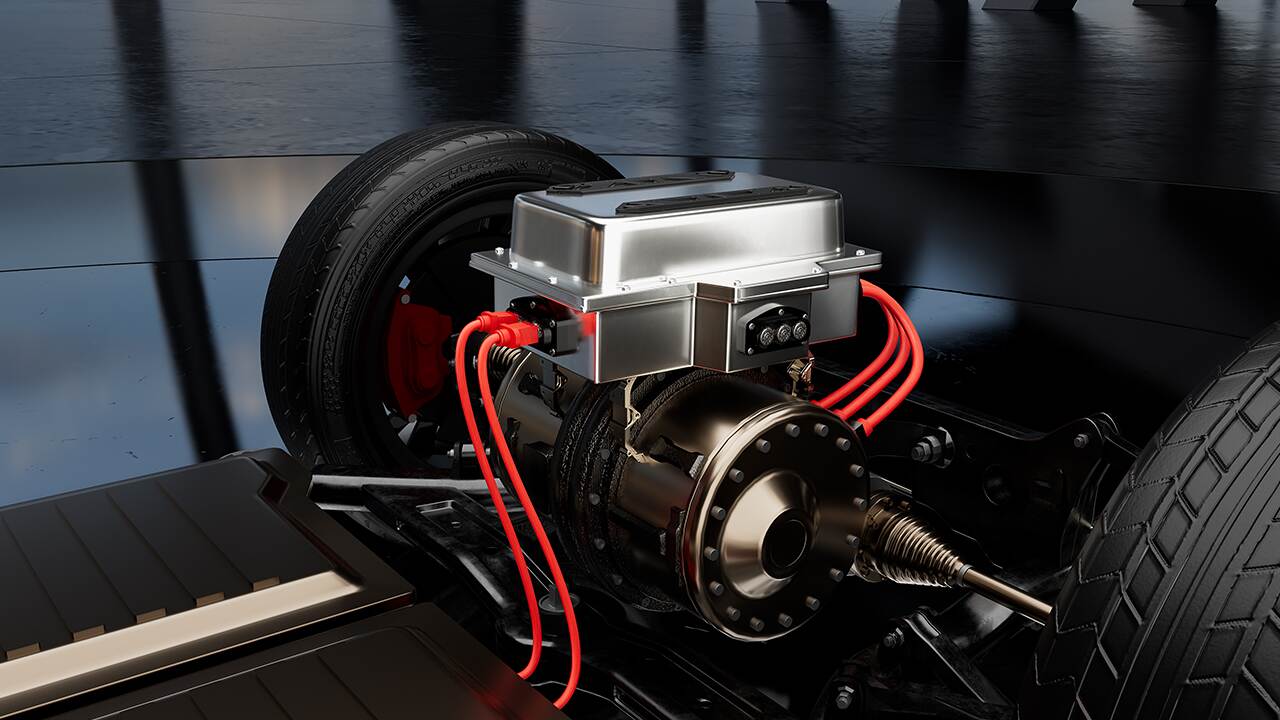
Texas Instruments (TI) has introduced the TMCS2100-Q1, a multiaxial coreless Hall-effect current sensor designed for hybrid and electric vehicle traction inverters. By measuring magnetic fields along two axes, the device is intended to improve current measurement accuracy and, consequently, torque control in electric drive systems.
TI has launched a multiaxial coreless Hall-effect current sensor developed for hybrid electric vehicle and electric vehicle traction inverter applications.
The device combines horizontal and vertical magnetic-field measurements with a proprietary processing algorithm, an approach designed to address one of the limitations of conventional coreless current sensing: measurement errors caused by displacement between the current conductor and the sensor.
Accurate phase-current measurement is a critical parameter in electric motor control. In a traction inverter, current feedback is used by the control system to regulate the torque produced by the electric machine. Errors in current measurement can therefore affect torque accuracy, efficiency and drivetrain behaviour, particularly under changing loads, temperatures and vibration conditions.
According to TI, the TMCS2100-Q1 provides up to 20 times greater accuracy than single-axis coreless alternatives. The company reports a displacement error below 1% with 0.4 mm of movement, falling to as little as 0.25% at 0.1 mm.
Dual-axis sensing targets vibration-induced errors
Vehicle vibration can cause small relative movements between the current sensor and conductor. In conventional single-axis differential coreless sensors, these displacements can alter the detected magnetic field and introduce measurement errors.
The TMCS2100-Q1 instead measures the magnetic field in both horizontal and vertical directions simultaneously. TI says this architecture can compensate for displacement effects while also reducing the influence of magnetic crosstalk between neighbouring conductors and phases.
For electric motor applications, more accurate current feedback can contribute to tighter control of electromagnetic torque and reduced torque ripple. Excessive torque ripple can translate into drivetrain vibration, acoustic noise and uneven acceleration while also negatively affecting system efficiency.
“Leveraging advanced research from TI’s Kilby Labs, the TMCS2100-Q1 was developed to give automakers a tool to build HEVs and EVs where tighter current measurement translates directly into longer range, smoother ride quality and more efficient motor control,” said Jason Cole, vice president and general manager of Sensing Products at Texas Instruments.
Smaller traction inverter architectures
The new sensor also addresses the trade-off between conventional magnetic-core current sensors and coreless architectures.
C-core sensing implementations can provide high measurement accuracy but require additional magnetic material, increasing the size and weight of the sensing assembly. Coreless Hall-effect devices can reduce the component footprint but are generally more susceptible to conductor displacement and external magnetic interference.
By removing the magnetic core while retaining higher measurement accuracy, TI says the TMCS2100-Q1 can support smaller and more power-dense traction inverter designs.
The development is particularly relevant as vehicle manufacturers increasingly move towards 800 V electric architectures, where traction inverter efficiency, switching performance and current measurement precision become increasingly important to overall drivetrain performance.





 has introduced the TMCS2100-Q1, a multiaxial coreless Hall-effect current sensor designed for hybrid and electric vehicle traction inverters.)