Axial Flex Tech™ by Dema: when the manufacturing process adapts to the design, not the other way around.
Interest in axial flux motors continues to grow. Their high torque and power density, compact architecture, and potential to outperform many conventional motor topologies are driving an increasing number of manufacturers and research organizations to invest in their development.
Alongside these opportunities, however, lies a less visible yet equally critical challenge: transforming an optimized design into a manufacturable component without compromising its performance.
In many cases, the real limitation is not the designer’s ability to develop better solutions, but the constraints imposed by existing manufacturing processes.
This is a familiar scenario for motor designers. During development, geometries capable of improving the motor’s electromagnetic performance are identified, only to be simplified later to fit conventional manufacturing capabilities. The result is not the best motor that can be designed, but the best motor that can be manufactured.
This is precisely the challenge that led Dema to develop Axial Flex Tech™: a technology designed to eliminate the trade-off between performance and manufacturability by allowing the manufacturing process to adapt to the design, rather than forcing the design to conform to manufacturing constraints.
Design freedom as a performance enabler
For axial flux stators, one of the key parameters influencing motor performance is the slot filling factor – the ratio between the actual copper volume inside the slot and the available slot volume.
A higher filling factor allows more active copper to be accommodated within the stator, improving current density, efficiency, and overall motor performance.
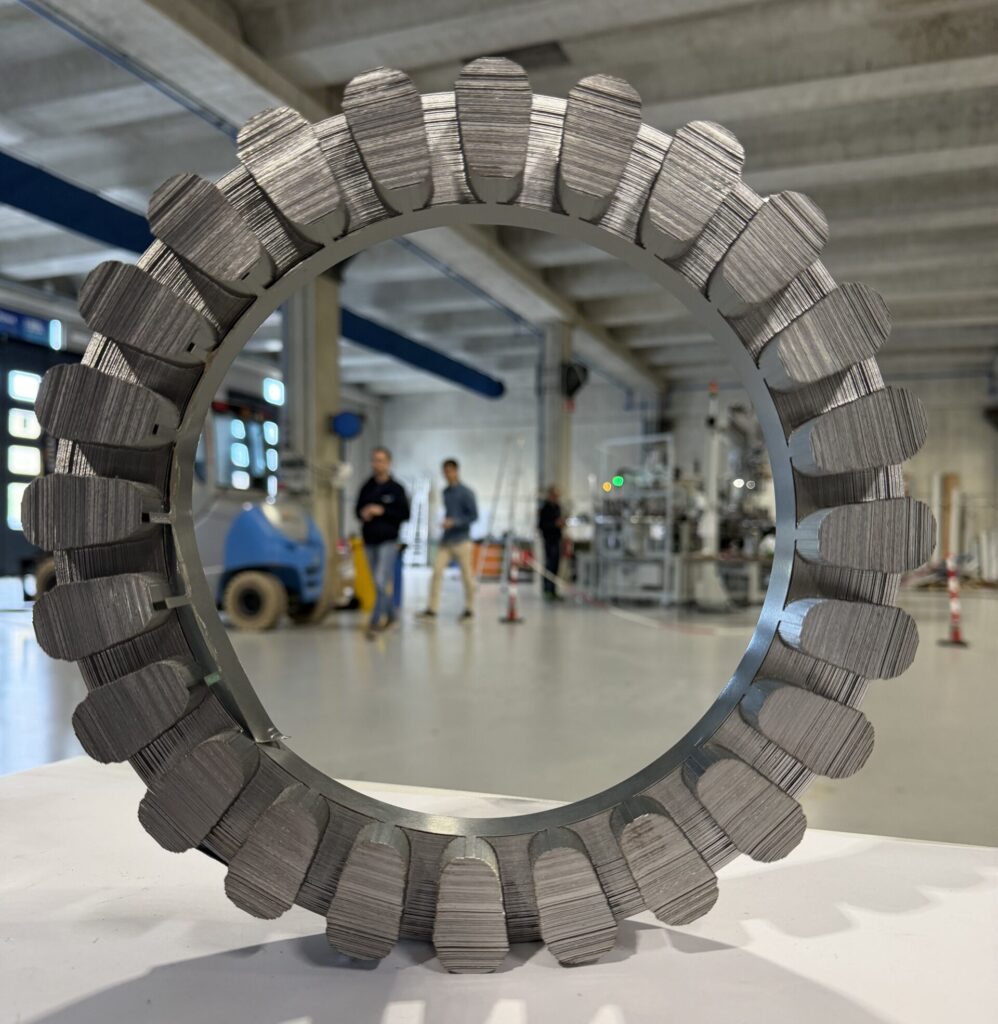
Among the factors that directly influence this parameter is the geometry of the stator teeth.
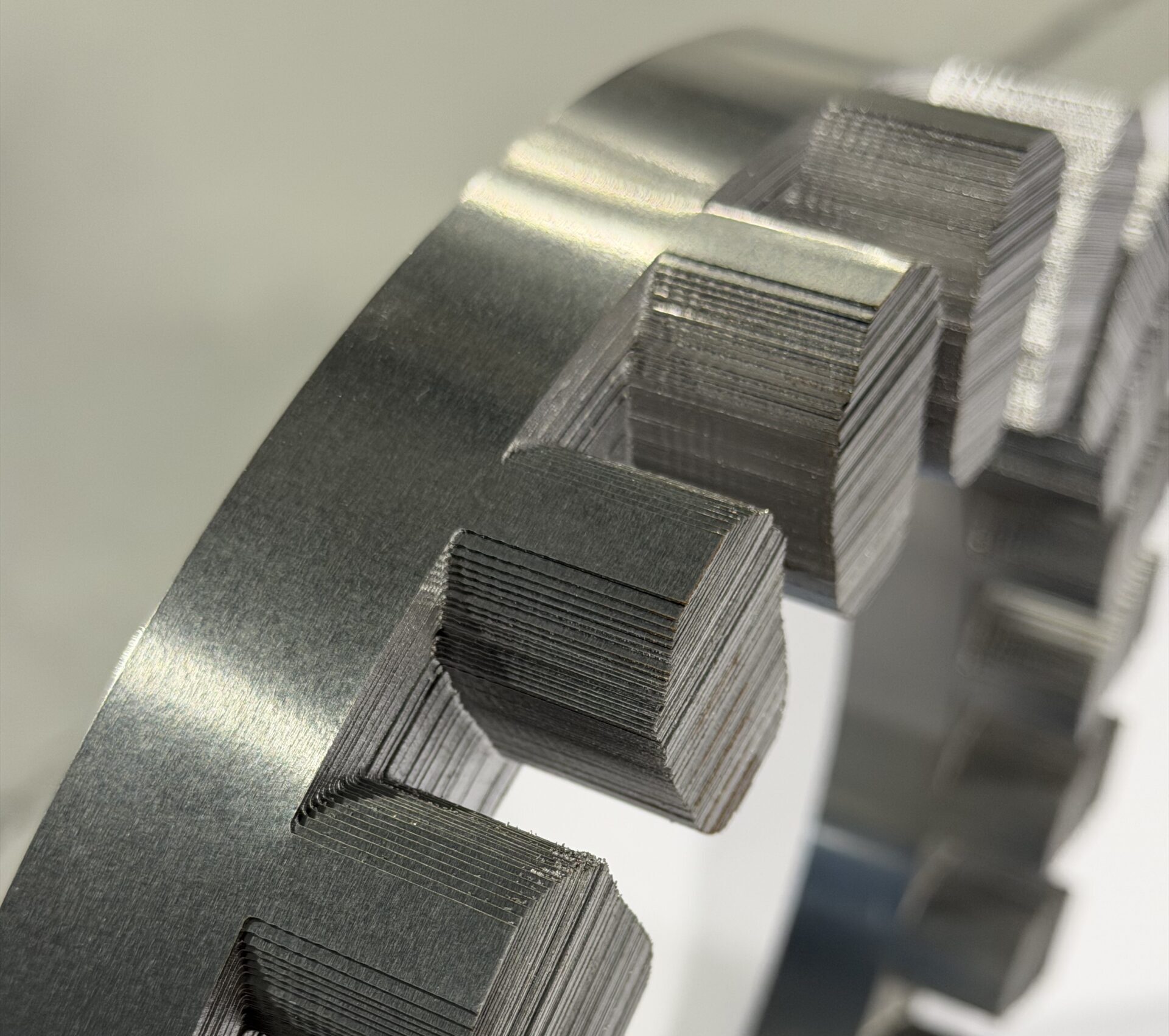
Conventional manufacturing processes typically impose sharp-edged tooth profiles. While these geometries are relatively straightforward to manufacture, they are not necessarily the most effective from an electromagnetic or winding perspective.
Rounded tooth profiles allow the conductor to occupy the slot more efficiently, increasing the effective filling factor and making better use of the available space.
Although this may appear to be a minor geometric detail, it has a direct impact on motor performance.
The challenge is that these optimized geometries, despite their technical advantages, are often difficult – or economically impractical – to manufacture using conventional production technologies. And this is exactly where innovation too often comes to a halt.
Rethinking the manufacturing process
Axial Flex Tech™ approaches the problem from a different perspective.
Instead of asking designers to adapt their components to the limitations of manufacturing, it redefines the manufacturing process so that it can accommodate the design.
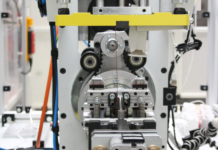
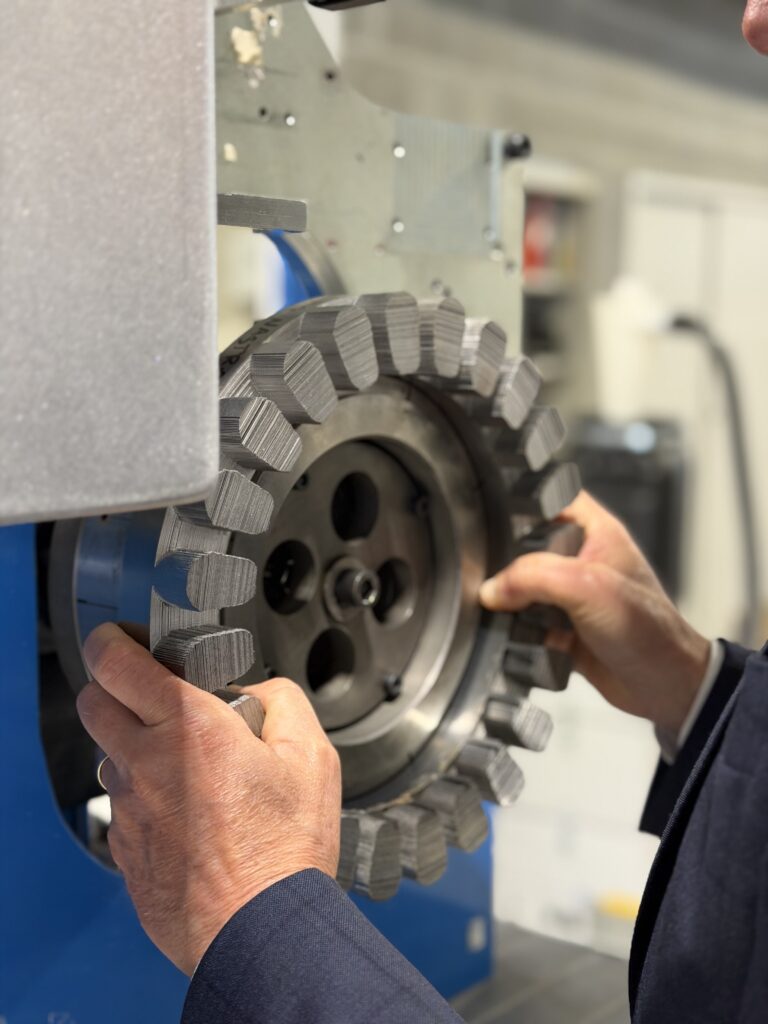
At the core of the technology is a highly flexible manufacturing system that enables rapid modification of stator geometries throughout the development phase while preserving complete design freedom.
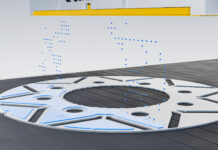
The system employs laser cutting to produce different stator configurations without requiring dedicated tooling, allowing multiple design variants to be evaluated quickly and efficiently.
Slot dimensions, tooth geometry, and other critical design features can be modified and validated in a rapid iterative process, enabling engineers to focus on identifying the highest-performing solution rather than the easiest one to manufacture.
In this way, prototyping returns to its original purpose: a tool for technical exploration rather than an exercise in engineering compromise.
From validation to mass production
One of the most critical stages in electric motor development is the transition from prototyping to industrial production. It is not uncommon for geometries successfully validated during testing to be modified later in order to satisfy manufacturability and production efficiency requirements.
Every change introduced at this stage carries the risk of altering the performance achieved during development. For this reason, Axial Flex Tech™ has been conceived as an integrated manufacturing approach.
Alongside the flexible prototyping platform, Dema has developed a dedicated solution for high-volume production capable of manufacturing the same validated stator geometries through an industrial process optimized for productivity and repeatability. This ensures continuity between development and industrialization.
What is successfully validated during the design phase can become the final production component without requiring its geometry to be altered in order to meet manufacturing constraints.
A new manufacturing paradigm
For decades, electric motor development has followed a well-established principle: first define the manufacturing limitations, then design the best possible motor within those boundaries. The evolution of axial flux motors calls for a different approach.
As performance increasingly becomes the key competitive factor, manufacturing processes must provide the flexibility required to fully exploit the designer’s vision, rather than limiting it. Axial Flex Tech™ has been developed around exactly this philosophy.
Because the ultimate objective is not to design the best motor that current manufacturing technologies allow. It is to make manufacturable the best motor engineers are capable of designing.