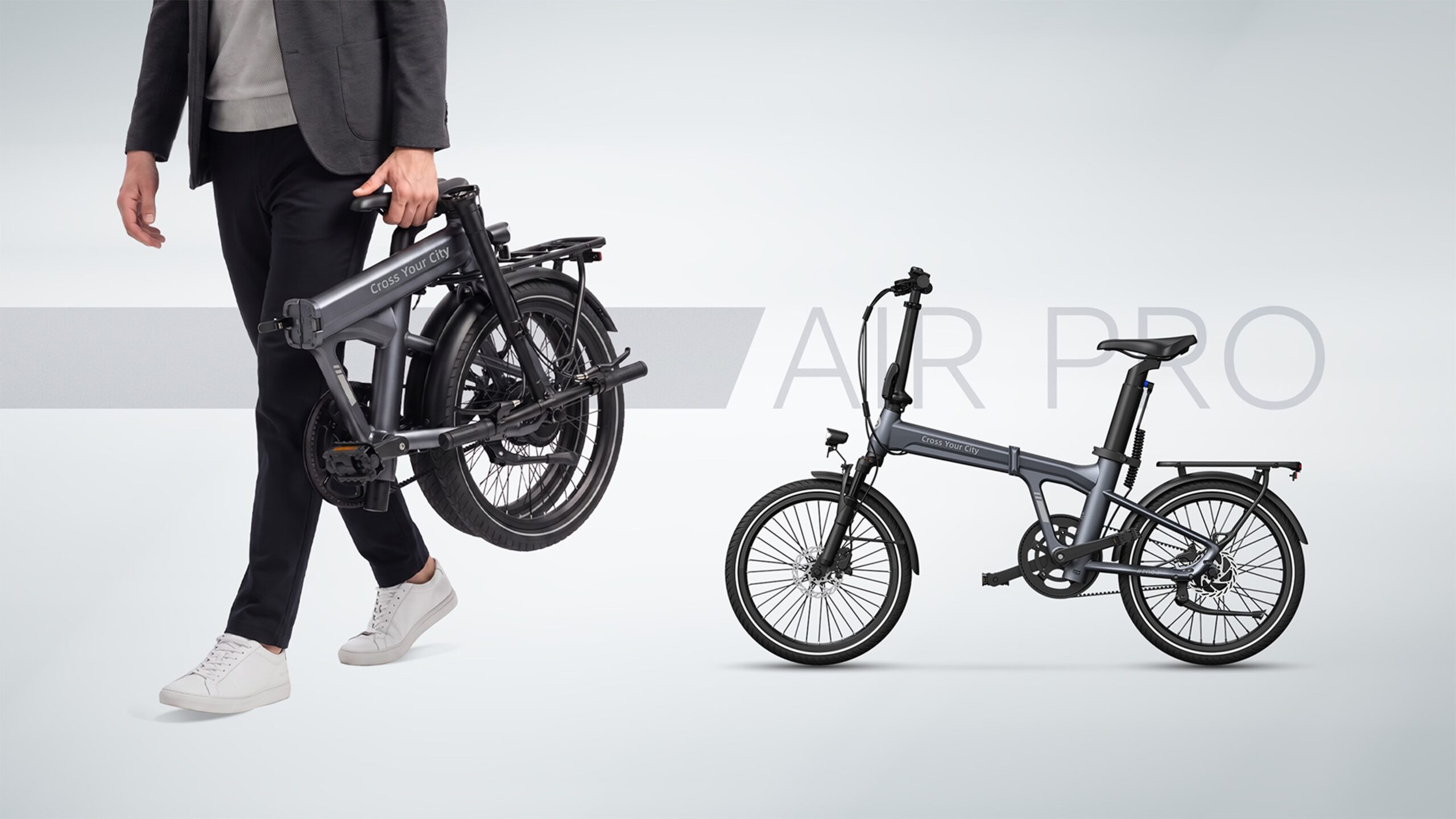
Honor is expanding its mobility portfolio with the Honor Choice Folding E-Bike ADO Air 20 Pro, a compact urban e-bike built around a 250 W BAFANG rear-hub motor featuring an integrated automatic two-speed transmission.
The drivetrain is one of the most technically relevant aspects of the new model. Instead of relying on the conventional single-speed architecture frequently adopted in compact folding e-bikes, the Air 20 Pro uses the Bafang H700 motor with an internal automatic gearbox designed to adapt the transmission ratio to changing riding conditions.
At low speed, during starting and climbing, the system automatically selects the lower gear to increase available torque at the wheel and improve acceleration. As vehicle speed rises, the drive shifts to the higher 1:1.36 ratio. The aim is to maintain a more appropriate pedalling cadence and reduce the “spinning out” effect that may occur on single-speed electric bicycles at higher speeds.
Torque sensing for more progressive assistance
Motor control is supported by a bilateral torque sensor that measures the force applied to both pedals. According to the manufacturer, the sensor can detect pedal input within a few milliseconds, allowing the electric assistance to react rapidly to changes in rider demand.
This approach differs from simpler cadence-based assistance systems, where motor activation is primarily triggered by crank rotation rather than by the actual torque generated by the rider.
By continuously correlating pedal force with motor assistance, the control architecture is intended to provide a more proportional response, particularly during low-speed manoeuvres, starts and changes in gradient.
The combination of automatic gear selection and torque sensing is therefore aimed at making the electric drive less intrusive while maintaining sufficient assistance across a broader operating range.
Carbon belt transmission
The H700 powertrain is combined with a carbon-fibre belt instead of a conventional chain. The solution reduces the need for periodic lubrication and is intended to deliver quieter operation while also avoiding corrosion-related issues associated with metallic chains.
Honor claims a maintenance-free operating interval of up to 10,000 km for the belt. From an engineering standpoint, a belt drive is particularly suited to this type of compact urban platform because it reduces routine servicing requirements and eliminates lubricant contamination, an advantage for a bicycle designed to be folded and transported in cars or on public transport.
250 W motor and 370 Wh battery
The rear motor has a rated output of 250 W and is powered by a removable lithium-ion battery integrated into the seatpost. Battery specifications are 37 V and 10 Ah, corresponding to a nominal capacity of 370 Wh.
The manufacturer quotes a maximum assisted range of up to 100 km, although actual energy consumption will depend on riding mode, speed, gradient, rider mass and environmental conditions.
The electric system can be operated in ECO and SPORT modes through the ADO EBIKE application. The app also provides ride data, navigation functions and over-the-air firmware updates for the controller and Bluetooth module.
A 2.4-inch colour IPS display provides speed, mileage, battery status and operating-mode information, while an integrated NFC module allows the bicycle to be switched on using the supplied card.
Compact architecture for urban mobility
The electric drivetrain is installed in an aluminium folding frame with a total vehicle mass of approximately 21 kg. The bicycle can be folded in three steps in around ten seconds, reaching dimensions of 900 × 430 × 670 mm.
The chassis incorporates a lockable front suspension fork, 20 × 1.95-inch tyres and hydraulic disc brakes with 160 mm rotors at both ends.
For urban operation, the platform also integrates a rear carrier, aluminium mudguards, a rear light and direction indicators.
The use of a compact rear motor with an integrated automatic gearbox is particularly significant for the overall packaging of the bicycle. By incorporating both propulsion and shifting functions within the rear hub, the architecture avoids the need for an external derailleur while preserving two distinct mechanical ratios.