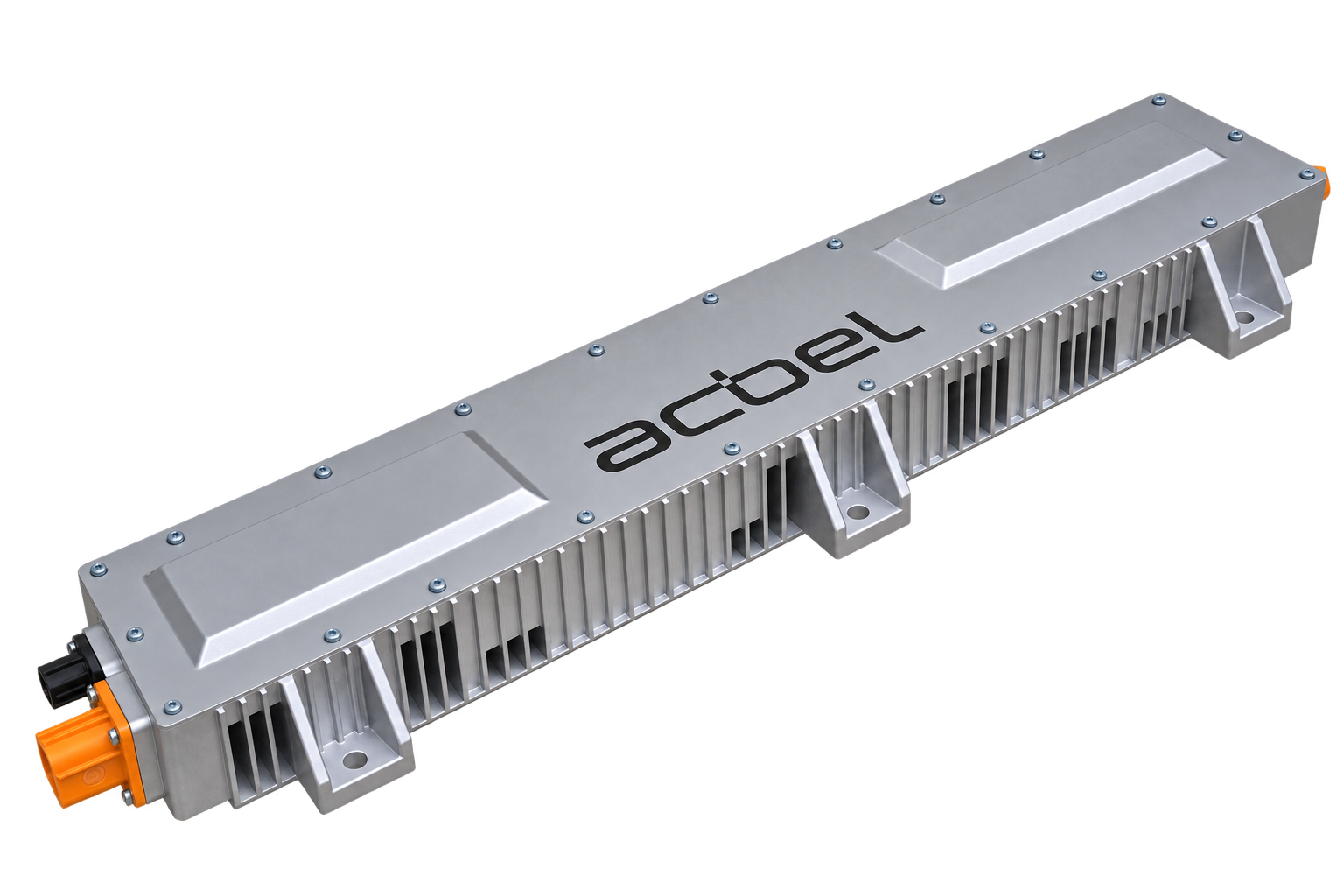
The company Acbel is expanding its electric mobility portfolio with 40 and 60 kW DC charging modules and an 11 kW passively cooled integrated OBC/DC-DC solution, addressing both charging infrastructure and on-board power conversion.
As electric vehicle charging moves towards higher power levels, power electronics are increasingly required to combine efficiency, scalability and compatibility with different battery architectures. Acbel Polytech is addressing this evolution with a portfolio that spans both stationary charging infrastructure and vehicle-side power conversion.
Recently, the company presented 40 kW and 60 kW DC charging power modules together with an 11 kW integrated on-board solution combining an on-board charger and a DC/DC converter.
Modular power conversion for DC fast charging
The 40 kW and 60 kW units are designed as the core power conversion stages of DC fast chargers. Rather than defining the power rating of the complete charging station through a single converter, the architecture allows several modules to operate in parallel.
This modular approach enables charging equipment manufacturers to configure systems across different power classes and to scale installations beyond 150 kW. From an engineering perspective, modularisation can also provide greater flexibility when adapting a charger platform to different installation requirements without redesigning the complete power conversion architecture.
The modules operate across an output voltage range from 150 V to 1,000 V and achieve peak efficiency above 97%. The wide voltage window is particularly relevant as charging infrastructure increasingly needs to accommodate vehicles based on different battery pack voltages, including platforms moving towards higher-voltage electrical architectures.
Efficiency remains a critical parameter for high-power chargers. At power levels of several hundred kilowatts, even relatively small conversion losses translate into significant thermal loads, influencing cooling requirements, component sizing and overall station efficiency.
Integration on the vehicle side
Acbel is following a similar integration strategy for on-board electronics. Its 11 kW 2-in-1 unit combines the on-board charger, responsible for converting AC grid power into the DC voltage required by the traction battery, with the DC/DC converter used to supply the vehicle’s low-voltage electrical system.
The distinctive feature of the system is its passive cooling architecture. According to Acbel, the unit does not require either a liquid-cooling circuit or a dedicated cooling fan. Eliminating these elements can reduce thermal-management complexity and simplify mechanical and electrical integration into the vehicle.
The company is also developing on-board power products for both 400 V and 800 V vehicle architectures. The latter are becoming increasingly significant in high-performance and fast-charging EV platforms because higher system voltage allows the same power to be transmitted at lower current, potentially reducing conductive losses and cable requirements. Acbel’s displayed portfolio therefore covers both established 400 V systems and the growing 800 V segment.
Poland accelerates DC charging deployment
The choice of Poland as the venue for presenting the technology also reflects the rapid expansion of the country’s charging infrastructure. According to figures cited by Acbel from the Polish New Mobility Association, publicly accessible DC charging points increased by 65% year on year in 2025.
Public investment is supporting this trend. In May 2026, Poland increased first-round funding for grid infrastructure serving high-power public charging stations to PLN 1.42 billion, approximately €327 million.
The development highlights a broader challenge for the European charging sector: increasing nominal charging power is only one part of the engineering equation. Charger manufacturers must simultaneously address conversion efficiency, thermal management, voltage flexibility, system modularity and time to market.