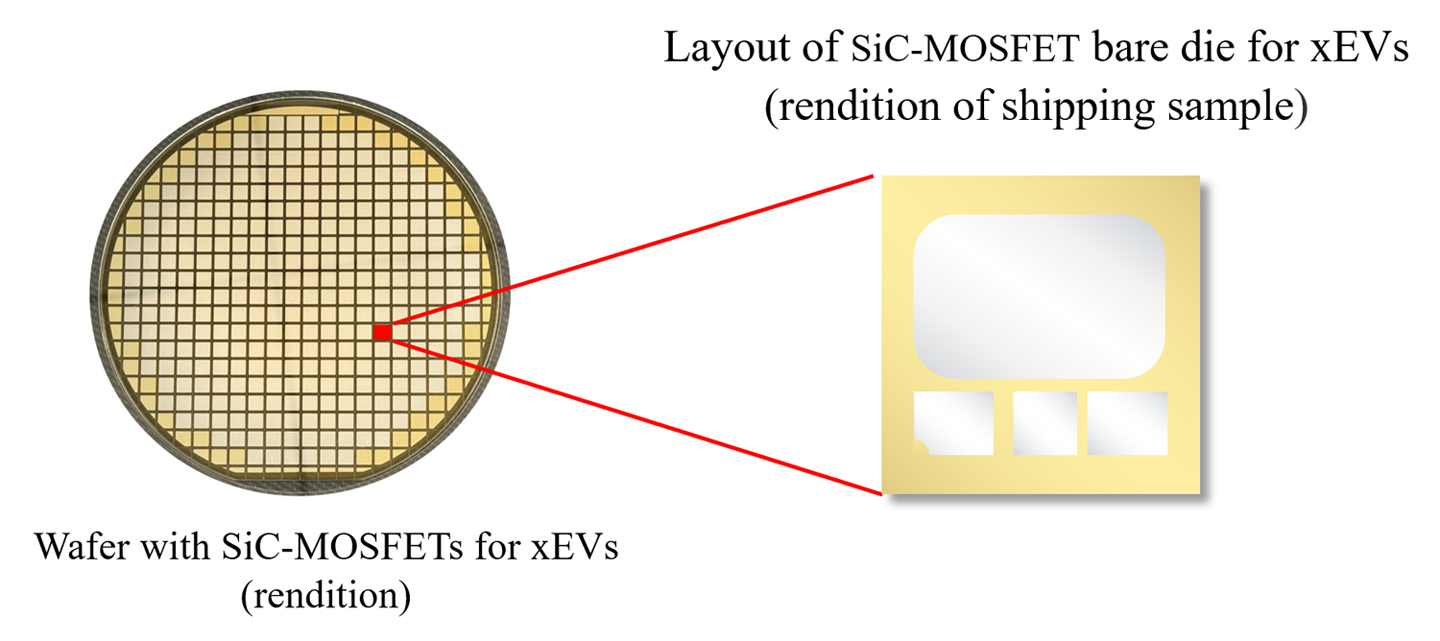
Inverter applications for electric drive motors and eAxles are the target of Mitsubishi Electric‘s two new fifth-generation silicon carbide metal-oxide-semiconductor field-effect transistors, which will begin shipping sequentially as bare-die samples in late June.
The new SiC-MOSFET bare dies are designed for use in electric vehicles, plug-in hybrid electric vehicles and other electrified vehicles. According to Mitsubishi Electric, the devices feature the company’s proprietary trench structure and achieve an on-resistance approximately 25% lower than that of existing products.
Although the announcement concerns power semiconductor technology rather than the electric motor itself, its relevance for electric drivetrain engineering is direct. In an xEV powertrain, the inverter is the interface between the battery and the electric machine. Its switching behaviour, conduction losses, thermal performance and packaging constraints influence not only overall system efficiency, but also the size, weight and cooling requirements of the drive unit.
Mitsubishi Electric said the new fifth-generation SiC-MOSFET bare dies are intended to contribute to the performance and miniaturization of xEV inverters and eAxles. In eAxle architectures, where the motor, inverter and gearbox are integrated into a compact drive unit, reducing losses in the power electronics can support higher power density and improve vehicle range. Lower on-resistance is particularly relevant because it reduces the resistance generated between the drain and source when the device is switched on, helping to limit conduction losses during operation.
The company also highlighted durability and quality stability as part of the development. Mitsubishi Electric said its proprietary manufacturing process technology suppresses performance degradation and fluctuations in power loss and on-resistance, supporting stable quality even after long-term use. This is significant for traction applications, where power semiconductors are exposed to repeated thermal and electrical stress over the vehicle lifetime.
The new products are based on a trench structure, in which grooves are etched from the wafer surface and filled with gate electrodes. This device architecture is widely used to improve current flow and reduce resistance compared with more conventional layouts, and is one of the key technology directions in next-generation SiC power devices for automotive traction.
The use of SiC devices in electric powertrains has become increasingly important as automakers push for higher inverter efficiency, faster switching, reduced cooling demand and more compact drive units. Compared with conventional silicon power devices, SiC components can support lower losses and higher operating efficiency, especially in high-voltage electric vehicle platforms. For motor and eAxle engineering, this can translate into improved system-level performance rather than a simple component-level gain.