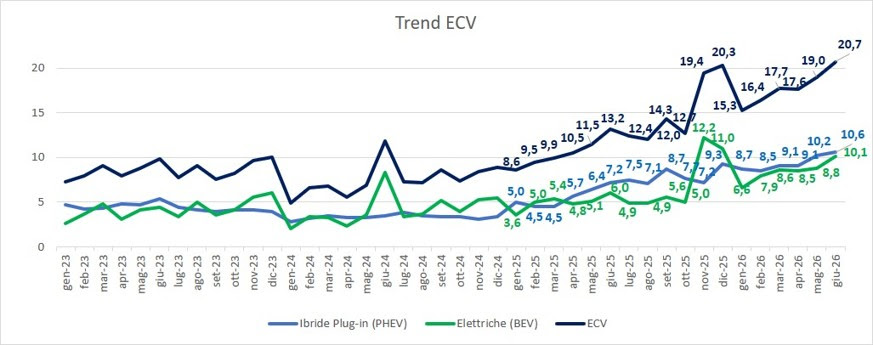
According to UNRAE’s latest market data, Italy’s car registrations rose 9.6% in the first half of 2026, while June confirmed the acceleration of electric drivetrains, with BEVs and PHEVs together reaching a 20.7% market share.
Italy’s passenger-car market is growing again, but for the electric motor industry the most relevant development is taking place beneath the headline registration figures. Electrified architectures are progressively increasing their weight in the powertrain mix, creating a broader and increasingly differentiated market for traction motors, integrated e-drive systems, power electronics and electrically driven auxiliary systems.
According to data released by UNRAE, the Italian association representing foreign vehicle manufacturers, 146,423 passenger cars were registered in June 2026, an increase of 10.6% compared with 132,402 units in June 2025. In the first six months of the year, registrations reached 936,783 units, 9.6% above the 854,910 vehicles recorded in the corresponding period of 2025. The market, however, remains 13.5% below its first-half 2019 level.
For electric drivetrain suppliers, June provided an even more interesting indication. Battery-electric vehicles reached a 10.1% market share, corresponding to 14,894 registrations. This compares with 6.0% in June 2025 and 8.8% in May 2026. UNRAE attributes part of the acceleration to the final phase of the previous incentive mechanism, with the 30 June deadline for dealer reimbursement claims, while also highlighting the concentration of sales: two brands alone accounted for more than 36% of BEV registrations during the month.
From an engineering perspective, the most significant development is not only the rise in BEVs. Plug-in hybrids also continued to expand rapidly, reaching 10.6% of the Italian market in June, compared with 7.3% one year earlier. Together, BEVs and PHEVs represented 20.7% of registrations during the month.
The picture becomes even more relevant when conventional hybrid architectures are included. Hybrid vehicles remained the largest powertrain category in June, with a 46.1% share. Full hybrids represented 16.0% of the market and mild hybrids 30.1%.
This means that a growing proportion of vehicles sold in Italy now incorporates at least one electric machine, although with widely differing functions, voltage levels, duty cycles and performance requirements.
The rise of BEVs to 10.1% of Italian registrations is positive for the electric drivetrain supply chain, but the composition of the result also raises a question concerning predictability.
UNRAE notes that June’s result was influenced by the final phase of the previous incentive cycle and by particularly strong registrations from two brands. This illustrates a challenge that is relevant to industrial planning: market electrification can proceed through sharp steps rather than through a smooth and linear adoption curve.