
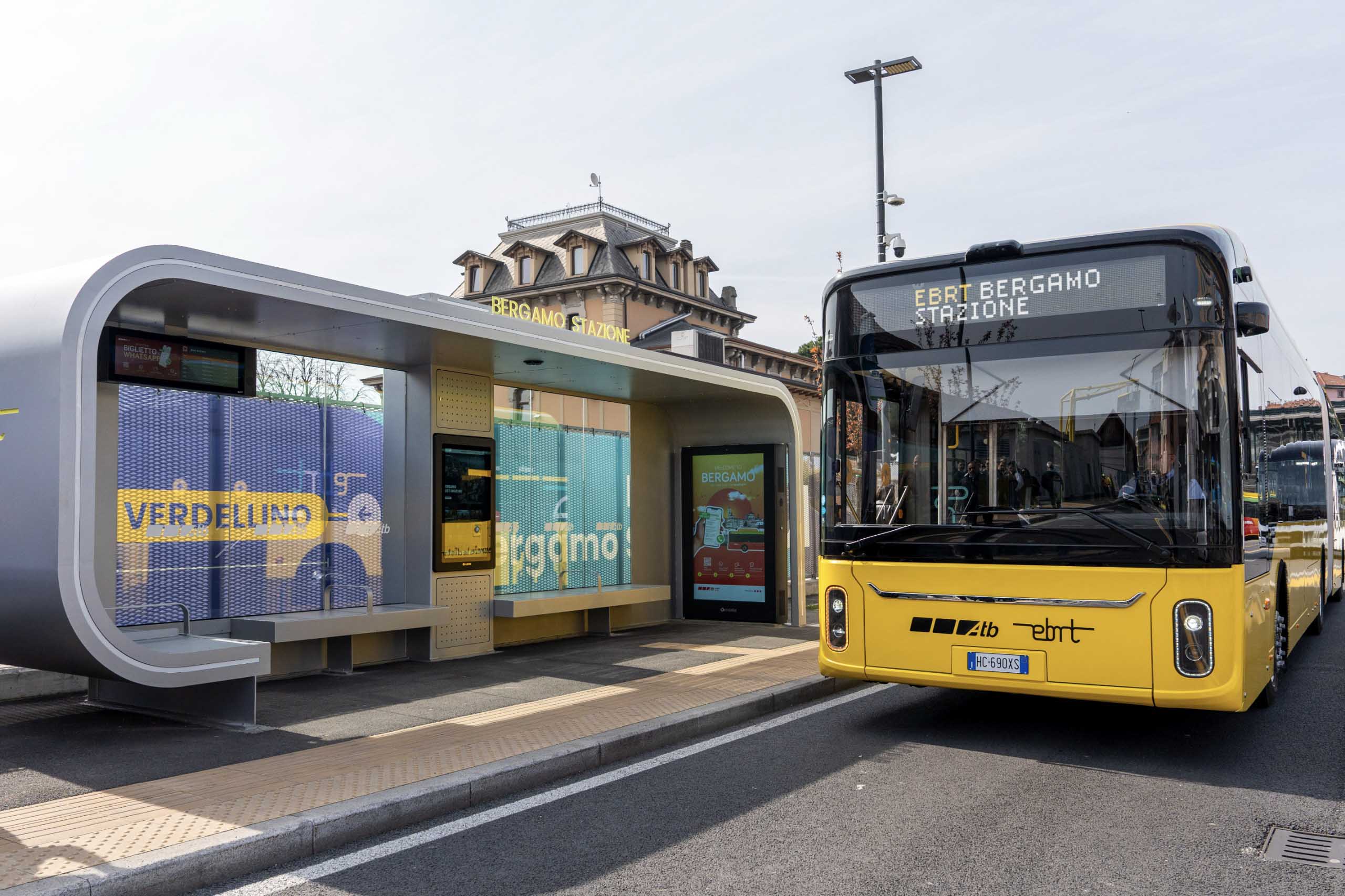
Thanks to the new electric Bus Rapid Transit system (e-BRT), a zero-emission corridor will connect Bergamo, Dalmine and Verdellino through a high-frequency electric bus service integrated with local routes, rail links and park-and-ride facilities.
Lombardy’s first electric Bus Rapid Transit system is scheduled to begin operation in Bergamo on 3 August 2026. Developed by the Bergamo Local Public Transport Agency, the e-BRT project introduces a fully electric, high-capacity road transport corridor designed to operate as a light metro system on rubber tyres.
The infrastructure was financed through Italy’s National Recovery and Resilience Plan, or PNRR, and is intended to provide a faster and more reliable alternative to conventional urban and suburban bus services. During the initial commissioning phase, the line will operate according to a reduced timetable, allowing the operator to monitor vehicle performance, service regularity and passenger flows before increasing frequencies.
The new route will connect Bergamo with Dalmine and Verdellino, forming the backbone of a broader reorganisation of public transport across the province. Rather than functioning as an isolated electric bus line, the e-BRT has been designed as part of an integrated mobility architecture comprising urban and interurban bus routes, interchange hubs, railway services and dedicated park-and-ride facilities.
From an engineering perspective, the project reflects a wider transition in public transport electrification. The operating concept combines battery-electric propulsion with high service frequency, dedicated infrastructure and coordinated interchange points. In such applications, the environmental benefits of electric drivetrains are coupled with higher vehicle utilisation rates and more predictable duty cycles than those of conventional mixed-traffic bus services.
According to the agency, the e-BRT is intended to encourage commuters arriving from municipalities surrounding Bergamo to leave their cars at interchange car parks and complete their journeys using frequent public transport. The corridor is therefore expected to reduce both traffic congestion and local tailpipe emissions.
“The start of e-BRT testing on 3 August, together with the reorganisation of urban and suburban routes, is not a simple timetable adjustment,” said Vezio Guidobono, Director of the Bergamo Local Public Transport Agency. “It is a structural transformation intended to gradually familiarise citizens with a new mobility model.”
Guidobono described the Bergamo–Dalmine–Verdellino route as the central element of a wider reform that will be completed through the future tendering of the province’s public transport network.
The electric corridor will also operate in coordination with Bergamo’s rail-based transport systems, including the existing T1 tram line and the planned T2 line. Local operator ATB Consorzio will introduce changes to routes, service frequencies and line designations as the new system enters operation.
The Bergamo project has already attracted interest from other Italian municipalities. A delegation from the city of Vicenza recently visited the infrastructure to evaluate whether the model could be replicated in another urban area.




, a zero-emission corridor will connect Bergamo, Dalmine and Verdellino through a high-frequency electric bus service integrated with local routes, rail links and park-and-ride facilities.)