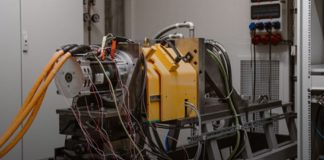
Researchers at the University of Strathclyde have demonstrated a 100 kW fully superconducting aviation motor, marking a technical step towards lightweight electric propulsion systems for future hydrogen-electric and all-electric aircraft.
Researchers at the Applied Superconductivity Laboratory (ASL) at the University of Strathclyde in Glasgow have demonstrated a 100 kW fully superconducting axial-flux motor for aviation applications. The prototype is described by the university as one of the first attempts worldwide to develop a fully superconducting axial-flux machine specifically for aircraft propulsion.
The system uses high-temperature superconducting (HTS) technology, enabling very high current densities with almost no electrical resistance when the conductors are cooled to cryogenic temperature. In this demonstrator, the operating temperature is around 20 K, equivalent to approximately -253 °C.
Although still at proof-of-concept level, the work is relevant for the next generation of electric propulsion architectures, where the main engineering constraint is not only efficiency but power density. Conventional electrical machines face significant mass and thermal-management penalties when scaled to the megawatt levels required by larger aircraft. Superconducting machines are being investigated because they could deliver the same power with a smaller and lighter motor, provided that cryogenic cooling, fault protection and system integration can be solved.
Why superconductivity matters for aircraft motors
In aircraft propulsion, power density is a decisive metric. Electric motors for regional or commercial aircraft must deliver high torque and high continuous power while keeping mass, volume and cooling requirements within strict limits. HTS materials can carry much larger current than copper windings, which opens the possibility of compact machines with higher magnetic loading.
The Strathclyde demonstrator uses rare-earth barium copper oxide superconducting tape, a material family that can operate in the 20–77 K range. These temperatures are still cryogenic, but they are significantly higher than those required by conventional low-temperature superconductors, which typically need cooling close to 4 K with liquid helium.
This temperature range is particularly interesting for hydrogen-electric aviation. Liquid hydrogen must already be stored at very low temperature, which means future aircraft using cryogenic fuel could potentially combine hydrogen storage, cryogenic cooling and superconducting electrical systems in a single propulsion architecture.
A fully architecture
The technical interest of the Strathclyde motor is not limited to the use of superconducting components. The team developed a fully superconducting axial-flux architecture integrating superconducting windings, low AC-loss design, brushless excitation and rotational cryogenic operation into a single platform.
Axial-flux machines are already being studied in electric mobility because of their high torque density and compact geometry. In aviation, where packaging and weight are critical, this topology can be attractive. The challenge becomes much greater when superconducting windings have to operate in a rotating cryogenic environment, with mechanical stresses, thermal gradients and electromagnetic losses all managed at the same time.
According to Strathclyde, the development brought together superconductor physics, cryogenic engineering, electromagnetic modelling and mechanical integration. The multidisciplinary team included chemists, physicists, electrical engineers and mechanical engineers.
Professor Min Zhang, who leads the Applied Superconductivity Laboratory, said the demonstrator shows that fully superconducting aviation motors are “no longer just a theoretical concept”. She added that the integration of superconducting windings, brushless excitation and cryogenic operation creates a platform that can inform the development of future megawatt-class propulsion systems.
From laboratory research to propulsion demonstrator
The demonstrator is part of the Zero Emissions for Sustainable Transport 1 programme, funded by the Aerospace Technology Institute and led by Airbus. The project connects university-level research on superconducting machines with the aerospace industry’s broader investigation of cryogenic electric propulsion.
A related Strathclyde research paper, “The development of the 100 kW fully superconducting axial flux motor: HTS armature tests”, was published in IEEE Transactions on Applied Superconductivity. The paper focuses on HTS armature tests and describes the use of a superconducting armature in an axial-flux superconducting motor. For the first tests, a permanent-magnet rotor was used to validate simulation data and verify motor-mode operation of the armature.
This is an important distinction. Many earlier superconducting machine studies focused on superconducting rotors, particularly for marine propulsion or stationary power applications. Aviation requirements are pushing research towards superconducting armatures and more compact architectures, because the mass of the complete propulsion unit — including cooling — is the critical parameter.
Link with Airbus cryogenic propulsion work
The Strathclyde demonstrator also fits within Airbus’s wider work on cryogenic electric propulsion. Airbus UpNext launched the Cryoprop demonstrator to mature superconducting technologies for future hydrogen-powered aircraft. The demonstrator is designed around a two megawatt-class superconducting electric propulsion system cooled by liquid hydrogen through a helium recirculation loop.
The industrial objective is not simply to prove that superconductivity can reduce electrical losses, but to understand whether a complete aircraft propulsion system can be made safe, maintainable, certifiable and industrially viable. This includes superconducting cables, motors, cryogenic power electronics and cooling systems.
Ludovic Ybanez, head of cryogenic electric propulsion system demonstrator at Airbus UpNext, described Cryoprop as a step towards the megawatt-class superconducting machines that would be required for larger aircraft.
Remaining engineering barriers
The Strathclyde result is technically significant, but the path to flight hardware remains complex. Superconducting propulsion introduces several coupled engineering challenges.
The first is cryogenic cooling. The thermal system must maintain superconducting components at the required temperature while dealing with heat ingress, losses under AC operation and transient loads. The second is protection. Superconductors can lose their superconducting state if temperature, current or magnetic-field limits are exceeded, a phenomenon known as quench. Detecting and managing these events is essential for aircraft safety.
The third challenge is integration with the complete propulsion chain. A high-power-density motor is useful only if the power electronics, cabling, cooling system and energy source do not offset the mass advantage. For aviation, the relevant figure is therefore not only motor power density, but system-level power density.
This is why the combination of superconducting machines with liquid-hydrogen aircraft concepts is attracting attention. If cryogenic infrastructure is already present on board, superconducting components may become easier to justify at system level.