
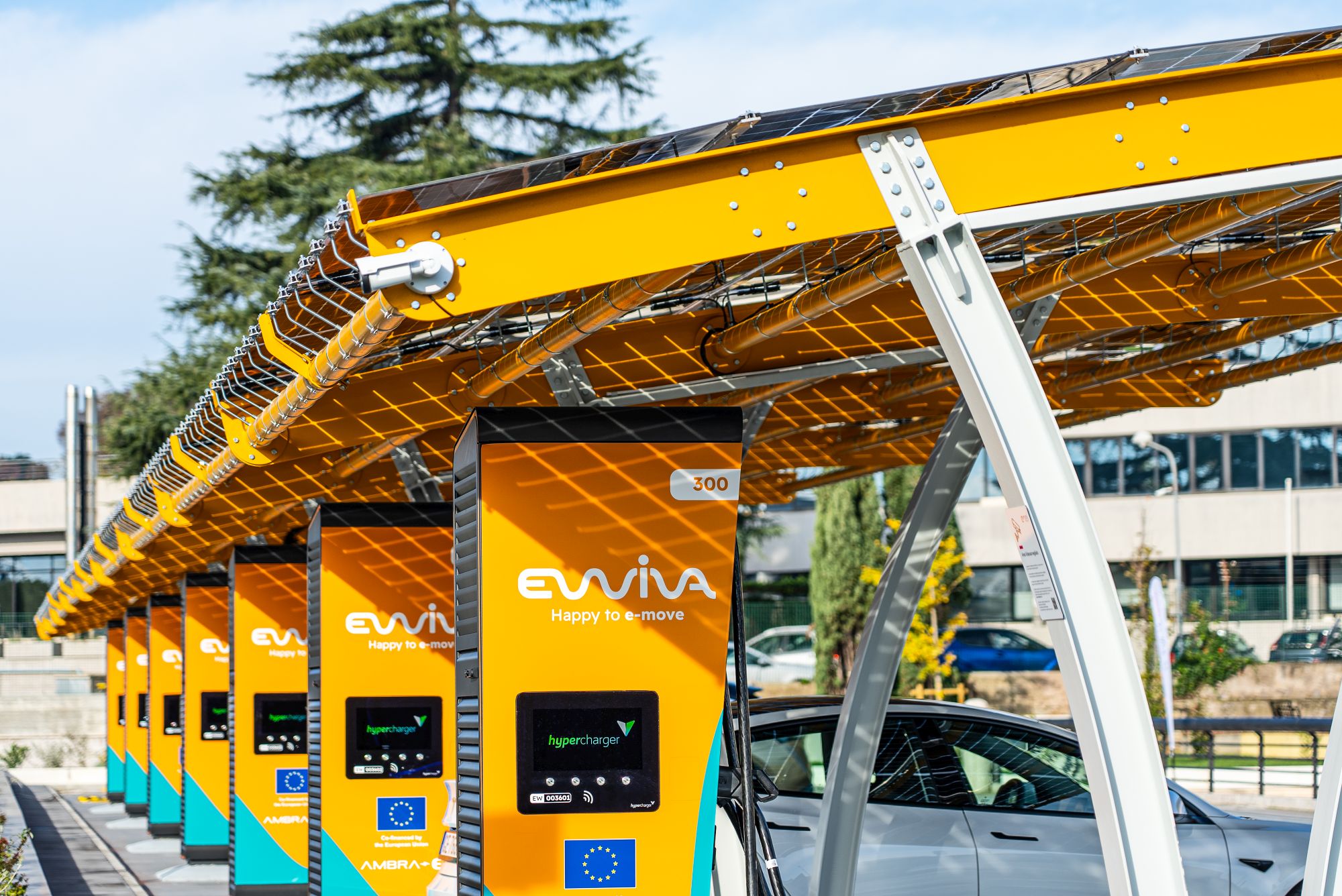
Ewiva, the high-power charging joint venture backed by Enel, has closed 2025 with a major milestone in Italy’s e-mobility infrastructure growth. Over the past year, the company added 430 new high-power charging points (PoC), distributed across 105 new stations nationwide. This expansion brings Ewiva’s network to more than 1,600 chargers across some 450 sites, all powered entirely by renewable energy.
The 2025 deployment represents a 150% increase over the previous year, with particularly strong acceleration in Southern Italy and the islands (+210%). Northern regions saw a growth of nearly +160%, while Central Italy expanded by more than +50%. Thanks to this pace, Ewiva achieved the symbolic goal of having at least one activation in every Italian region.
Since its launch, Ewiva’s network has delivered over 50 million kWh of renewable electricity, enabling drivers to travel more than 300 million electric kilometers—equivalent to circling the Earth about 7,500 times. The company estimates this has reduced CO₂ emissions by over 35,000 tons, alongside significant decreases in nitrogen oxide and particulate matter.
Technological Advancements in User Accessibility
In parallel with network expansion, Ewiva upgraded its entire infrastructure with integrated contactless POS systems, allowing payment via credit/debit cards or digital platforms such as Apple Pay and Google Pay. This complements existing methods available via Ewiva’s interoperable 100+ Mobility Service Providers (MSPs), RFID cards, and Plug & Charge technology, which enables automatic authentication by simply connecting the vehicle.
Ewiva also inaugurated its first public high-power charging site dedicated to e-trucks in Piacenza—a pioneering step in developing the heavy-duty electric logistics ecosystem on Italian soil. The installation marks an early move toward decarbonizing freight transport, a major challenge for the national energy transition.
Building Awareness and Future Skills
Beyond infrastructure, Ewiva continues to promote the cultural and educational aspect of the energy transition. Its E-MOBILITY@SCHOOL program involved more than 12,500 students and 500 school classes, providing training on electric mobility and sustainability. The project was recognized among the finalists at the Blue Green Economy Award 2025 and will be renewed for the 2025–2026 academic year.
The company’s engagement extended to sponsoring the national Sustainable Mobility Competition (SEL3C4RS) during Key Energy 2025 in Rimini, where Italian students designed and built small-scale electric vehicles.






, distributed across 105 new stations nationwide.)