
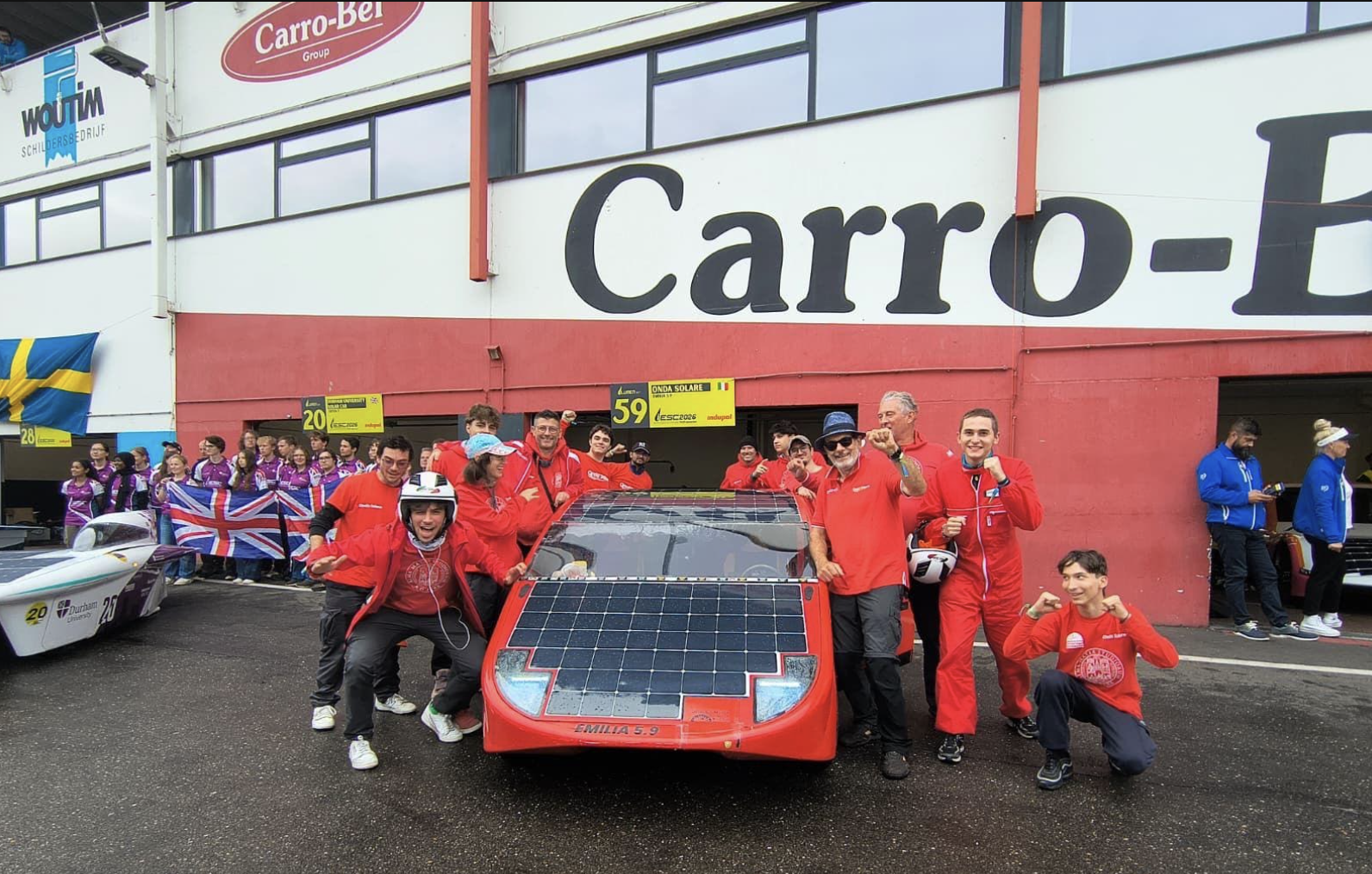
The Emilia 5.9 solar-powered electric vehicle, developed by Team Onda Solare in collaboration with theUniversity of Bologna and the National Centre for Sustainable Mobility (MOST), combines in-wheel electric propulsion, photovoltaic energy generation, lightweight composite structures and advanced energy management strategies.
The four-seater prototype, designed for the Cruiser category of international solar vehicle competitions, features approximately five square metres of photovoltaic panels integrated into the roof and two electric motors incorporated directly into the wheels. The in-wheel motor architecture eliminates the need for conventional mechanical transmission components, contributing to drivetrain simplification and reducing associated mechanical losses.
The chassis and several structural components are manufactured using carbon fibre-based composites to achieve a favourable strength-to-weight ratio. Vehicle development has focused on the interaction between aerodynamic performance, structural weight reduction, energy conversion efficiency and passenger accommodation.
Another significant engineering feature is the suspension system, designed and patented by the Mechanical Design and Machine Construction research group at the University of Bologna’s Forlì Campus. The solution received innovation awards at both the 2024 Sasol Solar Challenge in South Africa and the 2025 Bridgestone World Solar Challenge in Australia.
During the latter competition, Emilia 5.9 covered more than 3,000 kilometres between Darwin and Adelaide, finishing third in the Cruiser category and becoming the first Italian vehicle in its class to complete the event.
Further experimental data emerged in September 2026 at the iLumen European Solar Challenge in Zolder, Belgium. With four occupants on board, the prototype completed 203 laps, covering more than 800 kilometres in 24 hours with a reported total energy consumption of approximately 35 kWh, corresponding to less than 4.4 kWh/100 km.
Presented by Giangiacomo Minak, professor at the University of Bologna, during the Urban Tech exhibition in October 2026, the project provides an experimental platform for investigating the integration of distributed electric propulsion, onboard photovoltaic generation and energy-efficient vehicle architectures in future passenger mobility.



, combines in-wheel electric propulsion, photovoltaic energy generation, lightweight composite structures and advanced energy management strategies.)