
The ANFIA 2026 Public Assembly, titled “The Time for Responsible Choices. Businesses, Nations, and Europe at a Decisive Turning Point,” took place in Milan at the Monte Rosa 91 Auditorium, last November 12, 2026. The event served as a forum for discussion on the major transformations affecting the sector within an increasingly complex international landscape, as well as the choices needed to preserve and strengthen the competitiveness of the European and Italian industries before it is too late.
The proceedings opened with a keynote address by Dario Fabbri, geopolitical analyst and director of Domino, who provided an in-depth analysis of the dynamics of international competition in the automotive sector – with particular reference to the trade and tariff strategies and policies of the United States and China – which is increasingly playing out in the realms of software and advanced technological innovation.
This was followed by a dialogue among European political leaders, featuring Carlo Fidanza (ECR), Giorgio Gori (S&D), and Massimiliano Salini (EPP). The discussion focused on the evolution of priority issues for the automotive sector – the revision of the regulation on CO2 emissions from light-duty vehicles and the “Made in Europe” initiative – as well as on the role of policymakers in creating conditions that promote and strengthen the competitiveness of the industrial sector.

Roberto Vavassori, ANFIA President
The debate then turned to the future of the automotive industry, with a discussion between Antonio Filosa, CEO of Stellantis; Adolfo Urso, Minister for Enterprise and Made in Italy; and Roberto Vavassori, President of ANFIA, on industrial strategies and Italy’s role in the European regulatory landscape.
The subsequent panel discussion, dedicated to the perspectives of the regions, included representatives from several Italian regions with a strong automotive industry presence: Vincenzo Colla, Vice President of the Emilia-Romagna Region; Guido Guidesi, Councilor for Economic Development of the Lombardy Region; Tiziana Magnacca, Councilor for Productive Activities, Industrial Research, and Labor for the Abruzzo Region; and Andrea Tronzano, Councilor for the Budget and Development of Productive Activities for the Piedmont Region. The debate centered on the role of regional administrations in supporting the industrial fabric – by creating favorable conditions for industrial investment, streamlining regulations, and expediting authorization procedures – and in facilitating the sector’s transition.
Finally, Marco Nocivelli, Vice President for Industrial Policies and “Made in Italy” at Confindustria, addressed the gathering.
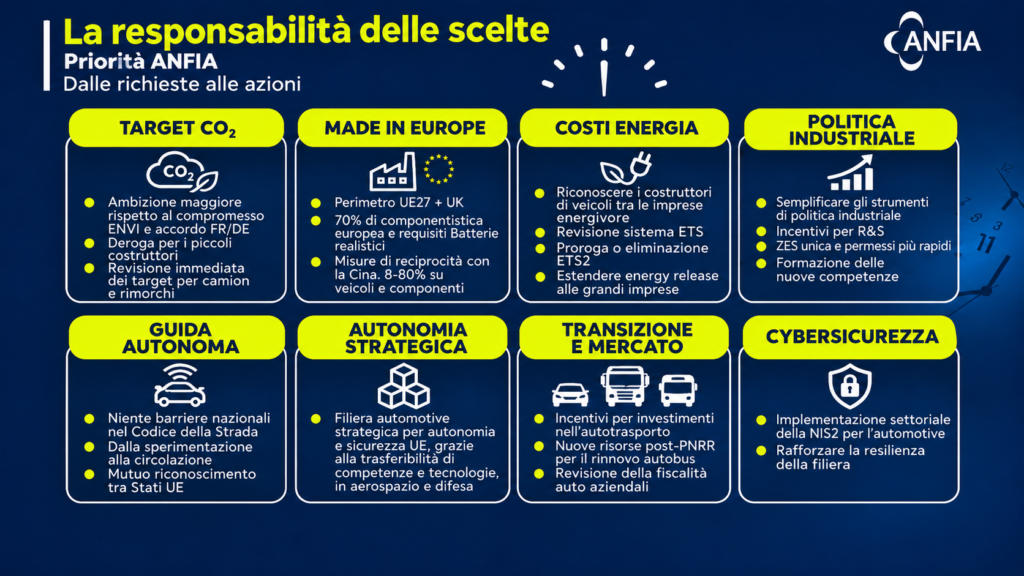
The ANFIA President concluded the proceedings by emphasizing the responsibility of businesses – which must continue to invest, innovate, improve processes, and offer solutions capable of winning over customers – as well as that of local communities and policymakers, presenting the priorities for action at the national and European levels that ANFIA hopes will be addressed in the coming months.
«To compete globally, we need a level playing field, which is currently lacking – especially when compared to our Asian competitors,» stated Roberto Vavassori, ANFIA President, «but we also need local certainties: sustainable and predictable energy costs, labor costs that do not hinder productivity, more accessible and subsidized research and innovation, and a single European capital market that injects resources into our system. This means that, at both the European and national levels, policy must keep pace with industry. If we want our country to remain competitive, we must work in synergy, just as we have done in Europe, where the Italian system played a decisive role in launching negotiations – both on revising CO₂ targets for light-duty vehicles and on supporting ‘Made in Europe’ as an essential component of the EU’s industrial policy.
Regarding the CO2 regulation, the task now is to continue working to further improve the ENVI compromise in the European Parliament’s plenary session and ensure that the Council’s position is more ambitious than the Franco-German agreement. The next step, once the legislative process for the Industrial Accelerator Act and the revision of CO₂ targets for trucks and trailers, will be to put a stop to regulatory overreach and return to discussing practical competitiveness – including by evaluating the introduction of effective trade defense measures that build on the tentative signal sent last month with the agreement between the EU Commission and China to limit car imports».