The surging demand for critical and strategic raw materials convinced analysts at Allianz Trade to release a new study covering the pros and cons of mining, highlighting the numerous controversies that such activities introduce; at the same time suggesting a way to try and solve them successfully.
The encreasing demand for critical raw materials
Earlier this year a team of experts at German-based Allianz Trade released a report titled Mining for the future: Addressing liabilities and unlocking sustainable transition opportunities. The scope of the study was that to analyse the cost-benefit balance of mining activities, and at the same time to underline the socioeconomic and environmental impact of the extractive sector. The starting point is that, for a number of reasons, the demand for critical and strategic raw materials is surging and the ascending trend will continue. Authors described strategic raw materials (SRMs) as a subset of the critical raw materials group, pointing out how essential they are to «technologies underpinning the green and digital transition», as well as to applications in the defence and aerospace sectors, for instance. According to Allianz Trade, «energy systems are shifting towards electrification» and, together with «renewables, storage and expanded grids» this is contributing to drive upwards the demand for a number of raw materials. On top of that, artificial intelligence and its most energy-consuming data centres are attracting investments, on the one hand, and pushing the request for certain commodities, on the other. The company quoted the International Energy Agency (IEA) and its forecasts, according to which «lithium demand could increase fivefold» by 2040. And lithium is just an example, since «graphite and nickel may double; cobalt and rare earth elements could rise by 50-60%; and copper demand by around 30%». At the same time, data centres are expected to double their electricity consumption: grid investments and additional materials are strongly needed.
From aerospace to wind turbines
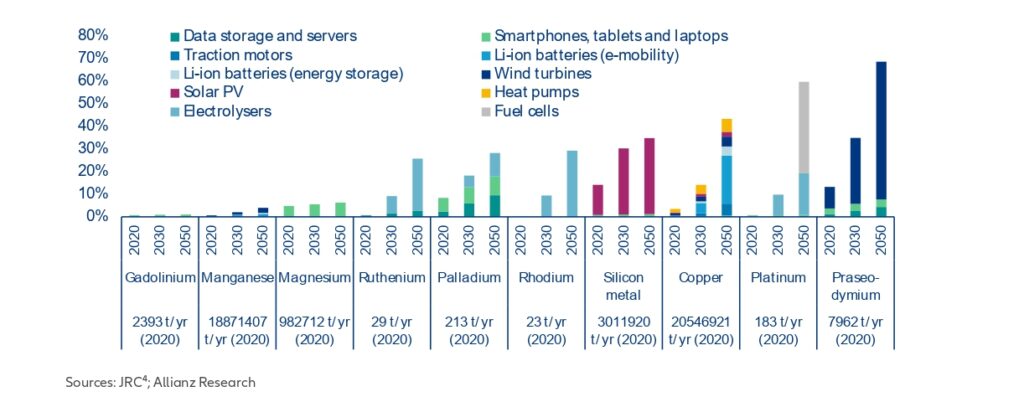
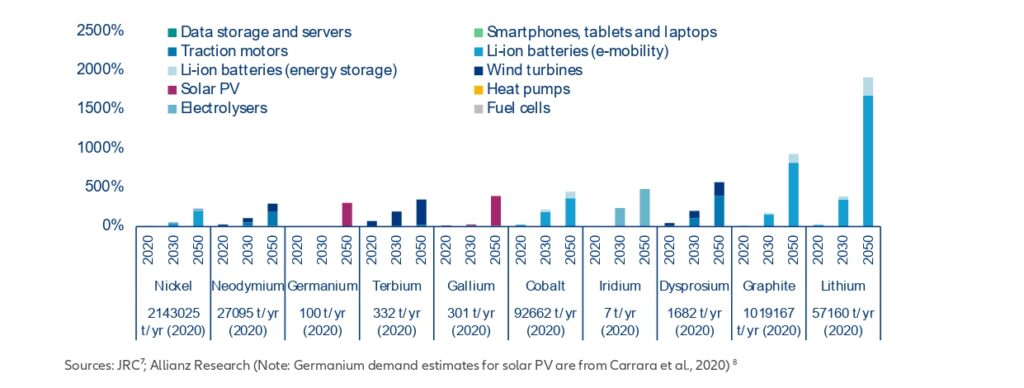
As for rare earth elements themselves, building upon studies by the European Commission’s Joint Research Centre, Allianz Trade focused on praseodymium, whose demand could undergo a 70% rise over the next 25 years. The point is that this material, whose overall consumption was as high as 7,600 tonnes in 2020, is primarily used for high-resistance alloys, finally destined to aerospace engines, but in the (near) future it could address and fulfil the needs of wind energy and turbines. A similar dynamic is predicted to influence the performance of terbium, which is also critical for wind turbines, and also in this case the demand might rocket, given its expected 500% increase by 2050. Last but not least, the demand for neodymium is likely to surge (+500%): it is crucial for powerful permanent magnets and therefore for industrial electric motors: its overall consumption, at the beginning of this decade, amounted at 27,000 tonnes approximately. Furthermore, other «non-strategic but critical inputs» and namely indium, tellurium and phosphorus «can, by 2050, reach demands that exceed current production, largely driven by specific technologies such as photovoltaics and batteries». None of the three belongs to the rare earth elements category, but all of them play a part in the green transition. In fact, EV batteries represent a typical field of application for phosphorus, whereas indium is highly appreciated in touch screen, LCD and advanced solar panels manufacturing. High-efficiency solar panels require tellurium too, and the metalloid is also used as an additive in order to enhance the strength and resistance of certain alloys and steel grades.
A different approach
The fast and steady demand growth adds to the issue of limited availability and therefore with that of a «limited refining capacity» and could end up triggering price volatility and cause new industrial projects to be delayed or, eventually, cancelled; several attempts to recover rare earth elements and other commodities from waste are now taking place. And in fact analysts at Allianz Trade agree that «a more circular economy may ease reliance on primary extraction», although they also point out that «supply chains for key transition minerals remain low to scale». As said, mining is the main topic and it is a worrisome one. To obtain relevant permissions and funding, and comply to environmental and social standards is no easy job at all, and it takes a long time. This is why authors consider that «the pace at which mining and refining capacity can grow is therefore a central constraint; failure to scale responsibly risks prolonging fossil-fuel dependence». Nevertheless, a way to overcome mining-related criticalities is there and it deserves to be discussed.
Costs and benefits
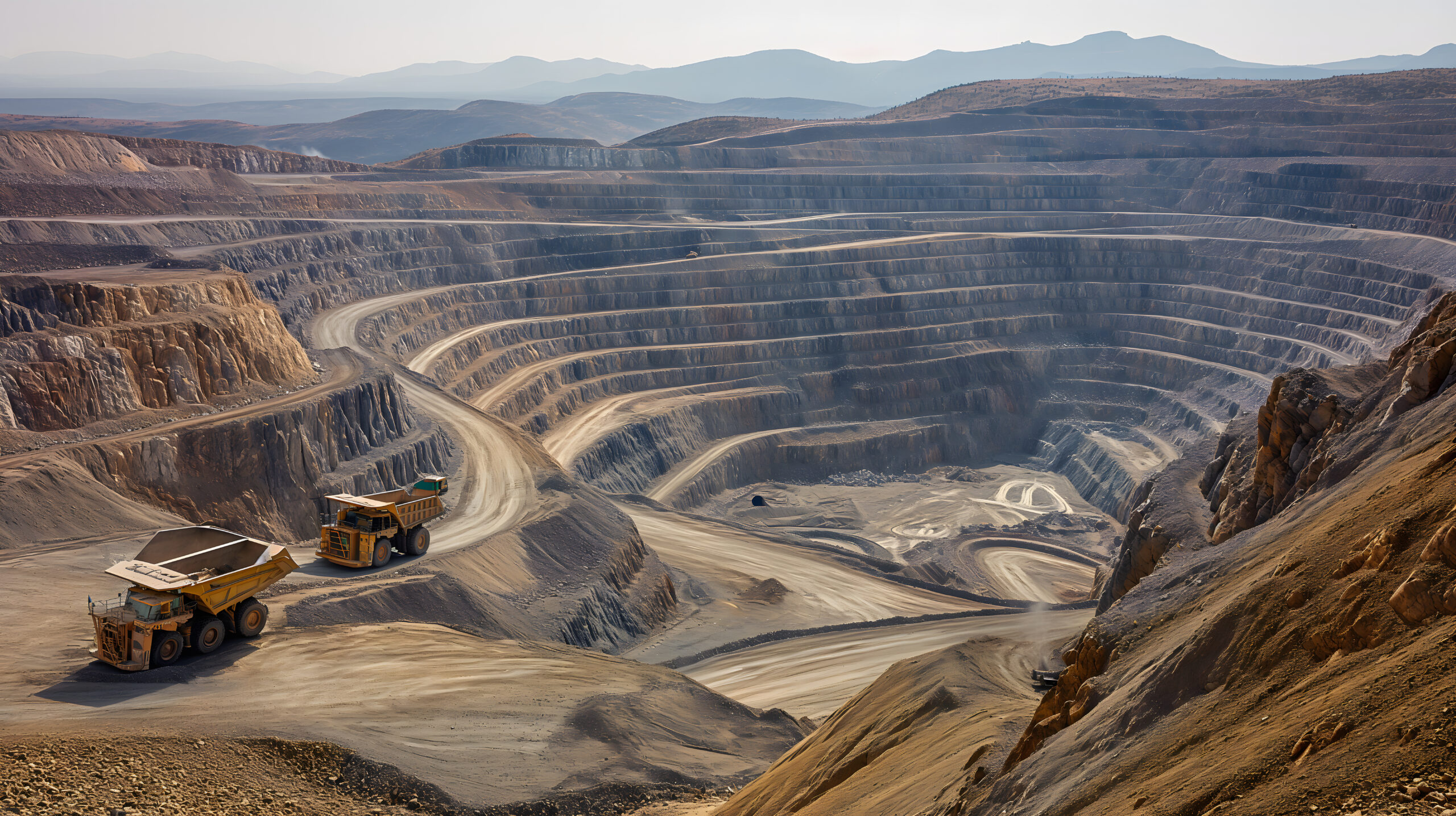
According to figures, mining activities represent roughly 2-4% of global GDP and 4-7% of overall greenhouse gas emissions. Furthermore, «although less significant than agriculture or urban expansion in driving forest loss, mining directly deforested nearly 20,000 square kilometres between 2001 and 2023, generating roughly 0.75 Pg of CO₂», which is «slightly more than Germany’s annual emissions in 2024». These impacts can be reduced, in the company’s view, by implementing «stronger operational practices» alongside with «rehabilitation and credible compensation mechanisms such as biodiversity offsets and reforestation». This requires massive investments, undoubtedly. «We estimate», researchers stated, «cumulative investment needs of around 1.1 trillion US dollars to 2040 across mining, processing and circularity. Sustainability has become a binding production constraint: permitting, insurance and community consent now shape capacity as directly as technical factors. Company disclosures suggest roughly 450 billion dollars may be required for decarbonization, tailings management, recycling and environmental controls. After accounting for overlap with the roughly 800 billion US dollars needed to develop new supply», is their conclusion, «total capital requirements remain very close to 1.1 trillion dollars».
Not an option
Yet, it is Allianz Trade’s opinion that sustainable mining is not a mere option, but something essential. And it is a concrete possibility. Such standards as the Initiative for Responsible Mining Assurance (IRMA), the Global Standard on Mining Tailings and Safety (GISTM), the International Council on Mining and Metals (ICMM) member guidelines and principles and the Consolidated Mining Standard Initiative (CMSI) aim to show that mining can become profitable, financially and environmentally sustainable and safe, both for businesses and for local communities and workers. At the very heart of some of these initiatives and consortia, there are the ideas of «community participation and benefit-sharing, biodiversity and pollution prevention, due diligence and traceability, electrification and automation to reduce operational emissions and safety risks». It is only the beginning, because «once materials enter the economic system», the focus must shift towards «circularity and recyclability by design», in order to reduce long-term primary demand. Following «the success of the Global Standard on Mining Tailings and Safety (GISTM)» a group of stakeholders gave birth to the Mining 2030 Initiative, whose goal is «to make mining attractive again for investors» and that builds upon a 10-year vision. It means to be «supportive» and to depict a clear framework of actions to address «the growing gap in raw materials available to meet the needs of economic growth and technological development». Finally, «the aim is that to raise the attractiveness of the mining sector for investors, community members, customers and consumers in order to support its expansion with stronger conviction of consistent adherence to best practices».
(Source: Allianz Trade, Mining for the future: Addressing liabilities and unlocking sustainable transition opportunities, February 2026. Authors and contributors: Markus Zimmer, Jasmine Gröschl, Imke Harten, Hazem Krichene, Ano Kuhanathan, Patrick Peura, Katharina Utermoehl, Jade Elisabeth)
Didascalie
Apertura da abobestock:
FIGURE 1 e 2 da pagina 5 del pdf su server
01_terre_0326 da pagina 5 del pdf su server
Global raw material demand by transition technology (in % of 2020 total production): EU strategic materials (high demand scenario), shares between 1% and 100% in 2050
02_terre_0326
Global raw material demand by transition technology (in % of 2020 total production): EU strategic materials (high demand scenario), shares above 100% in 2050