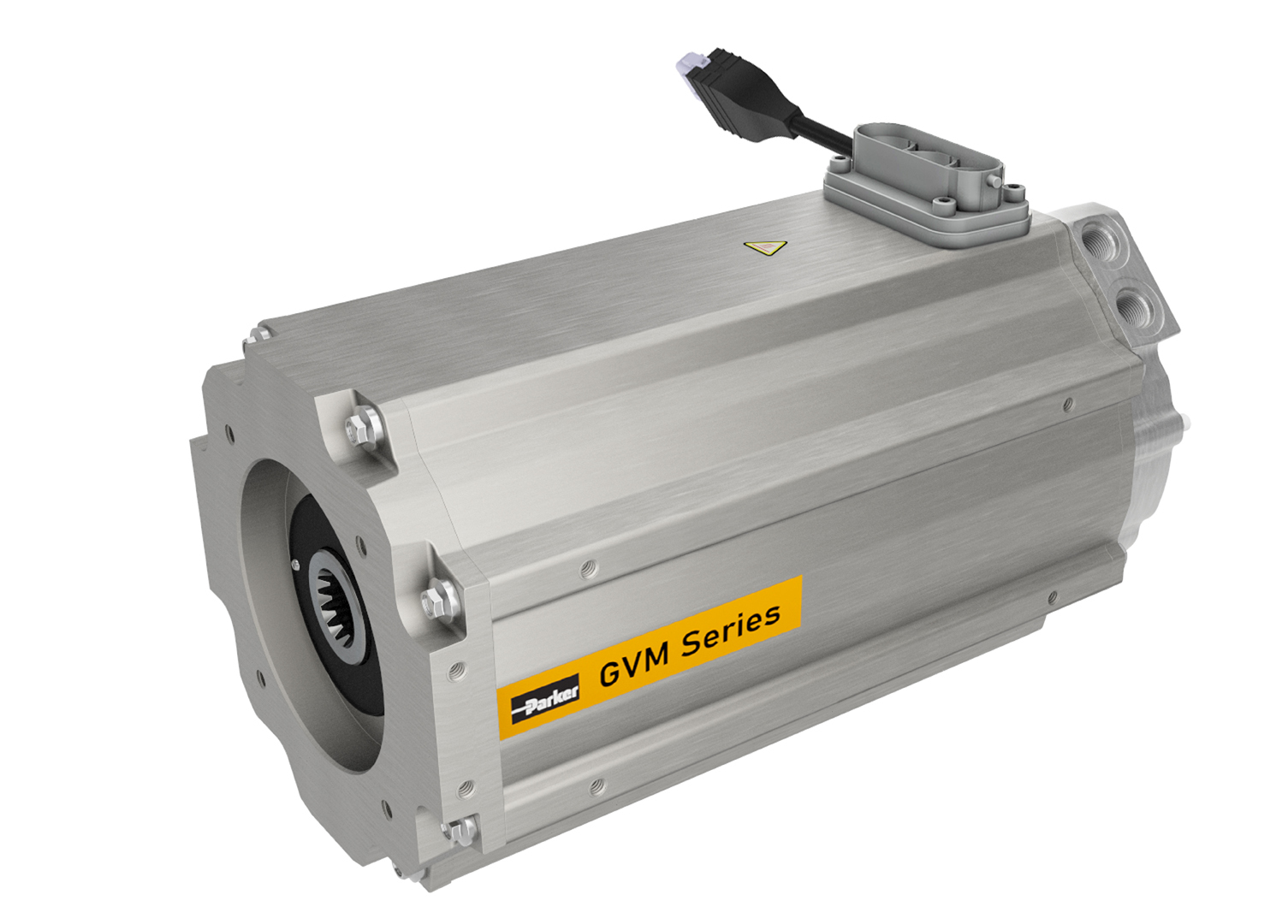
Parker Hannifin has introduced the second generation of its Global Vehicle Motor series, the GVM210 Gen 2, expanding its electric motor offering for OEMs and system integrators involved in the electrification of on- and off-highway vehicles. The new platform has been developed to streamline installation, improve integration flexibility, strengthen safety functions, and increase robustness in demanding operating environments.
The GVM210 Gen 2 is positioned as an evolution of Parker’s established GVM210 architecture, retaining the performance base of the first-generation design while addressing several practical challenges that emerge during vehicle integration and field deployment. The motor is intended for a broad range of applications, including material handling equipment, construction machinery, mining vehicles, agricultural equipment, utility vehicles, and other specialty mobile platforms. In these sectors, the electrification of drivetrain and auxiliary systems places increasing emphasis not only on power density and efficiency, but also on installation simplicity, thermal protection strategy, and durability under severe duty cycles.
A key engineering focus of the new generation is easier system integration across different vehicle architectures. To support a wider range of control topologies and packaging requirements, Parker has introduced pigtail connector options in both 12-pin and 16-pin configurations. This provides greater flexibility for OEMs in matching the motor’s feedback and monitoring interfaces with specific inverter platforms and vehicle control strategies. The 16-pin configuration is particularly significant because it enables the use of two PT1000 temperature sensors on a separate mode, allowing full motor thermal protection in three-phase control architectures, including conditions where torque is demanded at low speed. This is a relevant enhancement for applications in which precise thermal supervision is critical to maintaining continuous torque capability and protecting the motor under high-load, low-speed operating points.
From a safety standpoint, Parker has integrated new functionality into the GVM210 Gen 2 through support for High-Voltage Interlock Loop (HVIL) capability on the power connector option. In electrified vehicle systems, HVIL is an increasingly important layer of protection because it enables the system to detect connector disengagement and immediately shut down the high-voltage supply. According to Parker, when either the power connector or the low-level connector is disconnected, the power supply is automatically and immediately cut off. This feature supports OEM efforts to align with current safety expectations in electrified mobile equipment, where serviceability and operator protection must be ensured without compromising overall system availability.
Another area of development concerns environmental sealing and mechanical robustness, especially for use in electro-hydraulic pump (EHP) systems operating in harsh conditions. Parker has added an optional O-ring on the prepared motor flange, a design measure intended to improve sealing between the motor and pump assembly. This enhancement is designed to prevent leakage and reduce the risk of grease contamination from dust and other external particulates, particularly around frequently exposed interfaces such as greased spline couplings. In rugged mobile applications, where motors may be subjected to vibration, contamination, and repeated load cycles, improvements of this kind can have a direct effect on long-term reliability, maintenance intervals, and overall system cleanliness.
From an engineering perspective, the GVM210 Gen 2 reflects a broader trend in mobile electrification: electric motors are no longer evaluated solely on nominal performance metrics, but increasingly on how efficiently they can be integrated into complete vehicle platforms. Factors such as connector configuration, thermal sensing architecture, sealing strategy, and safety interlock compatibility now play a decisive role in reducing development complexity from prototype stage through to series production. Parker’s redesign approach appears to address exactly these integration pain points, while preserving the core performance expectations established by the first-generation GVM210 platform.