
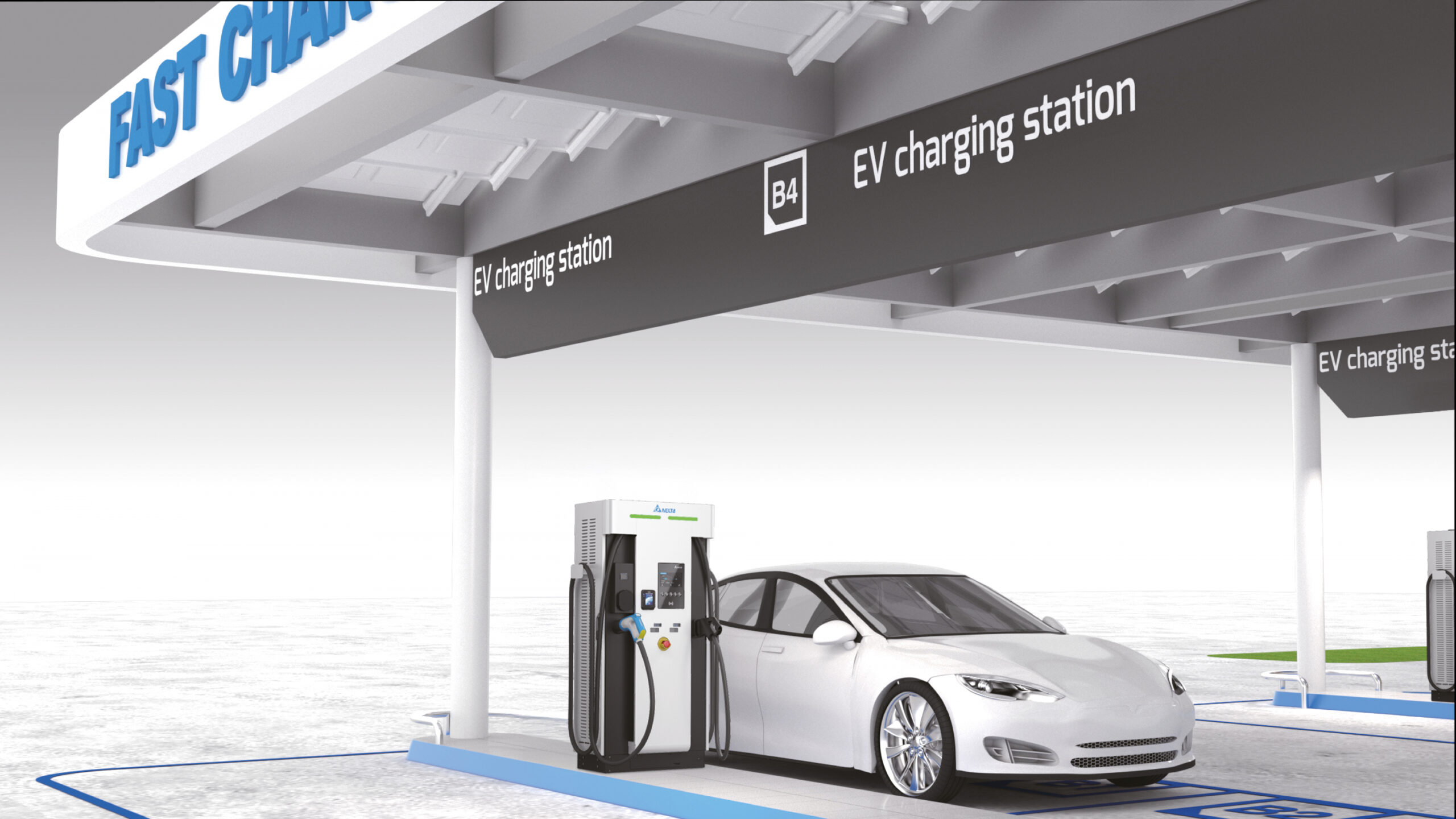
The certification of the SLIM 100 under German calibration law adds a compact 100 kW option to Delta’s compliant DC charging range, addressing regulatory requirements for transparent billing in public and commercial EV charging infrastructure.
Delta has obtained Eichrecht certification for its SLIM 100 fast DC electric vehicle charger, adding the 100 kW unit to its portfolio of DC charging products compliant with German calibration law. The certification is relevant for public and semi-public charging applications in Germany and Austria, where accurate, verifiable and tamper-proof energy metering is a legal requirement for the commercial sale of electricity to EV users.
The SLIM 100 is a compact 100 kW DC charger aimed at public charging sites, corporate fleet facilities and depot applications. With the new certification, the charger can be deployed in environments where operators must provide users with transparent billing based on calibrated metering systems. In technical and regulatory terms, Eichrecht compliance is not only a product label: it concerns the entire process by which delivered energy is measured, recorded and made available for verification.
For charge point operators, the certification reduces one of the main barriers to deployment in regulated European markets. Germany’s Eichrecht framework is considered one of the most demanding calibration regimes for EV charging infrastructure, requiring certified metering and data transparency when energy is sold to end users. This affects CPOs, commercial fleet operators, public transport infrastructure planners and municipal procurement bodies, particularly where public access or third-party billing is involved.
The certification also completes Delta’s Eichrecht-certified DC charging line-up. The SLIM 100 joins the company’s already certified DC Wallbox 50 kW and UFC 500 systems, creating a range that covers different power classes and installation scenarios. According to the company, the three certified DC chargers are based on the same technology platform and are configurable according to installation requirements, including functional specifications and external design adaptations.
From an infrastructure perspective, the availability of certified chargers across several output levels is significant. Fleet depots, city-edge charging hubs and public fast-charging sites do not require the same power rating, footprint or duty cycle. A 50 kW wallbox, a compact 100 kW DC unit and a higher-power ultra-fast charger address different operational profiles while maintaining a common compliance framework.
The development also reflects a wider trend in European EV infrastructure: charging hardware is increasingly evaluated not only on power output, efficiency and user interface, but also on metrological compliance, cybersecurity of billing-related data and compatibility with evolving regulatory frameworks. As more countries consider calibration and transparency requirements similar to those applied in Germany, certified platforms may become a prerequisite for operators seeking to scale networks across multiple jurisdictions.