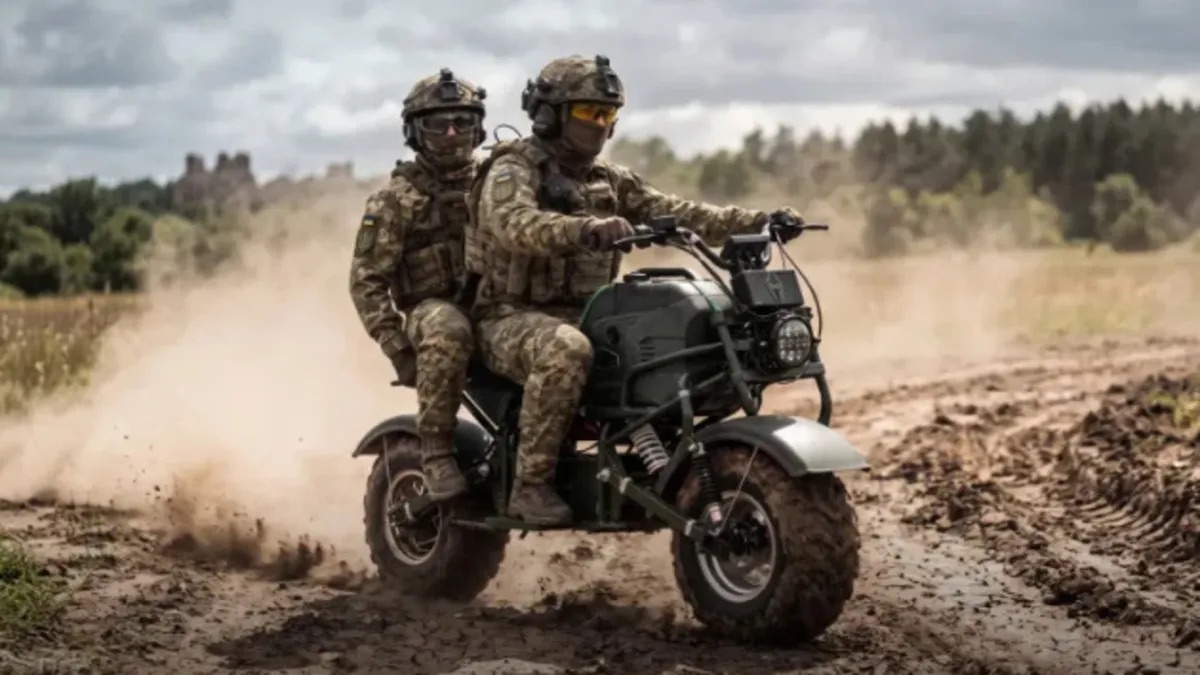
The 2×2 electric motorcycle combines two independent traction motors with an almost 100-km battery range and a removable petrol generator that can also power drones and communication equipment.
The Ukrainian Ministry of Defence has codified the MUL.E, the country’s first domestically developed all-wheel-drive electric motorcycle, and authorised it for operational use by the Armed Forces.
Developed by an unnamed Ukrainian company specialising in military equipment, the vehicle was designed in response to requirements gathered from troops operating in high-intensity warfare. Its tasks include transporting personnel and weapons, carrying small loads, evacuating wounded soldiers and operating over roads, mud, sand, snow and marshland. The motorcycle can also tow a loaded trailer.
Two independent electric motors
The most relevant engineering feature is the 2×2 drivetrain. Rather than relying on a single motor and a mechanical system to transfer torque to both wheels, the MUL.E uses two independent electric motors to provide all-wheel-drive traction.
According to the Ministry, this configuration improves the vehicle’s “survivability”: a malfunction or damage affecting one motor does not necessarily disable the entire propulsion system. From a powertrain perspective, a distributed dual-motor architecture can also permit more precise torque delivery between the two wheels, particularly on surfaces with different grip levels. However, the Ukrainian authorities have not disclosed whether the motorcycle uses active electronic torque distribution or a simpler control strategy.
The Ministry describes the units only as “high-performance electric motors”. Rated and peak power, maximum torque, operating voltage, motor topology, cooling method and inverter specifications have not been released. It has also not been confirmed whether the traction units are hub motors or are connected to the wheels through reduction stages.
This lack of detailed specifications also applies to the battery. The manufacturer has not disclosed its chemistry, usable energy capacity, nominal voltage, charging power or thermal-management system. The confirmed figure is the operating range: the MUL.E can travel almost 100 km on a fully charged battery. Its maximum speed is described as high, although no numerical value has been published.
Electric traction with a removable generator
To reduce dependence on fixed charging infrastructure, the motorcycle carries an additional petrol-powered generator on its frame. The unit can recharge the standard traction batteries and is removable, allowing soldiers to use it separately as a portable power source.
The generator can supply electricity to mobile phones, radio and communication systems, as well as batteries for FPV drones. The motorcycle therefore performs two functions: it is both a low-signature mobility platform and a decentralised energy source for units operating far from the electricity grid.
Technically, the arrangement resembles a range-extender concept because the combustion engine is used to produce electricity rather than directly drive the wheels. Nevertheless, neither the generator’s electrical output nor its fuel capacity has been disclosed. It is also unclear whether it can recharge the battery while the motorcycle is moving or is mainly intended for stationary operation.
Low acoustic signature and off-road traction
Electric propulsion reduces the acoustic signature compared with an internal-combustion motorcycle, while the absence of a continuously operating combustion engine can also reduce thermal visibility. These characteristics make the vehicle suitable for reconnaissance, frontline logistics and the rapid movement of small units.
Wide off-road tyres distribute the vehicle’s mass over a relatively large contact area. The Ministry claims that its pressure on the ground is comparable to that produced by a soldier’s foot, reducing the probability of activating mines designed for heavier vehicles. This should not be interpreted as protection against every type of mine or explosive device, but as a consequence of the motorcycle’s comparatively low ground load.
The MUL.E enters service as motorcycles assume a growing role in Ukrainian military logistics. Ukraine’s Defence Procurement Agency has signed contracts for 1,500 motorcycles in 2026, three times the quantity ordered in the previous year. The procurement announcement does not state that all 1,500 vehicles are MUL.E models