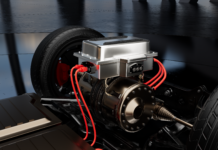
Developed with the Ningbo Institute of Materials Technology and Engineering, the new axial-flux motor exceeds 18,000 rpm and relies on a dedicated permanent-magnet material engineered for high-speed, high-temperature operation
PanGood Power has presented a new generation of axial-flux electric motors capable of reaching an effective power density of 25.73 kW/kg and a maximum rotational speed above 18,000 rpm.
The production-oriented motor was jointly developed by PanGood and the Ningbo Institute of Materials Technology and Engineering, part of the Chinese Academy of Sciences. According to the company, the project addresses some of the most persistent limitations affecting axial-flux machines, including magnet demagnetisation, thermal stability, mechanical strength and reliable operation under high-speed and high-load conditions.
At the core of the development is a dedicated permanent-magnet grade called PGH, or PanGood High. Rather than adopting a general-purpose magnetic material, the partners worked on the magnet composition, microstructure, manufacturing process and protective system to adapt it specifically to the electromagnetic and mechanical conditions of axial-flux machines.
PanGood says the resulting material offers improved magnetic energy product, high-temperature stability, resistance to alternating-field demagnetisation and greater tolerance to vibration and mechanical shock. These properties are particularly important in axial-flux motors, where high rotational speeds and elevated power density can increase thermal loads and place considerable mechanical stress on the rotor structure.
Beyond the conventional axial-flux speed range
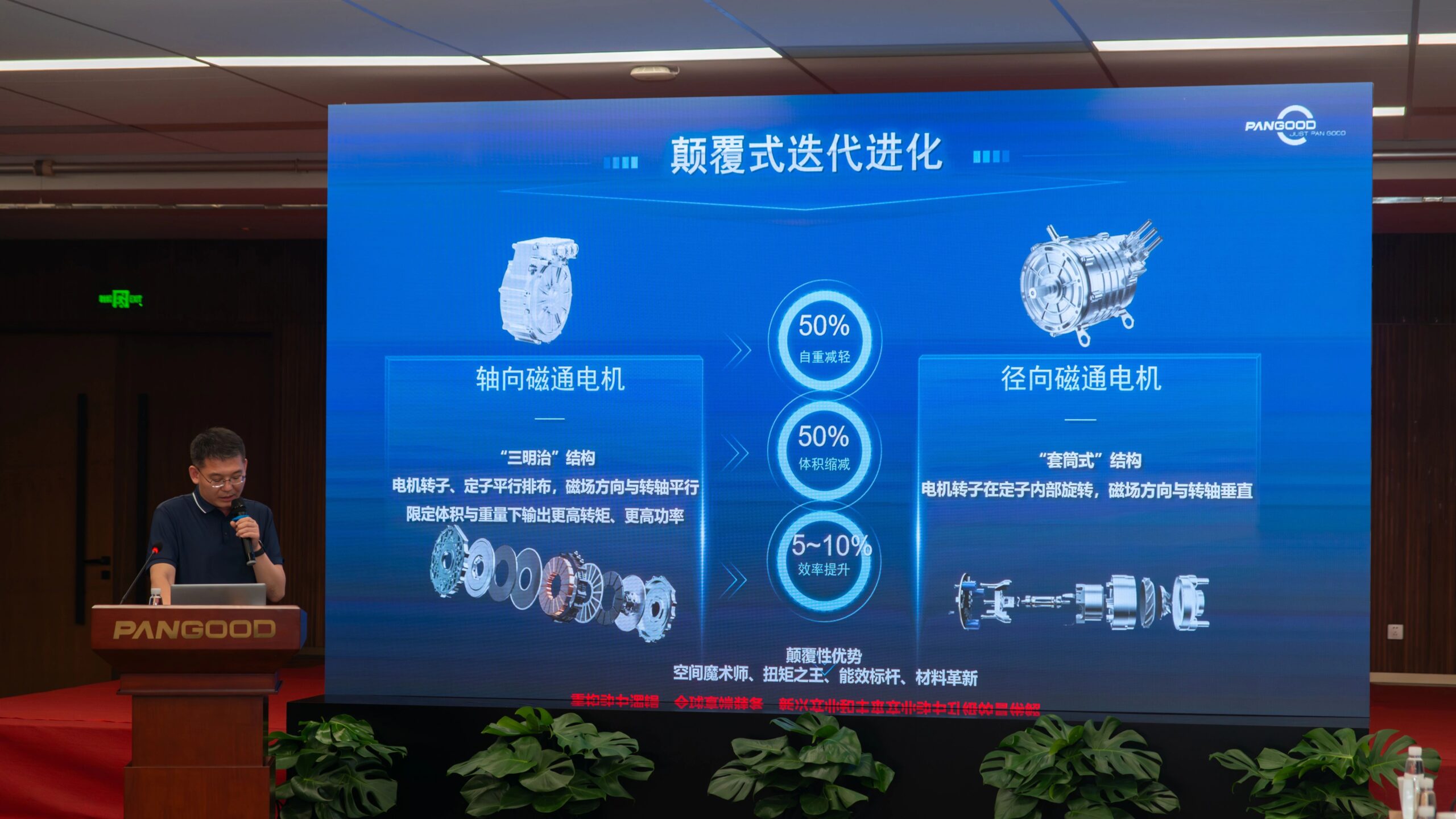
Axial-flux motors use a disc-shaped configuration in which the magnetic flux travels parallel to the shaft rather than radially through a cylindrical air gap. This topology can provide a shorter axial package and high torque density, but the large rotor diameter can make high-speed operation difficult because of centrifugal forces, rotor deformation and magnetic-force imbalances.
PanGood reports that the new motor exceeds 18,000 rpm while maintaining the stability required for continuous, high-load applications. The company describes this as a significant step for production axial-flux technology, which has traditionally been associated with high torque and compact packaging but more limited maximum rotational speeds.
The declared effective power density of 25.73 kW/kg is 42.94% above the target established for 2040 by China’s Energy-saving and New Energy Vehicle Technology Roadmap 3.0, according to PanGood. The company has not, however, disclosed in the announcement the motor’s rated output, peak output, complete system mass or the precise components included in the power-density calculation. The figure should therefore be interpreted according to PanGood’s definition of “effective power density”, rather than as a directly comparable whole-system specific-power value.
The manufacturer claims that, at equivalent output, its axial-flux architecture can reduce motor weight and axial length by approximately 50% compared with conventional machines. The compact package could provide vehicle designers with more space for battery modules, suspension components or passenger accommodation.
From electric vehicles to humanoid robots
The first target applications include new-energy vehicles, humanoid robots and low-altitude electric aircraft.
For automotive traction, the combination of high rotational speed and reduced axial dimensions is intended to support high-speed cruising, repeated acceleration and continuous high-load operation while helping manufacturers reduce drivetrain mass and improve chassis packaging.
PanGood axial-flux motors are already being used in distributed wheel-side drive systems for electric buses. The reduced dimensions of the drive units allow the motors to be installed close to the wheels, eliminating the need for a conventional central drivetrain and enabling a fully flat passenger floor. PanGood founder Han Jun said that this configuration allows an eight-metre bus to offer passenger capacity comparable with that of a conventional ten-metre vehicle.
A separate version developed for humanoid-robot joint modules reportedly reaches an assembly torque density of 293 Nm/kg, 22% higher than the benchmark product selected by the company. PanGood also claims an approximately 8% increase in peak output efficiency and a doubling of operating life for the joint-drive assembly. These values, like the automotive motor figures, are manufacturer-declared and have not been accompanied by a detailed third-party test report.
For electric aviation, the flat geometry and high power-to-weight potential of axial-flux machines could improve propulsion-system integration and thrust-to-weight ratio, although PanGood has not yet provided specifications for a flight-qualified motor derived from the new platform.
Materials and manufacturing move together
The development highlights how improvements in electric-machine performance increasingly depend on the simultaneous optimisation of electromagnetic design, materials, thermal management and manufacturing processes.
The Ningbo Institute research team worked with PanGood not only on the magnetic material, but also on the magnetic circuit, cooling system and overall motor integration. The partners say they developed production processes intended to improve component forming accuracy, assembly consistency and resistance to temperature cycling, vibration and ageing.
PanGood states that it has developed 16 categories of specialised motor materials, 93 types of dedicated production equipment and a manufacturing sequence comprising 151 processes. Its Lanxi facility in Zhejiang Province has an announced annual capacity of 300,000 large axial-flux motor and electric-drive units.
By May 2026, the company reported cumulative deliveries approaching 60,000 axial-flux motors and drive systems. Its portfolio covers power levels from 63 W to 1,200 kW and includes products for commercial vehicles, passenger cars, agricultural machinery, mining equipment, industrial fans, pumps and robotic systems.
The latest motor suggests that axial-flux technology is moving beyond its traditional role as a specialised high-torque solution. The decisive challenge will now be demonstrating that its headline power-density and speed figures can be maintained under continuous operation, automotive duty cycles and large-scale manufacturing conditions.