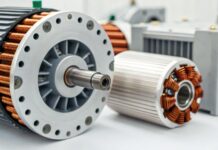
The European Commission has recently highlighted the progress of MAXIMA, a Horizon Europe project developing a modular axial-flux electric motor for automotive applications. The project combines multiphysics design, digital-twin technology, advanced magnetic materials and permanent-magnet recycling to support a more sustainable European EV supply chain.
As the European automotive industry accelerates its transition towards electric mobility, the performance of the electric traction motor is no longer the only engineering priority. Cost, manufacturability, recyclability, carbon footprint and exposure to critical raw materials are becoming equally decisive design constraints. This is the context in which the European Union-funded MAXIMA project — Modular AXIal flux Motor for Automotive — has been developed.
Launched in 2023, MAXIMA aims to design an affordable, adaptable and scalable axial-flux electric machine for the automotive sector. The project addresses one of the most strategic challenges in EV powertrain engineering: how to deliver compact, high-performance motors while reducing dependence on rare and critical raw materials, particularly those used in permanent magnets. According to the project description, MAXIMA focuses on a low-cost modular permanent-magnet axial-flux electrical machine for the automotive core market, with reduced environmental impact and improved performance.
Why axial flux matters
Axial-flux machines are attracting increasing attention in electric vehicle applications because of their potential for high torque density, short axial length and compact integration within vehicle architectures. Compared with conventional radial-flux machines, the axial-flux topology can offer packaging advantages, particularly where high torque and reduced motor volume are critical.
However, moving from promising topology to industrial-scale automotive deployment requires more than electromagnetic optimisation. Thermal management, mechanical integrity, manufacturability, cost control and end-of-life treatment must be integrated from the earliest design phase. This is where MAXIMA’s approach becomes particularly relevant.
A multiphysics design platform
A central pillar of MAXIMA is the development of an advanced multiphysics design and analysis platform. As explained by project coordinator Stéphane Clénet of Arts et Métiers ParisTech, the platform allows engineers and manufacturers to consider electromagnetic, structural and thermal performance together with recyclability from the beginning of the design process.
This is a significant shift from traditional sequential development workflows. In many motor programmes, recyclability and disassembly are assessed late in the product cycle, when the main architecture has already been fixed. MAXIMA instead treats circularity as a core design constraint. This enables optimisation not only for efficiency and power density, but also for modularity, manufacturability and ease of dismantling.
The same digital framework also supports a multiphysics digital twin. In practical automotive terms, this can enable real-time system monitoring, predictive maintenance and adaptive control. By correlating operating data with validated simulation models, the digital twin can help extend motor lifetime, improve reliability and optimise performance under real driving conditions.
Materials and manufacturing innovation
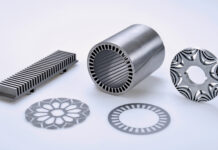
MAXIMA is also targeting the material layer of motor engineering. The project is working with a combination of soft magnetic composites and advanced electrical steels, optimised to reduce losses while maintaining production feasibility. These materials are being evaluated not only for electromagnetic performance, but also for manufacturing cost and environmental footprint.
This is particularly important for axial-flux machines, where flux paths, stator geometry and thermal behaviour differ significantly from more conventional radial-flux designs. Material selection must therefore be aligned with the specific topology of the machine, the expected duty cycle and the industrial production route.
According to the European Commission’s CORDIS coverage, MAXIMA is expected to deliver tested prototypes that combine these material and process innovations, with the goal of reducing both CO₂ footprint and production cost.
Closing the loop on permanent magnets
One of the most strategically important aspects of MAXIMA is its work on permanent-magnet end-of-life strategies. The project team has developed a recycling process in which neodymium-iron-boron magnets are recovered, purified and regenerated for reuse.
This is a crucial development because NdFeB magnets remain central to many high-performance electric traction machines, but their supply chain is exposed to geopolitical, environmental and economic risks. Recovering and reusing these magnets could reduce Europe’s dependence on primary rare-earth extraction and support a more resilient EV manufacturing ecosystem.
The process described by the project aims to preserve most of the magnets’ original properties despite contamination and operational wear. From an engineering standpoint, this is essential: recycled magnets must be compatible with demanding traction motor requirements, not only with low-performance secondary applications.
From prototype to automotive validation
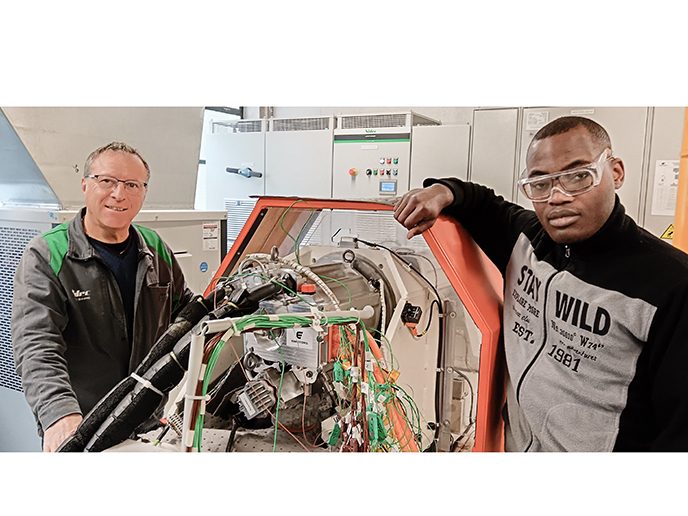
The next phase for MAXIMA is to use the technologies developed so far to build and test several motor prototypes in realistic automotive environments. The project roadmap includes scaling up prototype manufacturing, expanding recycling trials and refining life-cycle assessment models using real-world data.
This validation stage will be decisive. For any new electric machine concept, laboratory performance is only the first threshold. Automotive deployment requires durability, repeatability, cost competitiveness, thermal robustness and compatibility with high-volume production systems.
By 2027, MAXIMA aims to leave a tangible industrial legacy: a validated design and manufacturing methodology for circular, lower-impact, axial-flux traction motors. If successful, the project could contribute to three key European objectives at once: accelerating vehicle electrification, strengthening strategic autonomy in critical materials and advancing climate-neutral industrial production.