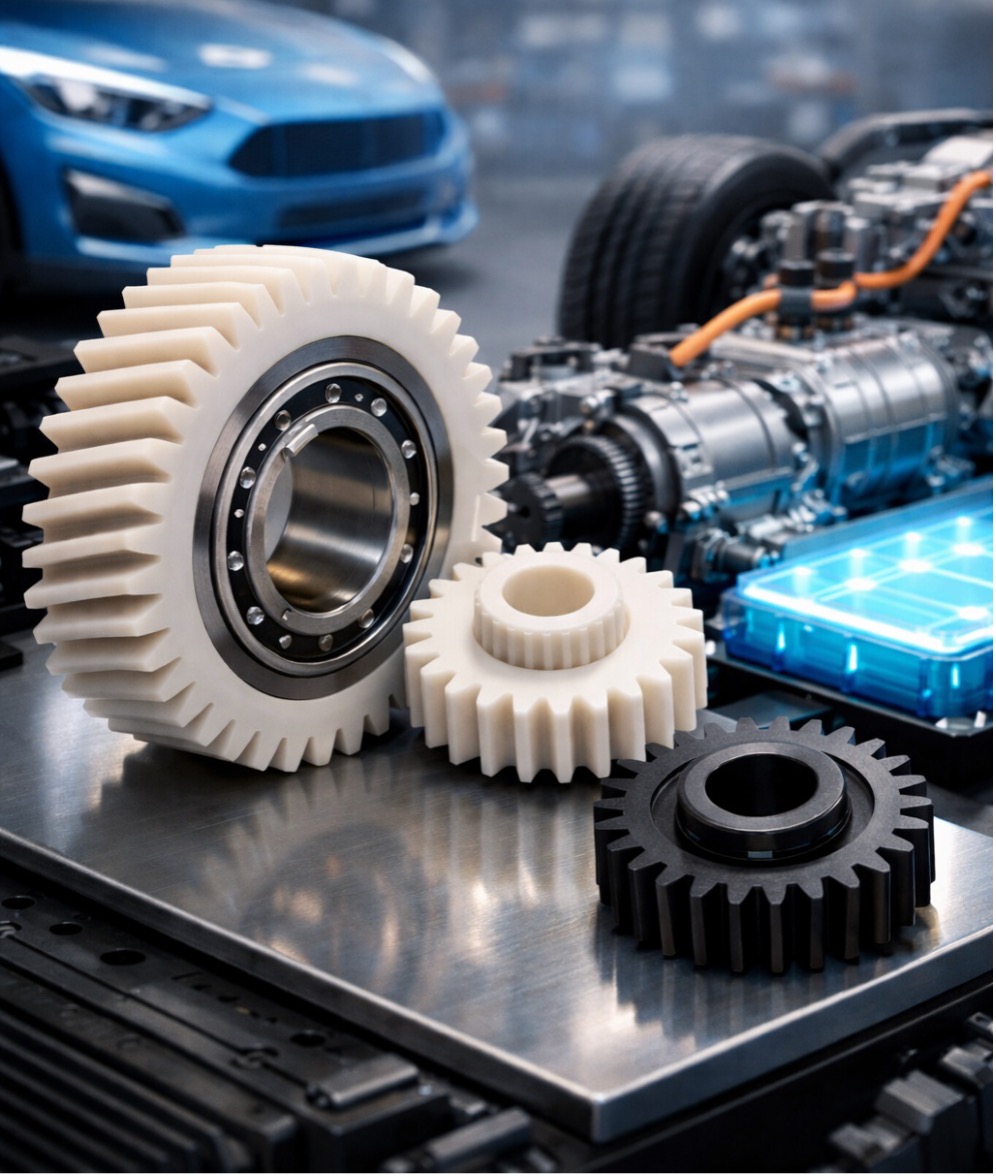
Polymer gears are playing an increasingly important role in modern engineering applications. Their use is no longer limited to secondary or low-load components but is progressively extending to critical functional elements. This evolution is closely related to the profound changes introduced by the electrification of powertrains, which imposes new requirements in terms of efficiency, acoustic behavior, reliability, and overall system sustainability.
Overcoming the traditional limitations associated with plastic materials has become possible thanks to the development of advanced polymer materials, particularly high-performance polymers such as reinforced polyamides, PPS (polyphenylene sulfide), and PEEK (polyether ether ketone). These materials enable operation under load, temperature, and durability conditions typical of electric vehicle transmissions, offering a favorable combination of low weight, mechanical strength, dimensional stability, and good tribological properties. These characteristics directly contribute to improving the overall efficiency of the transmission system and reducing mechanical losses.
In electric vehicles, the operating conditions of the powertrain differ significantly from those of traditional internal combustion systems. The high torque available at low rotational speeds, frequent and rapid variations in speed and torque, together with the increasing attention to noise and vibration reduction, make gear design a particularly critical aspect. In this context, polymer gears offer specific advantages, such as reduced rotating masses, vibration damping, and improved acoustic behavior.
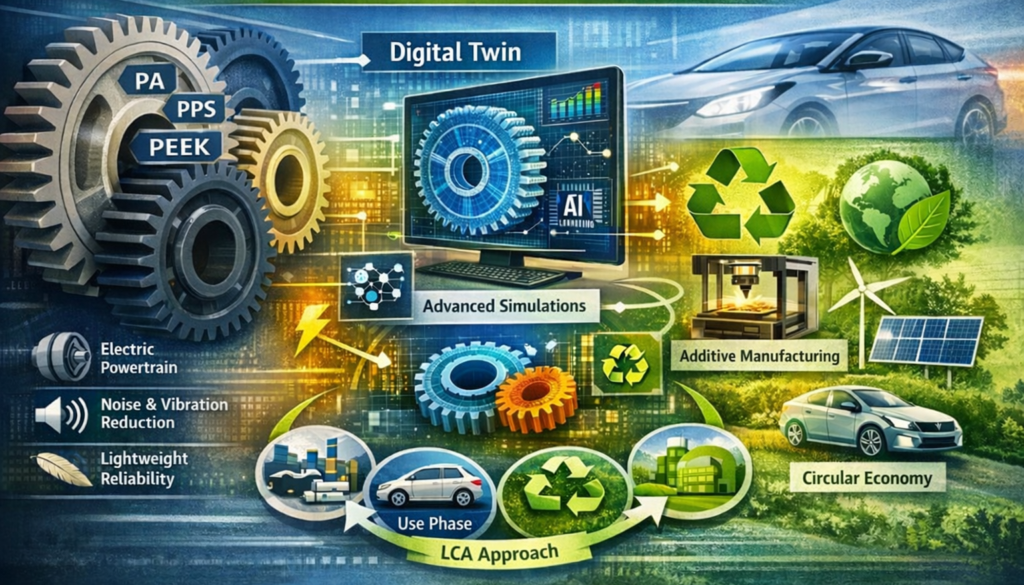
Fully exploiting the potential of polymer gears is closely linked to the adoption of advanced design and simulation approaches. The use of digital twins makes it possible to integrate multiphysics models capable of describing the mechanical, thermal, and tribological behavior of the component throughout its entire lifecycle, enabling the prediction of performance evolution and degradation mechanisms under real operating conditions.
At the same time, artificial intelligence and machine learning techniques can increasingly support the optimization of geometries, the selection of materials and process parameters, and the prediction of service life. This reduces the need for extensive physical testing and accelerates industrial development cycles.
Within this framework, material selection plays a central role not only from a performance standpoint but also from a sustainability perspective. The choice of high-performance polymers, possibly reinforced or tailored to specific application requirements, must be balanced with considerations related to environmental impact, recyclability, and compatibility with circular economy strategies. At the same time, design and manufacturing decisions from geometry definition to the choice of production technology, such as additive manufacturing (AM), significantly influence both component performance and its environmental profile throughout the entire lifecycle.
A systemic approach is therefore required, combining advanced design methodologies, digital tools, artificial intelligence, and sustainability criteria. Such a strategy is essential when the goal is to improve efficiency, reliability, and reduce the environmental impact of next-generation transmission systems.
Sustainability of manufacturing processes: LCA, Ecodesign and circular economy
In the context of electric mobility, the sustainability of transmission components must be assessed across the entire lifecycle, moving beyond evaluations limited solely to the manufacturing stage.
Within this framework, polymer gears represent a solution of increasing interest, as they combine mass reduction, potential improvements in energy efficiency, and opportunities for integration within circular economy models. However, these advantages must be quantified through structured methodologies, particularly through Life Cycle Assessment (LCA), to avoid purely qualitative or incomplete evaluations.
In LCA studies applied to electric vehicles (figure 2), the environmental impact of a component results from the contributions associated with the different phases of its lifecycle. These phases include resource extraction, material production, component manufacturing, the vehicle use phase, and end-of-life management. In this context, polymer gears stand out, when performing the same function, for their significantly lower density compared to traditional metallic solutions, resulting in reduced component mass and lower rotating masses within the transmission system.
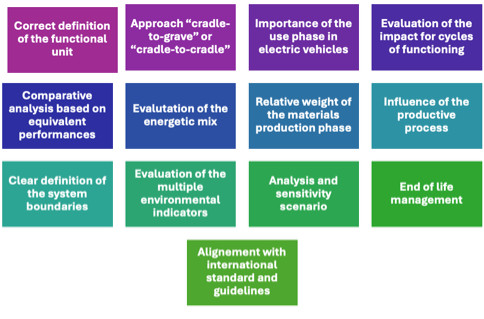
From an LCA perspective, the reduction of rotating masses plays a particularly important role during the vehicle use phase, since it directly affects electrical energy consumption throughout the entire operating cycle. Although the production of high-performance polymers may initially be associated with a relatively high environmental footprint, the lower energy demand required for vehicle operation and acceleration can compensate for, and in many cases outweigh, this disadvantage over the component’s service life.
This effect is particularly pronounced in the case of rotating components such as gears, for which the energy required for acceleration depends on the moment of inertia, a function of mass and its geometric distribution relative to the axis of rotation. Mass reduction therefore leads to lower energy requirements during start-up, acceleration, and speed variations, that are conditions typical of electric vehicle operation. In addition, a potential reduction in mechanical losses can also be observed. Lightweight gears may generate lower loads on bearings and reduced contact forces between teeth, resulting in decreased friction losses, especially when materials characterized by low coefficients of friction are employed.
In the powertrain of an electric vehicle, subject to frequent and rapid variations in speed and torque, the reduction of rotating masses therefore contributes to improving the overall efficiency of the system. Although the benefit associated with a single component may appear limited when considered individually, the cumulative effect over millions of operating cycles becomes highly significant from both an energy and environmental standpoint.
Another important aspect concerns the indirect nature of emissions associated with electric vehicles, which strongly depend on the energy mix used to generate electricity, a factor that varies over time and across geographical contexts. From an LCA perspective, reducing energy consumption during the use phase translates into lower CO₂-equivalent emissions and reduced impacts related to other environmental indicators, such as acidification, eutrophication, and primary resource depletion. Even relatively small percentage improvements in powertrain efficiency can therefore generate substantial environmental benefits when extended across the entire vehicle lifetime, high mileage, or large production volumes, as highlighted in comparative analyses between metallic and polymer-based solutions.
It is nevertheless important to consider that the high-performance polymers used to produce gears (such as reinforced polyamides, PPS, or PEEK) often present a higher initial environmental impact compared to steel or more common metallic alloys, both in terms of impact per unit mass and in terms of the energy required by manufacturing processes. However, in LCA analyses the decisive parameter is not the impact per kilogram of material, but rather the impact associated with the function performed (functional unit), namely the component’s ability to ensure a given performance level throughout its expected service life, also considering its interaction with the overall system within appropriately defined system boundaries.
When mass reduction is significant, the component operates for a large number of cycles, and its lifetime is comparable to that of the vehicle, the benefits achieved during the use phase tend to compensate for, and often exceed, the initial environmental impact associated with polymer production. This aspect is particularly relevant in electric vehicles, where powertrain efficiency represents a key factor both for vehicle range and overall sustainability. Conversely, insufficient service life, frequent replacements, or progressive performance degradation strongly penalize the LCA balance. When, instead, the gear maintains its performance over millions of cycles without significant degradation, the initial environmental impact is progressively diluted, making the polymer solution competitive and, in some cases, environmentally preferable to metallic alternatives.
Another key element for maximizing the sustainability of polymer gears is Ecodesign, understood as the systematic integration of environmental criteria during the stages of design. The principles of Ecodesign (figure 3) involve conscious material selection, favoring recyclable solutions or those with reduced environmental impact, as well as the simplification of architectures and the reduction of the number of components.
In electric vehicle transmissions, the growing attention to system modularity and accessibility makes it possible to design gears that are easily replaceable, enabling localized interventions and reducing the need to replace entire subsystems. This approach significantly contributes to lowering resource consumption and waste generation.
End-of-life management represents another important aspect to consider. Unlike metal gears, which are traditionally sent for remelting, polymer gears may follow alternative pathways, such as mechanical recycling, chemical recycling, or remanufacturing strategies. In particular, the regeneration or reuse of components that do not exhibit critical structural damage represents a promising solution for EV applications, enabling the extension of transmission system lifetimes and reducing the overall environmental impact associated with the production of new components.
In this context, additive manufacturing opens further opportunities in terms of sustainability and circular economy. The possibility of producing replacement gears on demand allows the reduction of inventory levels, transportation needs, and material waste, thereby supporting more flexible and localized production models. At the same time, the use of recycled or bio-based polymers, where compatible with the performance requirements of electric vehicle transmissions, represents a growing area of research and development.
The sustainability of polymer gears for electric vehicles is therefore the result of a systemic approach integrating LCA analyses, Ecodesign principles, end-of-life management strategies, and innovation in materials and manufacturing processes. Only through such an integrated vision can the full contribution of polymer gears to the transition toward truly sustainable electric mobility be realized.
Additive manufacturing as an enabler of sustainability
Additive manufacturing, when coherently integrated with LCA analyses and Ecodesign principles, represents a powerful enabler of sustainability for polymer gears used in electric vehicles. It allows targeted interventions across several phases of the component lifecycle, transforming both manufacturing approaches and end-of-life management strategies.
From a design perspective, AM enables the development of gears optimized according to “design for performance and sustainability” principles, in which the material distribution is tailored to the actual mechanical and tribological loads typical of electric vehicle transmissions.
Through integration with advanced simulation tools and by considering the outcomes of LCA analyses, it becomes possible to identify geometric configurations that maximize the performance-to-weight ratio, limiting material use in non-critical areas and reducing the environmental impact associated with the manufacturing phase. Regarding production, AM also overcomes some typical limitations of traditional processes, such as the high incidence of waste and the need for dedicated molds.
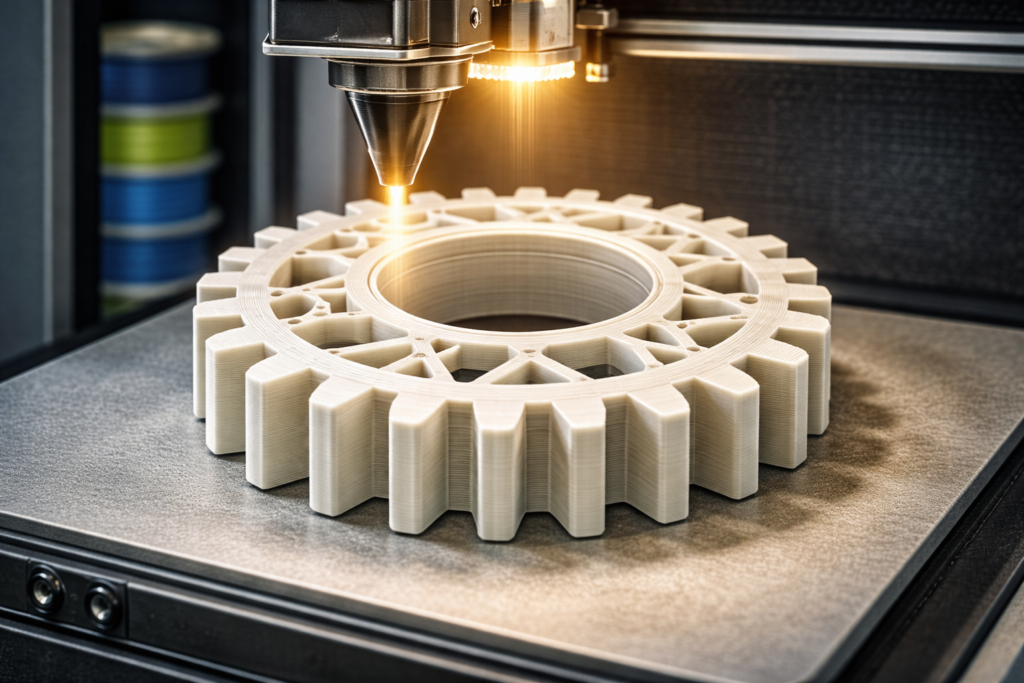
Additive production significantly reduces unused material and allows rapid adaptation of the component to design modifications or different application requirements, avoiding the need for oversized production batches.
From an LCA perspective, these advantages translate into a reduction of the environmental impact associated with the manufacturing stage, a particularly relevant aspect for gears produced from high-performance polymers or sustainable materials such as recycled or bio-based polymers. The benefits of AM also become particularly evident during the use phase and end-of-life management.
Consistent with LCA principles, the possibility of producing replacement gears on demand allows the extension of transmission system lifetime, reducing the need to replace entire subsystems in the case of localized damage.
In this context, AM supports remanufacturing and selective repair strategies, enabling the replacement of a single gear or specific functional elements, with significantly lower resource consumption compared to the production of entirely new components.
From an LCA perspective, extending the system’s lifetime represents one of the most effective strategies for reducing overall environmental impact.
Finally, the increasing compatibility of AM technologies with recycled or regenerated polymer materials opens new perspectives within a circular economy framework. In advanced scenarios, material recovered from end-of-life gears can be regenerated and reused to produce new components intended for less critical applications or aftermarket services.
This approach enables closing the material loop, reducing dependence on virgin polymers and further lowering the environmental footprint of transmission systems.
The integration of AM, LCA, and Ecodesign therefore represents not only a technological evolution but also a structural shift in the way polymer gears for electric vehicles are designed, produced, and managed, providing concrete and measurable sustainability benefits (figure 4).

Conclusions and future scenarios
Polymer gears today represent a technologically mature and increasingly strategic solution for electric vehicle transmissions, capable of making a tangible contribution to improving energy efficiency, acoustic quality, and the overall sustainability of the powertrain. The evolution of high-performance polymers has progressively reduced the functional gap with metallic materials, making it possible to employ polymer gears even in applications characterized by high loads, intensive operating cycles, and stringent requirements in terms of reliability and durability.
However, the real added value of these solutions emerges fully only when the component is designed, evaluated, and compared within a systemic perspective that considers the entire vehicle lifecycle and the interactions among materials, geometries, manufacturing processes, and operating conditions.
From a sustainability standpoint, evidence from LCA studies indicates that polymer gears can provide a favorable environmental balance, particularly thanks to the reduction of rotating masses and the resulting improvement in powertrain efficiency during the use phase. These benefits are especially relevant in the context of electric vehicles, where even apparently modest percentage improvements in system efficiency, when extended over the entire vehicle lifetime and large production volumes, can translate into significant reductions in overall environmental impact. For these advantages to materialize, however, it is essential to ensure stable performance over time, adequate durability, and the absence of premature replacements, which would compromise the LCA balance.
Looking toward future scenarios, one of the most important development areas concerns materials innovation. The integration of high-quality recycled polymers and high-performance bio-based materials represents one of the most promising, yet also most challenging, directions for EV transmission applications, due to the stringent requirements related to reliability, stability, and long-term performance.
Advances in material formulations, reinforcement systems, and functional additives could enable the combination of high mechanical and tribological performance with a significant reduction in the environmental footprint of the base polymer matrix. At the same time, the development of materials designed from the outset for recycling or remanufacturing will open new opportunities for the adoption of circular economy models even in components with high functional responsibility.
Another enabling factor for the future of polymer gears is the ongoing evolution of AM technologies. Beyond the already evident benefits in terms of waste reduction, production flexibility, and on-demand spare part manufacturing, AM offers new opportunities for functional design, such as topology optimization, integration of multiple functions, and the realization of internal geometries that cannot be achieved with conventional manufacturing processes.
In this perspective, these technologies may support localized production, reduced inventories, and more efficient end-of-life management strategies, including material reuse and component remanufacturing.
Finally, the integration of digital tools, such as digital twins, multiphysics simulations, and artificial intelligence, will make it possible to accelerate the development of optimized solutions while reducing the number of physical prototypes and improving the predictability of long-term performance. These tools will allow designers and engineers to evaluate more accurately the impact of material and process choices not only on mechanical performance but also on environmental indicators throughout the lifecycle.
In conclusion, the future of polymer gears for electric vehicles lies in the convergence of sustainability, materials innovation, and digitalization of engineering processes. The ability to integrate these dimensions in a coherent and systemic way will be decisive in making these components not only technically competitive but also fully aligned with the objectives of truly sustainable electric mobility.