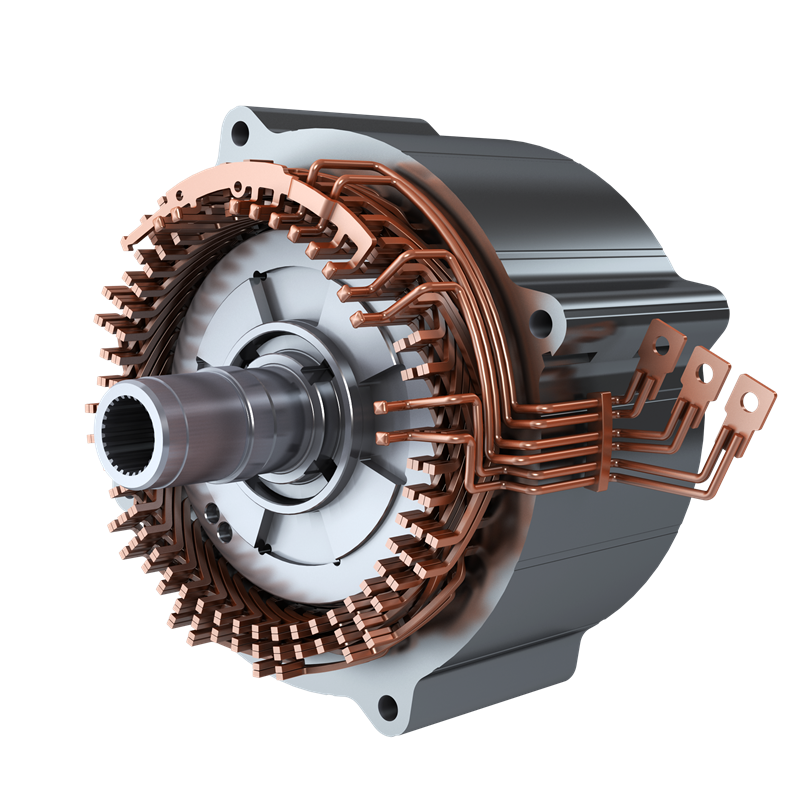
Horse Powertrain has unveiled a new dedicated hybrid transmission motor that, according to the company, achieves a peak efficiency of 98.2%. Called the Amorphous Motor, the unit delivers 140 kW and 360 Nm, while using an amorphous steel alloy stator to reduce iron losses and improve overall energy conversion. Horse says the technology can contribute to a 1% reduction in whole-vehicle fuel and power consumption in hybrid applications.
The core innovation lies in the stator material. Instead of conventional electrical steel laminations, HORSE uses amorphous steel, a soft magnetic alloy with very low core losses. In this motor, the stator layers are just 0.025 mm thick, about one tenth the thickness of those used in traditional motors. According to the company, this helps cut stator iron losses by 50% compared with equivalent designs
From an engineering perspective, this is important because stator iron losses are one of the main efficiency limits in electrified drivetrains, especially at higher switching frequencies and over broad operating ranges. Amorphous alloys are attractive because their non-crystalline structure reduces hysteresis and eddy-current losses. Proterial, a specialist in amorphous magnetic materials, states that amorphous alloy cores can reduce iron loss to around one third to one fifth of conventional silicon steel in suitable applications.
What makes the Horse announcement especially relevant is the application target. This is not a laboratory demonstrator, but a hybrid transmission motor intended for use in HEVs, PHEVs and range-extended EVs. That makes the development significant for OEMs still investing in highly efficient electrified combustion-based architectures, where even small gains in motor efficiency can improve fuel economy, emissions performance and thermal management. Horse explicitly positions the motor as a solution for the next generation of low-emission hybrid powertrains.
The broader technical significance is that this innovation comes from materials engineering rather than a radical motor topology change. The electromagnetic principle remains familiar, but the use of amorphous steel in the stator addresses one of the most difficult loss channels in electric machines. If HORSE can industrialize the material and manufacturing process at scale, the Amorphous Motor could mark an important step forward in the evolution of high-efficiency hybrid propulsion systems. A long-standing challenge with amorphous stators has been manufacturing complexity, an issue that industry sources have noted for years despite the material’s proven low-loss potential.