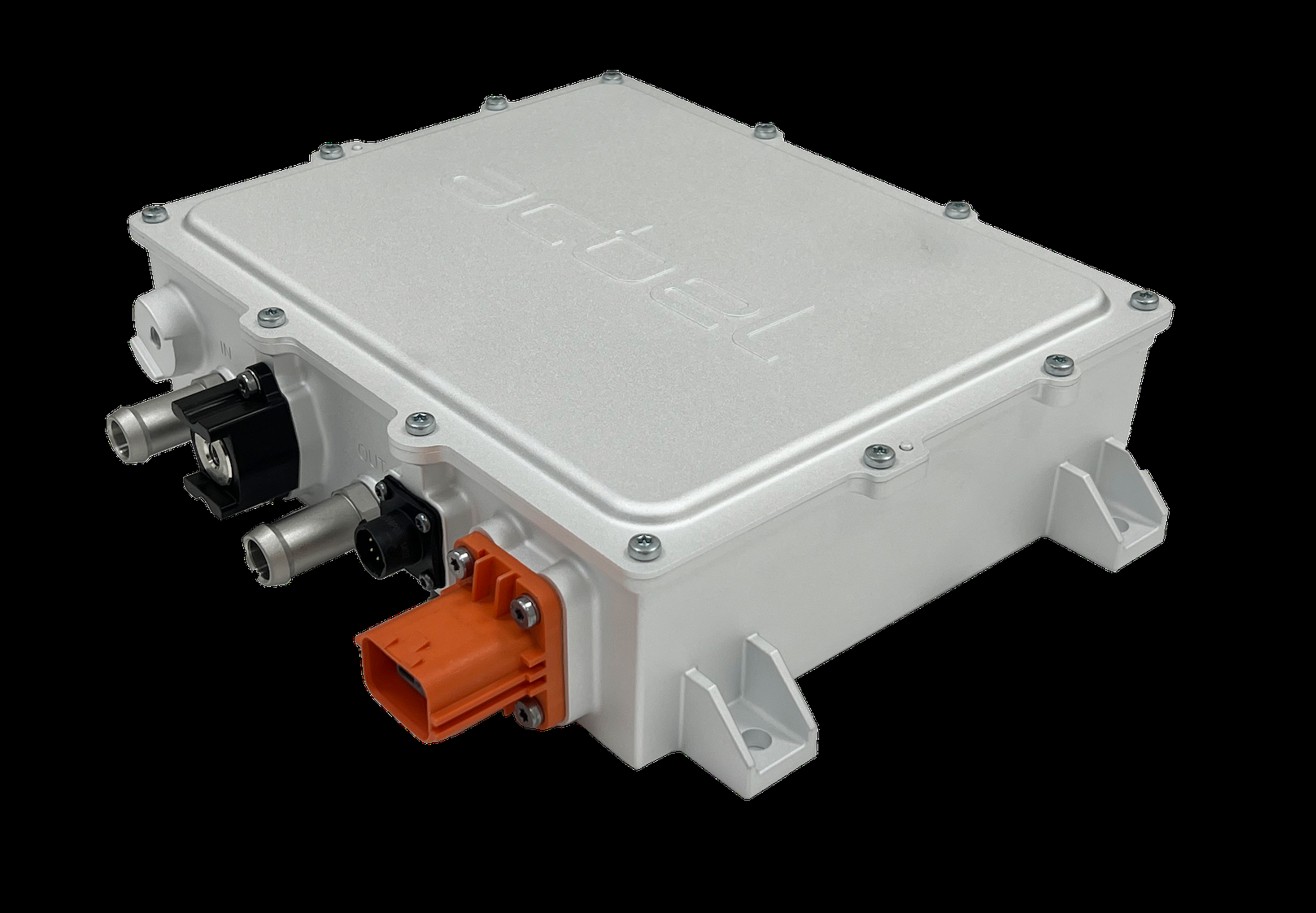
Acbel Polytech used Power2Drive Europe 2026 in Munich to present its latest electric vehicle power conversion technologies, placing particular emphasis on onboard charging, DC/DC conversion and charging infrastructure applications.
The company recently showcased a portfolio designed to address both vehicle-side power electronics and charging infrastructure requirements. The presentation came at a time when Europe’s electric mobility market is placing growing pressure on suppliers to deliver compact, efficient and scalable power conversion systems across 400 V and 800 V vehicle architectures.
According to the International Energy Agency, electric car sales in Europe reached 4.2 million units in 2025, equivalent to 28% of new car sales in the region. Public charging infrastructure also continued to expand, with the number of public charging points in Europe increasing by around 20% over the year. Against this backdrop, Acbel positioned its portfolio as a response to the parallel development of EV platforms and charging networks.
At the centre of the company’s display was its 400 V and 800 V 2-in-1 Combo series, which integrates an 11 kW onboard charger with vehicle-to-load functionality and a 3 kW DC/DC converter. The system is intended for multi-platform EV applications where high conversion efficiency, packaging integration and compatibility with different voltage classes are increasingly important design parameters.
The integration of onboard charging and DC/DC conversion reflects a broader trend in EV powertrain engineering, where component consolidation can help reduce system complexity, optimise weight and improve electrical architecture efficiency. The addition of V2L capability also broadens the use case of the vehicle beyond traction, enabling the battery pack to supply external electrical loads.
Acbel also presented standalone DC/DC converter products, including an 800 V to 48 V/12 V 6 kW dual-output converter and a 400 V to 12 V 3 kW converter. These units are designed for high-efficiency conversion across wide input voltage ranges and target auxiliary power distribution in electric vehicles. The 800 V to 48 V/12 V configuration is particularly relevant for next-generation EV architectures, where higher-voltage traction systems coexist with 48 V subsystems and conventional 12 V electrical loads.
The company said the featured power conversion products were developed in accordance with ISO 26262 automotive functional safety requirements. Selected products in the portfolio are also expected to obtain ISO 21434 cybersecurity certification in the third quarter of 2026, an increasingly relevant requirement as power electronics, charging interfaces and vehicle control systems become more software-defined and connected.
“Europe is one of the world’s key markets for electric vehicles and charging infrastructure, and it is an important region for Acbel’s international EV business development,” said Sven Lee, Vice President of Power and Energy Solutions Business at Acbel. “Through co-development programs with automakers in the United States and Japan, as well as with leading international charging infrastructure companies, Acbel has built a strong foundation in EV power applications. Our participation in Power2Drive Europe is an important step in bringing these capabilities closer to the European market.”
Lee added that the company aims to support vehicle manufacturers, charging equipment providers and charge point operators with reliable, efficient and scalable power solutions.
Beyond onboard conversion, Acbel also used the exhibition to display an EV charging infrastructure solution developed in partnership with ChargePoint. The move signals the company’s intention to extend its role from vehicle-side power systems to the wider charging ecosystem, including infrastructure-side applications.
Power2Drive Europe 2026 focused strongly on charging infrastructure, bidirectional charging, megawatt charging and smart charging, reflecting the increasing convergence between electric vehicles, grid infrastructure and renewable energy systems. For suppliers such as Acbel, this creates opportunities not only in onboard chargers and DC/DC converters, but also in the power electronics required to support more resilient and intelligent charging networks.