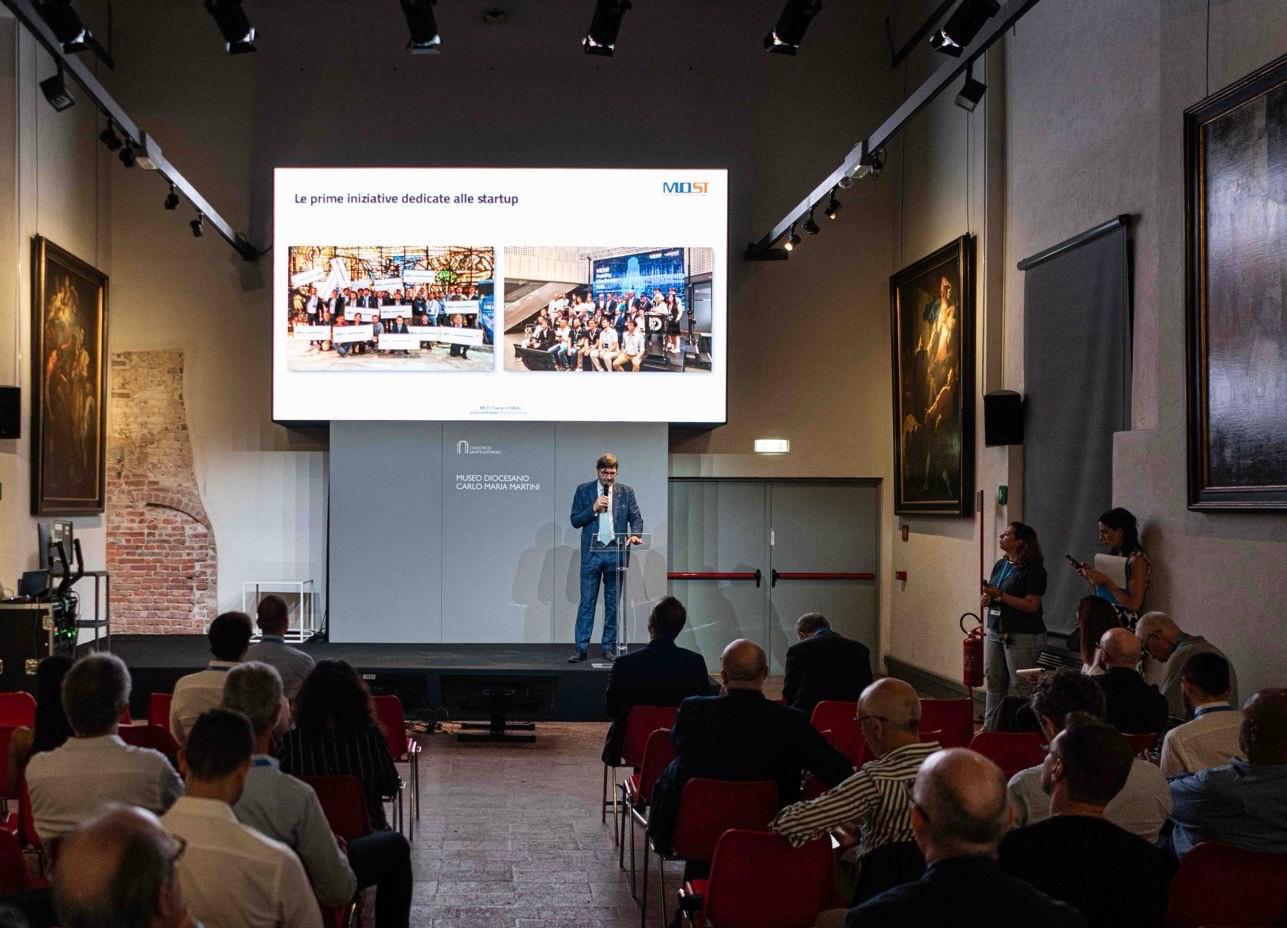
MOST – Centro Nazionale per la Mobilità Sostenibile has brought 40 startups and innovative SMEs together with large companies, investors, research bodies and institutions at the Investor Day “MOSTriamo il Futuro e incontriamo l’innovazione”, held at the Museo Diocesano in Milan. The initiative, supported by Regione Lombardia and Assolombarda, was designed to accelerate the transition from research to market for technologies linked to sustainable mobility.
Innovation is moving from isolated R&D projects to integrated platforms involving propulsion, batteries, charging, advanced materials, automation, IoT, autonomous driving, micromobility and digital traffic management.
MOST has activated more than €11.5 million to support innovation in sustainable mobility. The figure includes €8.5 million in grants awarded through three contest editions between 2024 and 2025, which collected more than 300 applications and selected 50 projects. A further €3 million has been allocated to minority investments in nine sector startups, selected through a public expression-of-interest procedure.
The ecosystem supported by MOST now includes 55 startups and innovative SMEs across 11 Italian regions, with around 300 professionals including researchers, entrepreneurs and technology teams. The solutions address key mobility challenges such as decarbonisation, congestion reduction, safety and accessibility, with applications ranging from Mobility as a Service to innovative propulsion, advanced materials, automotive, aerospace and maritime technologies.
The nine startups selected for minority investments presented their projects during the event: Arxax, Unicorn Mobility, Ulisses, Supair, Niulinx, Fast Charge Engineering, TrafficLab, Overspace Aviation and Velettrica. Their fields of activity cover intelligent traffic and logistics systems, electric micromobility, IoT asset tracking, advanced air mobility, batteries, autonomous driving and maritime solutions.
This range of applications is particularly significant for the electric motor industry. Sustainable mobility is no longer limited to vehicle electrification. It involves the entire enabling chain: electric drives, compact propulsion systems, battery architectures, charging infrastructure, embedded control, sensorized components and software-defined mobility services. Startups operating in these areas can become key technology suppliers for OEMs, fleet operators, infrastructure providers and industrial groups.
Gianmarco Montanari, Director General of MOST, said the challenge is no longer only to finance good ideas, but to create the conditions for them to become industry, market and real impact. According to Montanari, the acquisition of minority stakes in nine high-potential startups is intended to strengthen the relationship between research, capital and industrial demand.
The event also highlighted the role of open innovation. Federico Chiarini, President of the Young Entrepreneurs Group and Vice President for Startups at Assolombarda, underlined that innovation increasingly depends on connections between research centres, investors, institutions, companies and startups. In the Assolombarda area, which includes Milan, Monza Brianza, Lodi and Pavia, 21% of Italian startups are concentrated, generating 36% of the national turnover of the sector.
Regione Lombardia is also preparing a new measure dedicated to sustainable mobility and innovative startups, expected after the summer and supported also by European resources. Alessandro Fermi, Regional Councillor for University, Research and Innovation, said the measure will be built through dialogue with companies and the innovation ecosystem, with attention to the growing impact of artificial intelligence on mobility.
MOST is already looking beyond the national scale. The Centre is working to bring this experience to TRA 2028 – Transport Research Arena, the main European event dedicated to transport research and innovation. In that context, MOST will contribute to the design of a startup section, intended to create a structured matchmaking space for startups, research centres, companies and institutions.