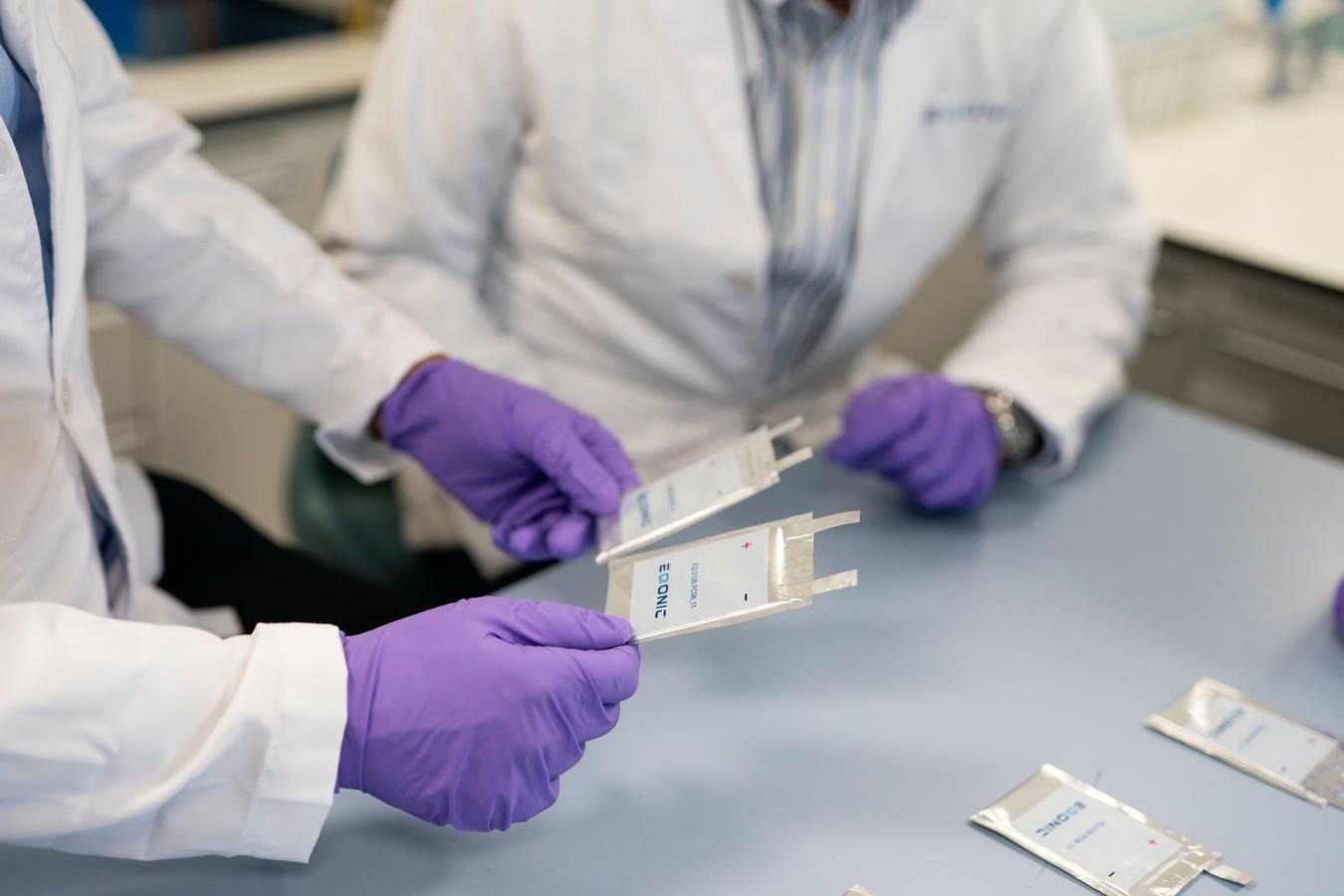
EQONIC has disclosed the aluminium-based chemistry behind its low-cost battery technology, designed without lithium, sodium or rare earths. The company is now moving the platform towards industrial validation, targeting a manufacturing cost of £50/kWh.
EQONIC Group has revealed that aluminium is the core material behind its low-cost battery technology and proprietary cell architecture. The announcement marks the first time the UK company has identified the material platform supporting its lithium-free, sodium-free and rare-earth-free technology.
According to EQONIC, the aluminium-based composite is now moving from laboratory development to industrial validation. This phase will involve testing at a larger scale to verify manufacturing feasibility, electrochemical performance and reliability under the production volumes required for commercial deployment.
A target of £50/kWh
The company states that the material cost of its technology could be reduced to approximately 30% of that associated with conventional lithium-metal batteries. EQONIC has also established a target manufacturing cost of £50/kWh once production reaches industrial scale.
Reaching this target could position the technology as a low-cost battery solution for electric mobility and stationary energy storage. However, the distinction between material cost and complete cell cost is significant. A finished battery cell also includes electrode processing, electrolyte filling, separators, current collectors, casing, formation, ageing, quality control and factory overheads.
The £50/kWh figure therefore remains a scale-up target rather than the demonstrated cost of a commercially available product.
EQONIC selected aluminium because of its abundance and the maturity of its international supply chain. The company argues that the material could reduce exposure to the price volatility, geopolitical concentration and export restrictions affecting several battery raw materials.
The technology is described as inherently non-flammable. EQONIC consequently expects its chemistry and architecture to prevent the thermal-runaway mechanisms associated with conventional battery systems. This characteristic could simplify pack-level safety engineering and thermal management, although it will need to be confirmed through independent abuse, propagation and certification testing.
Technical specifications still undisclosed
EQONIC has not yet released detailed information about the electrochemical system. The company has not specified the compositions of the anode, cathode and electrolyte, nor has it published data concerning nominal cell voltage, gravimetric and volumetric energy density, specific power, charge rate, cycle life, temperature range or round-trip efficiency.
The technology should therefore be described as aluminium-based, rather than more specifically as an aluminium-ion battery, until its charge-storage mechanism and electrode architecture are disclosed.
These parameters will determine its suitability for electric mobility. Low material cost and improved intrinsic safety would be valuable for electric vehicles, but automotive applications also require competitive energy density, fast-charge capability, long cycle life and stable performance across a wide operating-temperature range.
Pack integration will additionally depend on the behaviour of the cells under high-current acceleration, regenerative braking and repeated rapid-charging cycles.
“Confirming the chemistry is one part of the story; progressing towards industrial validation is the part that matters most,” said EQONIC founder and CEO Jas Kandola.
From laboratory development to manufacturing
Industrialisation is being supported by the development of a full-stack digital twin of the manufacturing process. EQONIC said it was selected for the UK Government’s Battery Innovation Programme, delivered by Innovate UK with support from the Department for Business and Trade.
The digital model is intended to help the company optimise production processes and accelerate its transition towards industrial-scale manufacturing. EQONIC also offers battery energy storage systems and identifies electric-vehicle battery packs and transport infrastructure among its target applications. However, the newly disclosed aluminium platform has not yet reached commercial production.
Its prospects as a competitive low-cost battery technology will depend on the results of the forthcoming validation programme and, in particular, on whether the company can demonstrate its cost, safety and performance targets at both cell and pack level.