Why 3D-printed linear electric motor could change how drives are designed? A failed electric motor can shut down an automated line for hours while a replacement is sourced, shipped and installed. In response, a team at MIT has demonstrated a new approach: a multimaterial 3D-printing platform that can fabricate complete electric machines in a single manufacturing process, directly where they are needed.
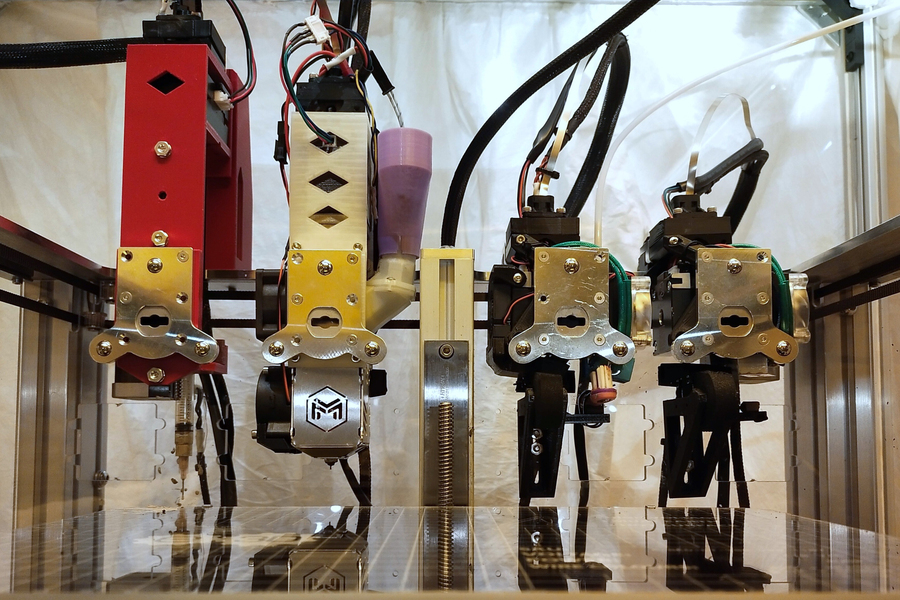
The researchers modified an existing printer by adding four different extrusion heads, each dedicated to a specific type of material: standard polymers, pellets, conductive inks and magnetic materials. The goal is to combine in one continuous process all the functional “building blocks” of an electric machine: conductors for current flow, insulating dielectrics and permanent magnets for the magnetic field.
The platform works layer by layer: each print head deposits its material in turn, while a sensor-guided control system steers the robotic arm, aligns the nozzles and switches tools automatically. Precise registration between layers is critical, because small alignment errors would translate into higher losses, possible short circuits or unwanted mechanical play in the finished motor.
Conductive inks were one of the most challenging elements to integrate, as they require pressure-based dispensing and must solidify without excessive heat or UV exposure that could damage surrounding insulating materials. This forced the team to balance electrical performance, printability and compatibility across all materials loaded into the system.
The demonstrator: a 3D-printed linear motor in three hours
To validate the platform, the team chose a linear motor, an actuator that delivers translational motion rather than rotation and is commonly used in pick-and-place systems, baggage handling and precision positioning stages. The prototype was fabricated entirely by 3D printing, using five different materials, with a total print time of roughly three hours.
The only post-print operation is magnetizing the “hard” magnetic materials to activate the motor’s magnetic circuit. The researchers estimate the total material cost per motor at around 50 US cents, which could be highly competitive in applications where fast replacement or high customization is more important than large-volume mass production.
In terms of performance, the printed linear motor was able to generate an actuation force several times higher than that of a commercial linear motor that relies on complex hydraulic amplification. This indicates that multimaterial 3D printing is not just a proof of concept, but can approach or even exceed the performance of established industrial solutions.
What this means for motor designers and manufacturers
For the electric motor industry, the most compelling prospect is shifting from a global supply chain to distributed, on-demand manufacturing. In maintenance scenarios, machine builders or end users could print customized motors or actuators on site, reducing downtime and dependence on centralized spare-part warehouses.
For design engineers, such a platform opens the door to new geometries and integration strategies: windings, magnets, structural parts and mechanical interfaces can be conceived from the outset as a single monolithic object, rather than separate components to be assembled. This could enable more compact motors with optimized flux paths, as well as tighter integration of sensors and even power electronics directly into the motor body.
Multimaterial additive manufacturing also promises lower waste: only the necessary material is deposited exactly where it is needed, without the chips, offcuts and scrap typical of subtractive machining. In a context of accelerating electrification and growing demand for specialized motors in robotics and electric vehicles, this can translate into both economic and environmental benefits.
Current limitations and next steps
The MIT platform is still a laboratory demonstrator, and several hurdles must be overcome before it can be deployed on factory floors: long-term reliability, throughput and standardized material sets are key open issues. At present, magnetization of the permanent magnets is still a separate process, requiring dedicated fixtures and equipment.
The research team aims to incorporate magnetization into the printing workflow, achieving true “single-step” fabrication of fully functional motors. Future targets include 3D-printed rotary motors and additional toolheads to embed power electronics and sensing directly during the print.
If these goals are met, the crucial question for professionals in the electric-motor sector will be when—and for which niche applications—it becomes worthwhile to replace parts of the conventional production chain with multimaterial additive systems capable of printing a motor “on demand,” directly at the point of use.