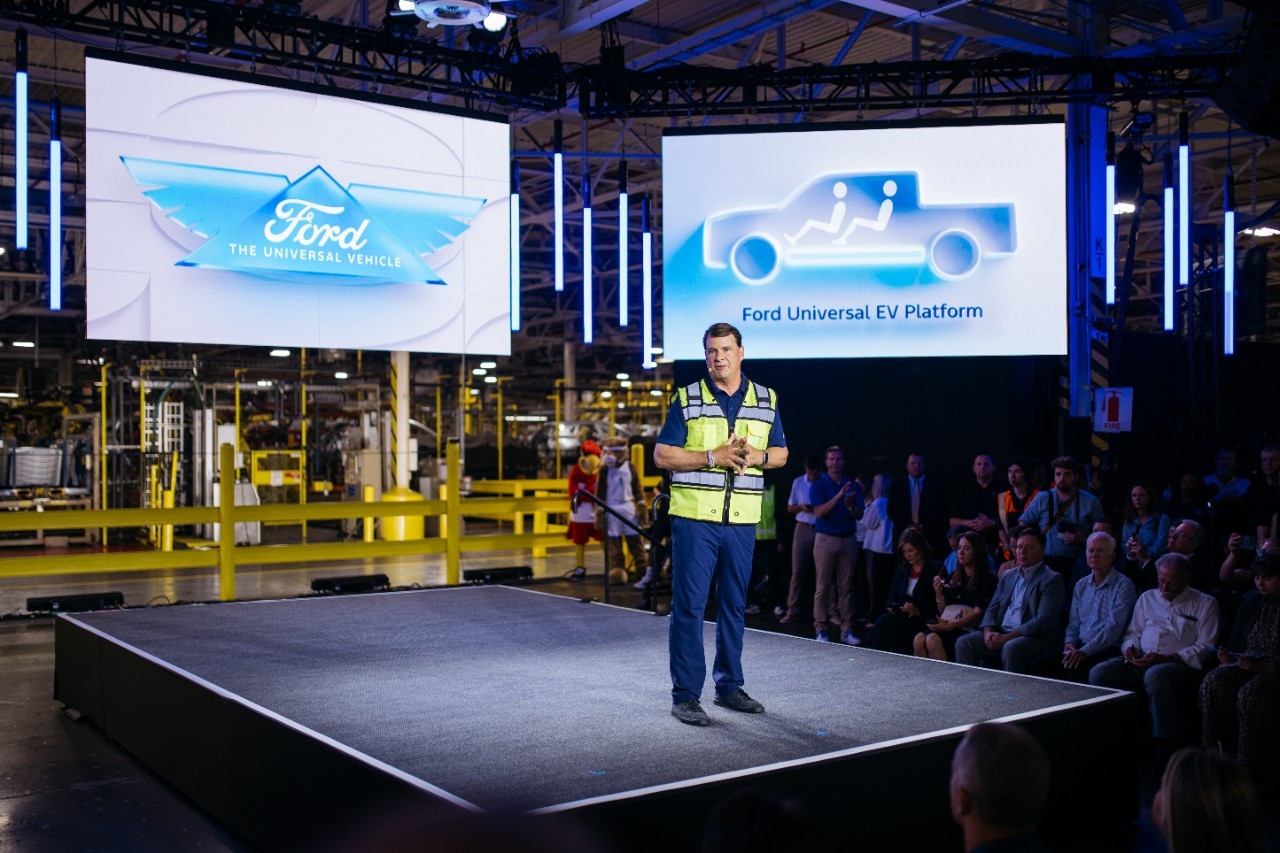
Ford is betting heavily on a new “Universal EV Platform” that aims to reset the economics of battery‑electric vehicles, even if, for now, its horizon is firmly anchored in the United States and surrounded by uncertainty in Europe. This is the first fully electric architecture developed in‑house by the company to underpin an entire family of more affordable EVs, ranging from midsize pickups to compact SUVs, while promising both lower production costs and improved driving performance.
At the heart of Ford’s strategy is a midsize, four‑door electric pickup that will debut the Universal EV Platform. Ford plans to build it at the Louisville Assembly Plant, with a targeted starting price of about 30,000 dollars and market launch in 2027 for the U.S. and selected export markets. The manufacturer claims performance on par with a Mustang EcoBoost in the sprint from zero to 60 mph, combined with more passenger space than the latest Toyota RAV4, plus the dual practicality of a front trunk and a traditional cargo bed.
Technically, the platform is designed to attack complexity and cost at their roots. Ford reports a 20 percent reduction in the number of parts compared with a typical vehicle, 25 percent fewer fasteners and 40 percent fewer workstations along the line, resulting in assembly times up to 15 percent faster. One of the most emblematic examples is the wiring harness of the new pickup, which will be more than 4,000 feet shorter and 10 kilograms lighter than that of Ford’s first‑generation electric SUV, with clear advantages in terms of manufacturing, weight and reliability.
Energy storage is entrusted to prismatic lithium iron phosphate batteries, free of cobalt and nickel, used as a structural element of the vehicle’s floor. This choice allows the pack to become a load‑bearing component, lowering the centre of gravity, improving handling and cabin quietness and freeing up additional interior space.
Equally radical is the rethink of how these vehicles will be built. Alongside the new platform, Ford is introducing what it calls the Universal EV Production System, which replaces the traditional linear assembly line with an “assembly tree”. Instead of a single conveyor, three main sub‑assemblies – the front section, the rear structure, and the structural battery module already fitted with seats, console and carpets – are built in parallel and then joined at a later stage.
From an industrial standpoint, the project is backed by roughly 5 billion dollars in investment split between the Louisville plant and BlueOval Battery Park Michigan, where the prismatic LFP cells for the pickup will be produced, with a total of about 4,000 jobs created or secured.
For the electric‑vehicle industry, the Ford Universal EV Platform is therefore a revealing test case. On one side, it showcases how much room remains to cut costs and complexity through structural batteries, new assembly concepts and aggressive simplification of vehicle architecture. On the other, its ambiguous prospects in Europe highlight the growing divergence between regional markets and the difficulty, even for a global player like Ford, of developing a truly universal electric platform that is economically viable on both sides of the Atlantic.