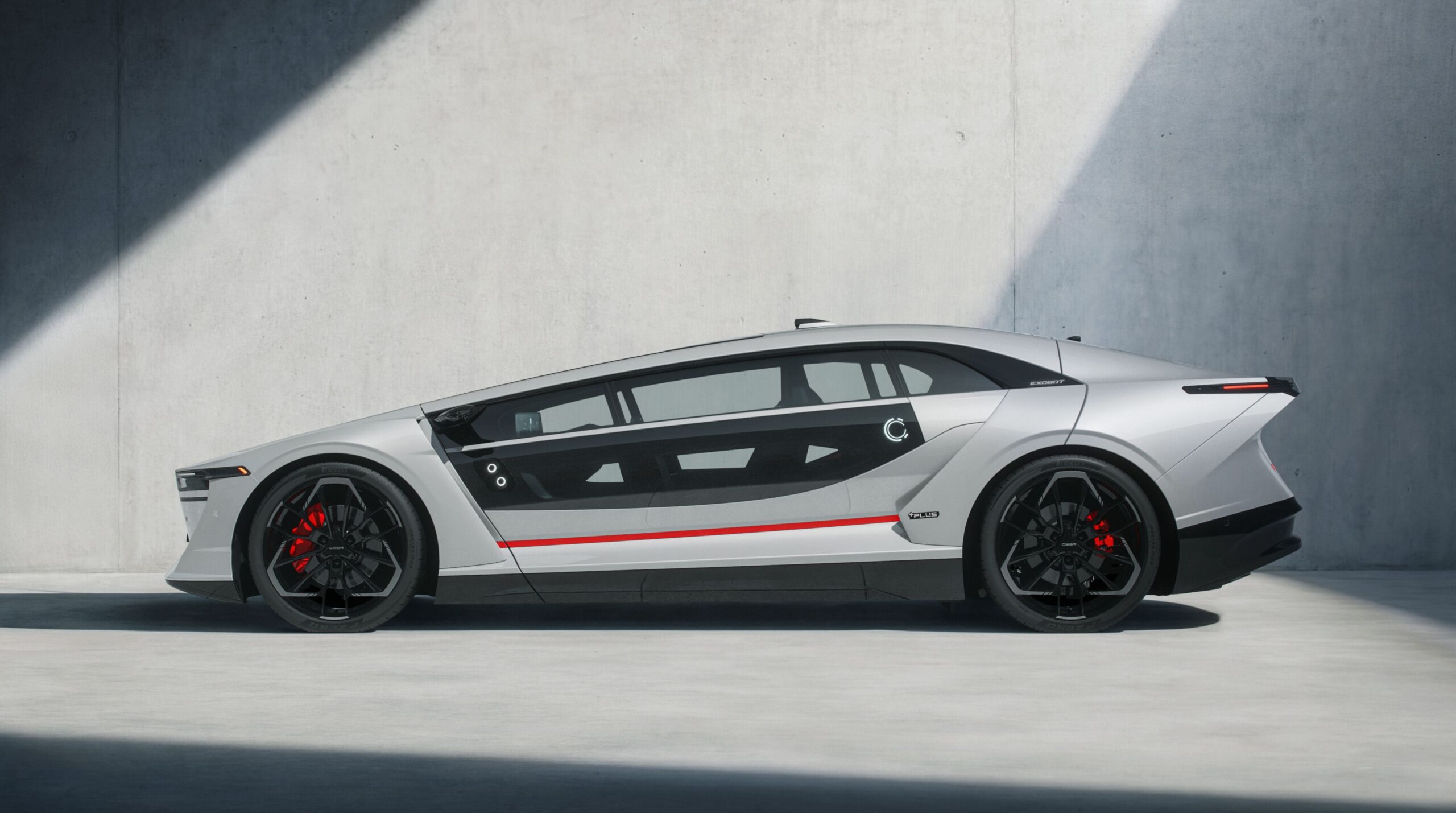
Saudi Arabia’s CEER has unveiled the EXOBOT electric sedan and SUV, built around a tri-motor all-wheel-drive powertrain, an 800 V electrical architecture and a 112 kWh battery. The platform is designed to reach up to 1,111 hp in its highest-performance configuration.
CEER has presented its first flagship electric vehicles, the EXOBOT Sedan and EXOBOT SUV, introducing a new high-performance electric platform developed for the Saudi Arabian and regional markets. The two models share a tri-motor all-wheel-drive architecture, with continuous torque vectoring and an active chassis control strategy intended to manage the very high torque available from the electric propulsion system.
At the upper end of the platform’s specifications, CEER quotes 1,111 hp and 1,500 Nm, with the sedan accelerating from 0 to 100 km/h in 2.1 seconds and reaching 250 km/h. The corresponding SUV completes the acceleration test in 2.4 seconds, with a maximum speed of 210 km/h.
However, these figures should be distinguished from those of the EXOBOT First Edition, the initial version of the vehicle. Its three-motor drivetrain develops 850 hp and 1,000 Nm, enabling 0–100 km/h acceleration in 2.6 seconds for the sedan and 2.9 seconds for the SUV.
Three electric machines and active torque distribution
From an electric-drive perspective, the main engineering feature is the use of three traction machines rather than the more conventional single- or dual-motor configuration.
The architecture allows propulsion torque to be distributed between the axles and, depending on the individual drive-unit arrangement and control strategy, provides greater scope for active yaw control and torque vectoring. CEER states that continuous torque vectoring is integrated with the vehicle’s active chassis systems to control stability, agility and traction.
The powertrain also reflects a supplier strategy involving established electric-drive specialists. In 2024, CEER signed a USD 2.18 billion agreement with Hyundai Transys for electric drive systems. The technology supplied by Hyundai Transys integrates the electric motor, inverter and reduction gearbox into a single three-in-one EDS unit, an approach designed to reduce packaging volume and mass while limiting electrical and mechanical interfaces.
CEER subsequently announced a partnership with Rimac Technology for high-performance integrated electric drive systems for its flagship EV range. Rimac described the programme as a move from its traditional limited-volume performance applications towards production of electric drive systems in significantly larger volumes.
CEER has not yet published a complete engineering breakdown specifying the output, motor topology or inverter technology of each individual EXOBOT traction unit. This leaves some relevant details — including individual front/rear motor ratings and semiconductor technology — still to be disclosed.
800 V architecture and 112 kWh battery
The First Edition is equipped with a 112 kWh high-voltage battery and an 800 V electrical architecture. CEER claims a 10–80% charging time of less than 30 minutes.
Moving to an 800 V system is particularly relevant for a vehicle combining high peak propulsion power with fast-charging requirements. For a given power level, increasing system voltage reduces current, potentially lowering resistive losses and allowing smaller conductor cross-sections, while also placing specific requirements on inverter components, insulation, DC-link design and thermal management.
CEER quotes an estimated driving range of up to 670 km for the sedan and 560 km for the SUV, although these figures are based on the NEDC cycle rather than the more recent WLTP procedure used for most new EVs sold in Europe. They should therefore not be interpreted as directly equivalent to WLTP range figures.
Thermal management designed for extreme temperatures
Thermal management is another significant aspect of the EXOBOT engineering programme. The vehicles have been developed specifically for operation in the high ambient temperatures typical of Saudi Arabia and the wider Middle East.
CEER refers to its thermal-management solution as Halo Cooling and states that the system was designed for sustained operation under high thermal loads. The company claims that, under extreme conditions, the climate-control system can reduce cabin temperature from 65 °C to 32 °C within ten minutes. Special glazing, reflective coatings and controlled airflow around the roof are also used to reduce solar heat gain.
For an electric vehicle, this operating environment is particularly demanding because propulsion motors, power electronics, battery cells and the passenger compartment compete for thermal-management capacity.
EXOBOT also introduces steer-by-wire, removing the conventional mechanical steering column between the steering control and the front wheels. CEER says steering input is reduced from approximately 400 degrees to 160 degrees. Rear-wheel steering is added to improve manoeuvrability at low speed and vehicle stability at higher speeds.