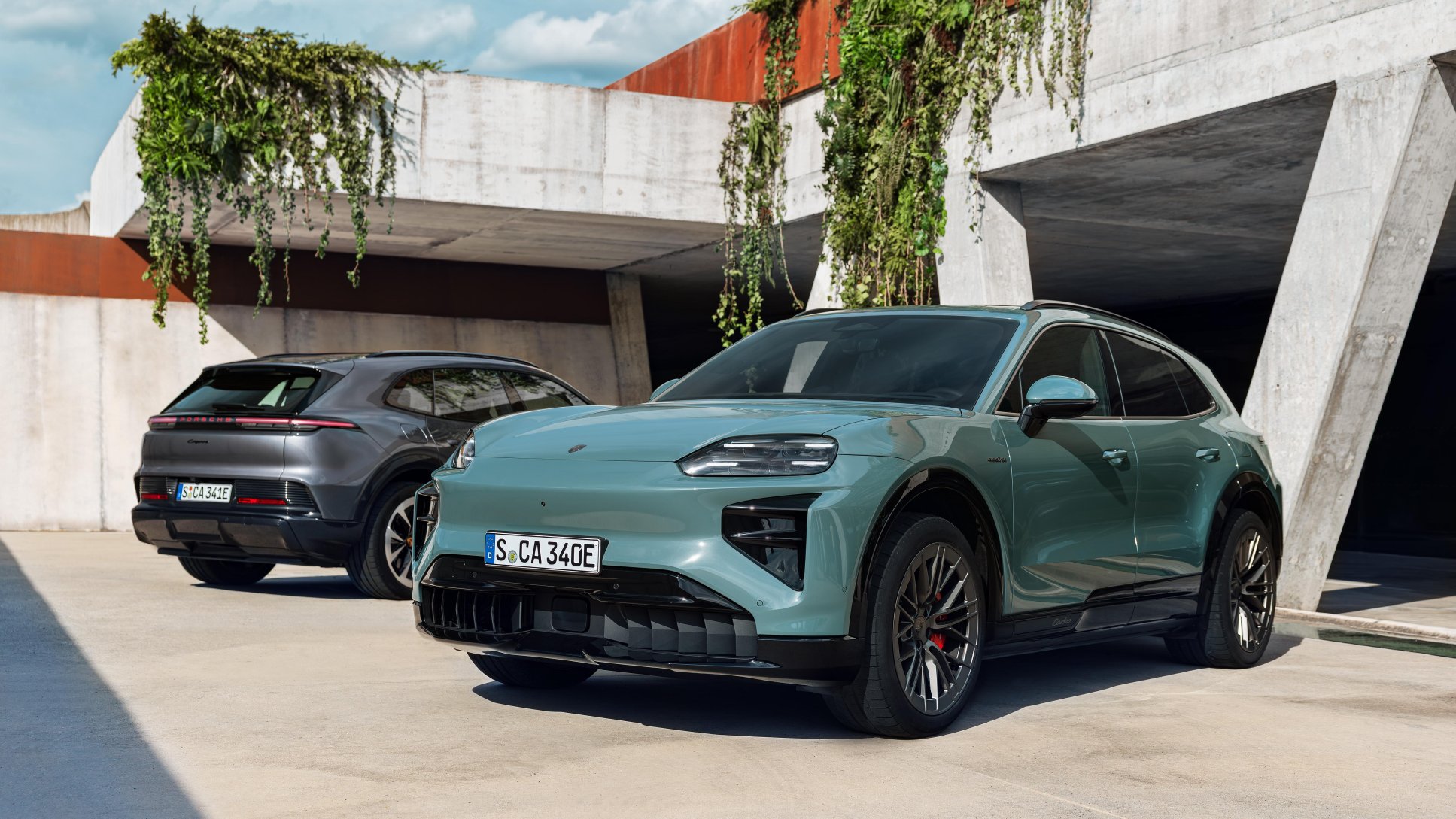
Porsche’s first all‑electric Cayenne is less about fireworks and more about showing how far a heavyweight SUV can push today’s EV hardware, starting from the powertrain and then translating it into performance figures that sit uncomfortably close to supercar territory.
The Cayenne Electric range launches with two dual‑motor, all‑wheel‑drive versions: Cayenne Electric and Cayenne Turbo Electric, both managed by an electronic Porsche Traction Management system rather than a mechanical transfer case. The standard Cayenne Electric delivers 300 kW in normal driving and up to 325 kW with Launch Control, with peak torque of 835 Nm, figures that would have defined a performance SUV only a few years ago.
The Turbo Electric turns the dial much further, with up to 630 kW available in regular driving and a temporary 130 kW boost through a Push‑to‑Pass function, taking overboost power to 850 kW and 1,500 Nm when Launch Control is engaged. On the rear axle, Porsche adopts a directly oil‑cooled electric motor with a 900 A silicon‑carbide inverter, a solution derived from motorsport that is designed to sustain high continuous output rather than just headline peaks.
Both variants use a new 113 kWh high‑voltage battery with double‑sided cooling, an architecture chosen as much for thermal stability under repeated hard use as for range. Energy recovery is central to the efficiency strategy: recuperation power reaches up to 600 kW, with around 97% of everyday braking handled by the motors rather than the friction brakes, a figure that hints at how aggressively the system is tuned.
Charging, range and real‑world use
The 800‑volt electrical system supports DC fast‑charging at up to 390 kW, with brief peaks up to 400 kW under ideal conditions, allowing a 10–80% charge in under 16 minutes. In practical terms, ten minutes at a suitable high‑power charger adds about 325 km of range for the Cayenne Electric and 315 km for the Turbo, numbers that matter more on a winter motorway than the brochure’s maximum values.
Officially, the Cayenne Electric offers up to 642 km of combined WLTP range, while the Turbo Electric drops only slightly to 623 km despite its power advantage, a sign that Porsche has tuned aerodynamics and power management to keep the consumption gap in check. For home or depot scenarios, inductive wireless charging up to 11 kW is available as an option, with the car starting the process automatically when parked over a floor plate, a convenience feature clearly aimed at owners who will rarely touch a cable.
Performance numbers in context
On paper, the Cayenne Turbo Electric reads like a tall supercar: 0–100 km/h in 2.5 seconds, 0–200 km/h in 7.4 seconds and a top speed of 260 km/h, all in a vehicle that weighs around 2,750 kg. The standard Cayenne Electric is hardly slow, hitting 100 km/h in 4.8 seconds and 230 km/h, performance that will be more than sufficient for most buyers but that leaves the Turbo as the clear halo model.
Those numbers are backed up by a chassis that tries to reconcile physics with marketing: both versions get adaptive air suspension with Porsche Active Suspension Management, while the Turbo adds a locking rear differential with Torque Vectoring Plus and can be specified with the new Porsche Active Ride system, which works to counteract body movements almost entirely. Rear‑axle steering, available on both, turns up to five degrees, helping disguise length and weight in tight spaces and at speed, but it also underlines how much engineering is required to keep a 4.985‑metre, 2.75‑tonne SUV feeling agile.
Optional off‑road packages, 3.5‑tonne towing capacity and generous luggage space from 781 to 1,588 litres plus a 90‑litre front trunk position the Cayenne Electric as a do‑everything flagship, but they also cement its role as an object of versatility and status rather than necessity. In that sense, the car becomes a litmus test for the next phase of premium electric mobility: a showcase for what current battery, motor and charging technology can deliver when cost and weight are allowed to climb, and a reminder that efficiency and excess still coexist uneasily in the electric age.