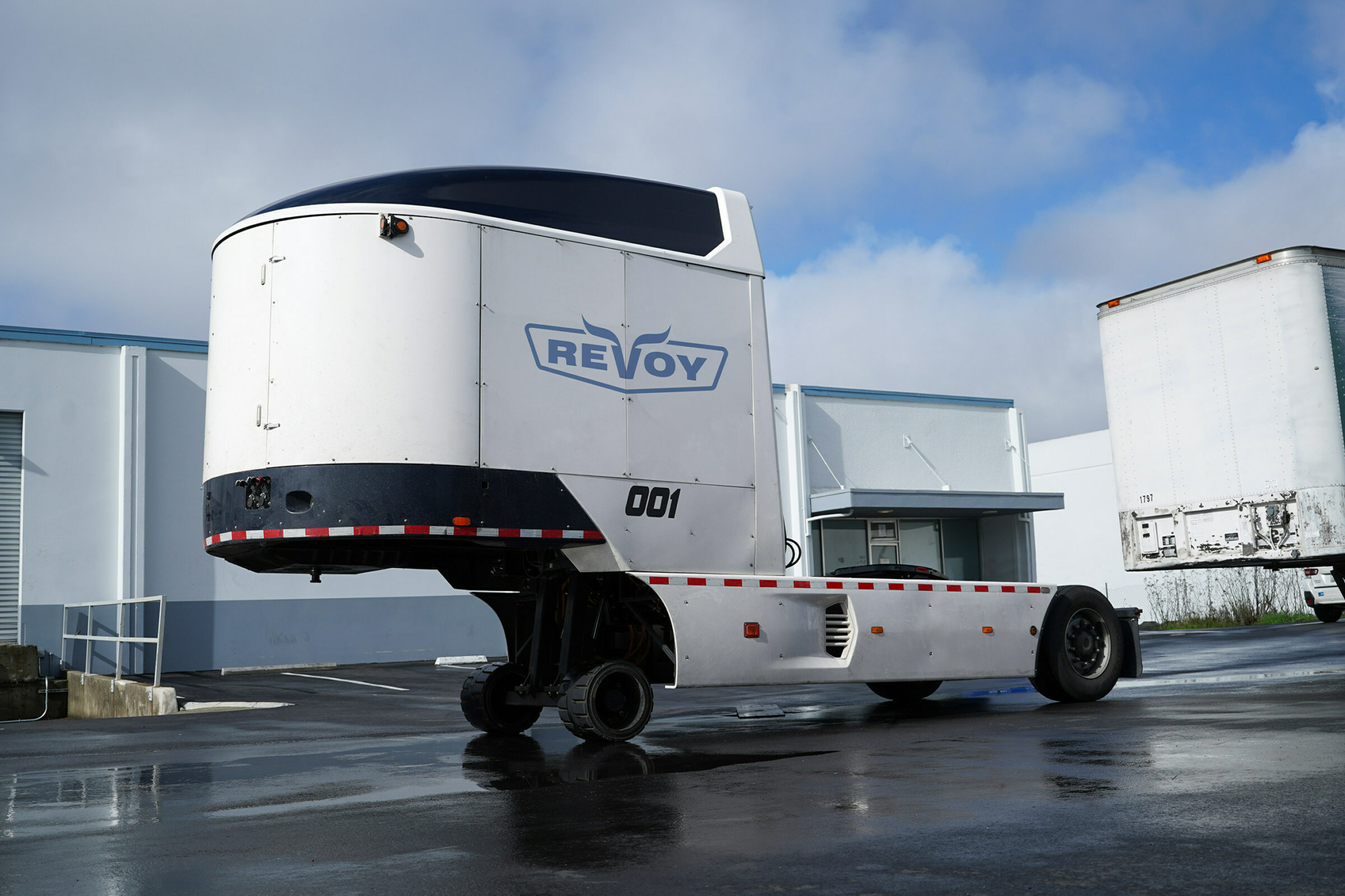
US startup Revoy has raised $27 million in Series A funding to advance its electric-powered dolly for heavy-duty trucks. Positioned between a conventional diesel tractor and semi-trailer, the system uses a battery-fed electric drive axle to supply additional traction torque and recover energy during braking, effectively creating a hybrid powertrain without modifying the truck itself.
Revoy has secured $27 million in Series A funding to bring a new generation of its electric drive technology closer to commercial-scale deployment. The funding round was led by Standard Capital, with participation from Doerr Capital, Time Ventures, Y Combinator, Leap Ventures and other investors. The company intends to use part of the capital to develop a second-generation powered dolly that will be lighter and less expensive than its current design.
For the electric motor industry, the project is particularly interesting because Revoy is approaching heavy-duty electrification from a different direction. Instead of integrating the electric machine, battery and power electronics into a new truck platform, the company packages the electric propulsion system into an independent module positioned between an existing diesel tractor and its trailer.
An electrically driven axle adds traction torque
The Revoy unit connects to the tractor through its standard fifth wheel, while the semi-trailer is attached to a second fifth wheel on the dolly. The module incorporates its own battery and an electrically driven axle, effectively adding another propulsion source to the vehicle combination.
During acceleration, the electric drivetrain supplies traction torque and reduces the power demand placed on the diesel engine. When braking, the electric machine operates regeneratively, converting part of the vehicle’s kinetic energy back into electrical energy for the battery.
The architecture therefore introduces some of the key functions found in conventional hybrid powertrains – electric torque assistance, energy recuperation and coordinated power delivery – without requiring mechanical integration between the electric machine and the truck’s internal-combustion powertrain.
According to Revoy, electronic control continuously monitors driver inputs and determines how much electric assistance should be supplied. The company’s control strategy is designed to use electric propulsion particularly during operating conditions such as acceleration, where high torque demand can push a diesel engine away from its most efficient operating region.
This torque-management approach leaves the combustion engine to operate more frequently under conditions where it can deliver better fuel efficiency.
Revoy says its current system can approximately halve diesel consumption on suitable routes. The company claims an electric operating range of around 250 miles, or about 400 km, depending on the operating conditions.
The challenge is no longer only electric propulsion
The technical issue facing the next generation is largely one of power density at vehicle level.
The current dolly reportedly weighs around 22,000 lb, close to 10 tonnes. That represents a major constraint in North American long-haul freight, where a conventional Class 8 tractor-trailer is generally limited to a gross vehicle weight of 80,000 lb without special permits.
Adding a heavy battery-electric propulsion module can consequently reduce the amount of revenue-generating payload the truck is able to carry.
This makes the design challenge significantly broader than simply selecting a high-torque electric motor. Battery capacity, electric axle performance, inverter and cooling requirements, mechanical structure and control software all have to be optimized as one system.
Revoy plans to address this issue with a second-generation dolly using a smaller battery pack, while seeking to preserve similar fuel-saving performance. Reducing battery capacity without substantially reducing electric assistance will place greater emphasis on energy management, regenerative braking and the efficient use of the electric machine across the duty cycle.
Battery swapping instead of high-power truck charging
Revoy is also developing its concept around battery swapping rather than requiring trucks to remain stationary for high-power charging.
Two swap locations are already operating in Texas and Arkansas, where a depleted unit can reportedly be replaced in around five minutes. Additional installations are planned for California and Oregon.
This infrastructure model separates the charging process from the truck’s operating schedule: discharged dollies can be charged while another unit continues the journey.
The company recently completed a year-long pilot programme with fleet operator Ryder System. It plans to deploy four additional units on an approximately 200-mile route in the Pacific Northwest by the end of 2026, followed by dozens of units by the end of 2027.