
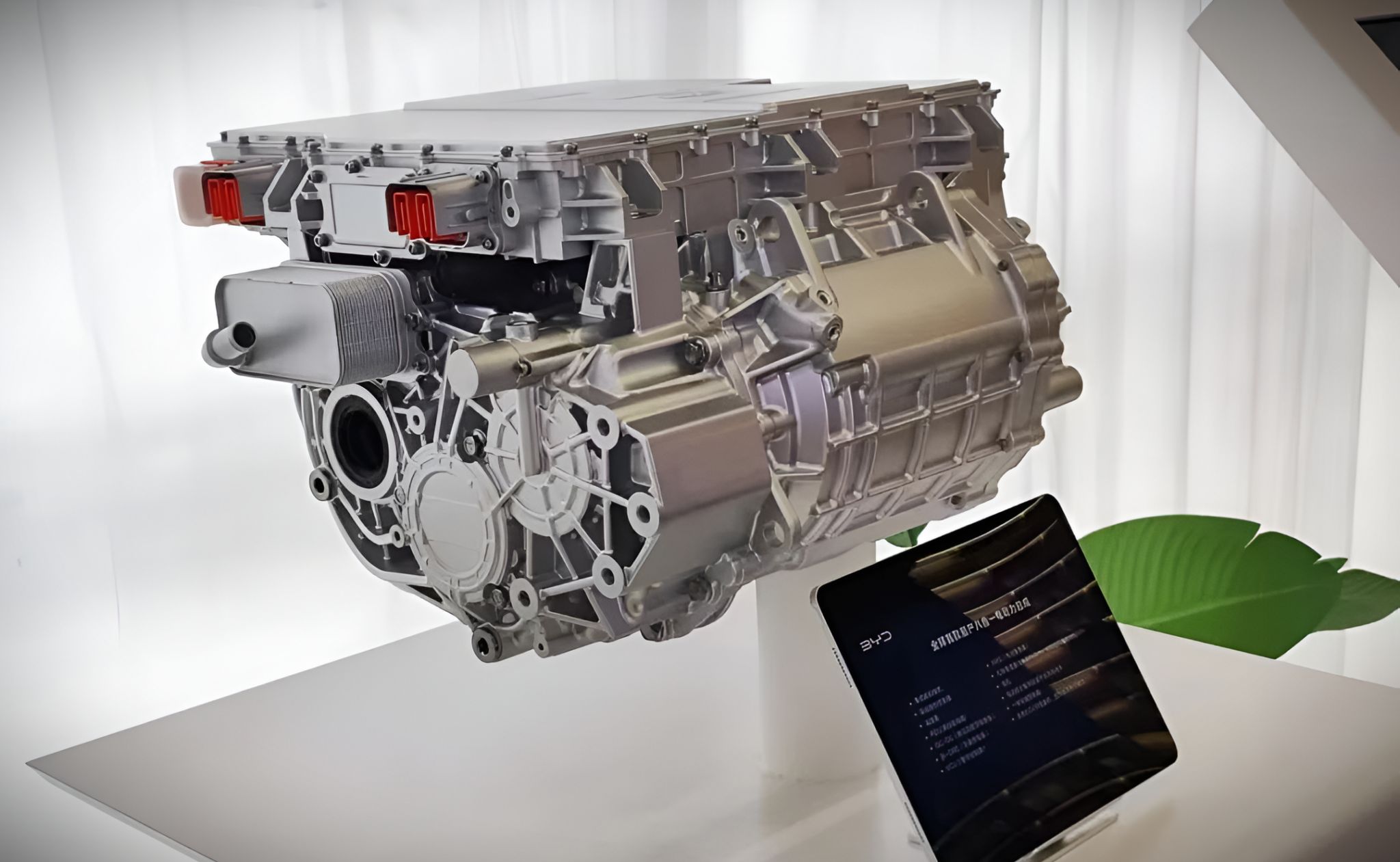
Chinese automaker BYD has filed a new series of patents in China for an advanced Variable‑Flux Permanent Magnet Synchronous Motor (VF‑PMSM) aimed at significantly reducing energy consumption at high vehicle speeds, especially in highway driving. The technology is presented as an evolution of the conventional permanent magnet synchronous motor, in which the rotor magnetic flux can be actively adjusted according to speed and load, widening the high‑efficiency operating window and improving overall drivetrain performance.
According to the patent documentation, the system integrates mechanical and magnetic adjustment elements within the rotor, including axially and/or radially movable components that alter the effective flux linkage and thus shift the motor’s operating point. This architecture enables a form of controlled flux weakening that does not rely exclusively on current‑based field‑weakening strategies in the inverter, with the result of limiting copper and iron losses at elevated rpm and enhancing thermal stability under continuous high‑load operation.
From an application standpoint, the variable‑flux PMSM concept is engineered to maintain high efficiency over a broader constant‑power speed range, delivering lower specific energy consumption during sustained high‑speed driving without increasing battery capacity or adding complexity to the cooling system. For electric vehicles, this translates into more predictable long‑distance range in real‑world highway cycles, improved robustness of the e‑powertrain under demanding duty cycles and, potentially, extended lifetime of critical components thanks to reduced thermal and electrical stress.
The patents outline multiple implementation variants, suggesting that the concept is intended to be scalable across different power classes and vehicle segments, from passenger cars to light commercial vehicles, reinforcing BYD’s strategic role in next‑generation electric motor technology.





)