
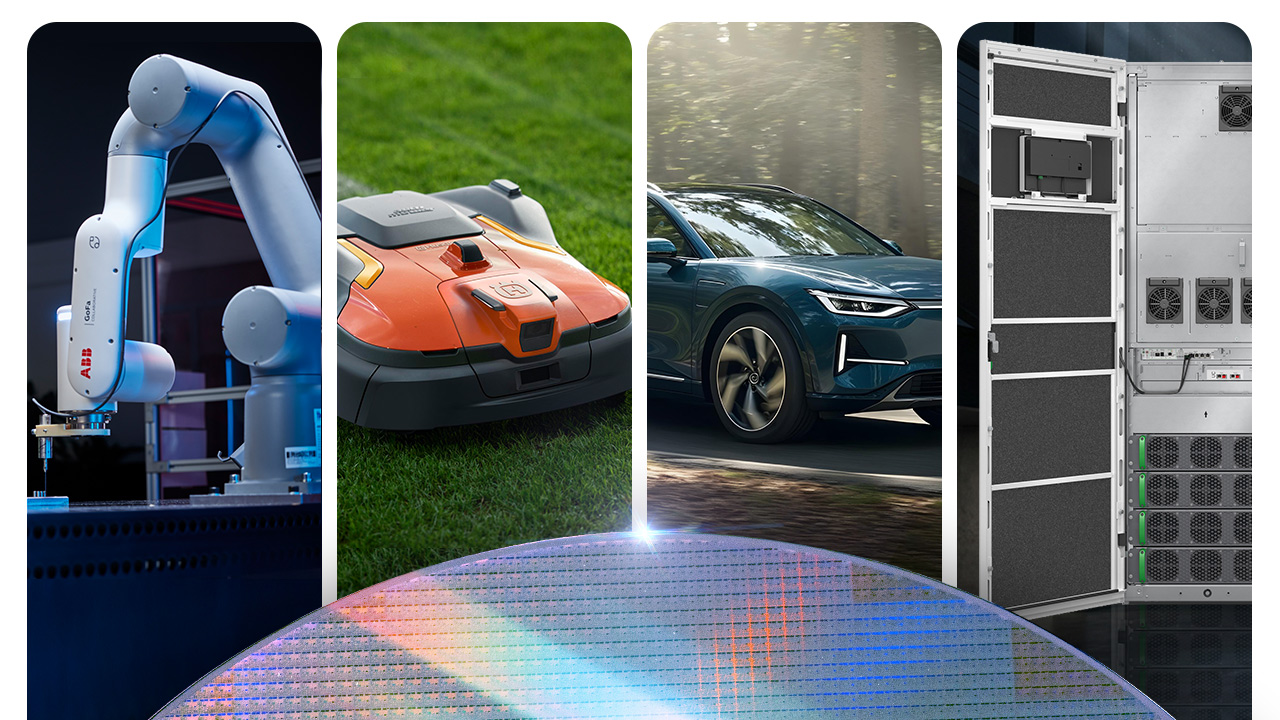
Texas Instruments is working with European manufacturers, including ABB Robotics, Porsche and Schneider Electric, to advance real-time motor control, power conversion and sensing technologies for more efficient and autonomous industrial and automotive systems.
From industrial robotics to automotive electronics, advances in real-time processing, motor control and power conversion are supporting the development of more efficient and autonomous systems.
The growing integration of electronics into electromechanical systems is changing the way electric motors, industrial automation and power management architectures are designed. Real-time processing, advanced sensing and high-efficiency power conversion are becoming essential to improve performance, precision and energy consumption across different applications.
These developments are reflected in several projects involving Texas Instruments (TI) and European manufacturers, including ABB Robotics, Porsche, Schneider Electric and Husqvarna Group. The applications, presented in connection with electronica 2026 in Munich, illustrate how semiconductor technologies are being integrated into increasingly complex industrial and automotive systems.
Real-time motor control for autonomous robotics
Industrial robotics is one of the areas where the integration of sensing, processing and motor control is becoming particularly important. ABB Robotics is developing its next generation of Autonomous Versatile Robotics (AVR), designed to operate in dynamic environments through the use of physical artificial intelligence.
These systems require electronic architectures capable of processing sensor information and coordinating mechanical movements in real time. TI’s microcontrollers, sensing solutions and motor control components contribute to the development of robotic platforms that can respond to changing operating conditions while maintaining precision, efficiency and safety.
In automotive applications, the collaboration between TI and Porsche focuses partly on gallium nitride (GaN) semiconductor technology. Its integration can enable more compact and efficient electronic designs, offering opportunities to reduce system dimensions without compromising performance. The cooperation also extends to advanced in-vehicle audio systems.
Power conversion represents another area of development. TI and Schneider Electric are working on electronic technologies for next-generation AI data center infrastructure, where increasing energy demand requires higher power density, improved conversion efficiency and reduced equipment footprints.
Meanwhile, autonomous outdoor equipment provides another example of the convergence between electronics and electromechanical engineering. TI’s collaboration with Husqvarna Group covers connected products such as robotic lawn mowers and intelligent irrigation systems, with development tools intended to simplify system integration and accelerate engineering processes.
Across these applications, semiconductor technologies are increasingly influencing the design of electric and electromechanical systems. The integration of motor control, sensing, embedded processing and power management enables engineers to develop architectures capable of combining precise motion control with greater operational flexibility and energy efficiency.