
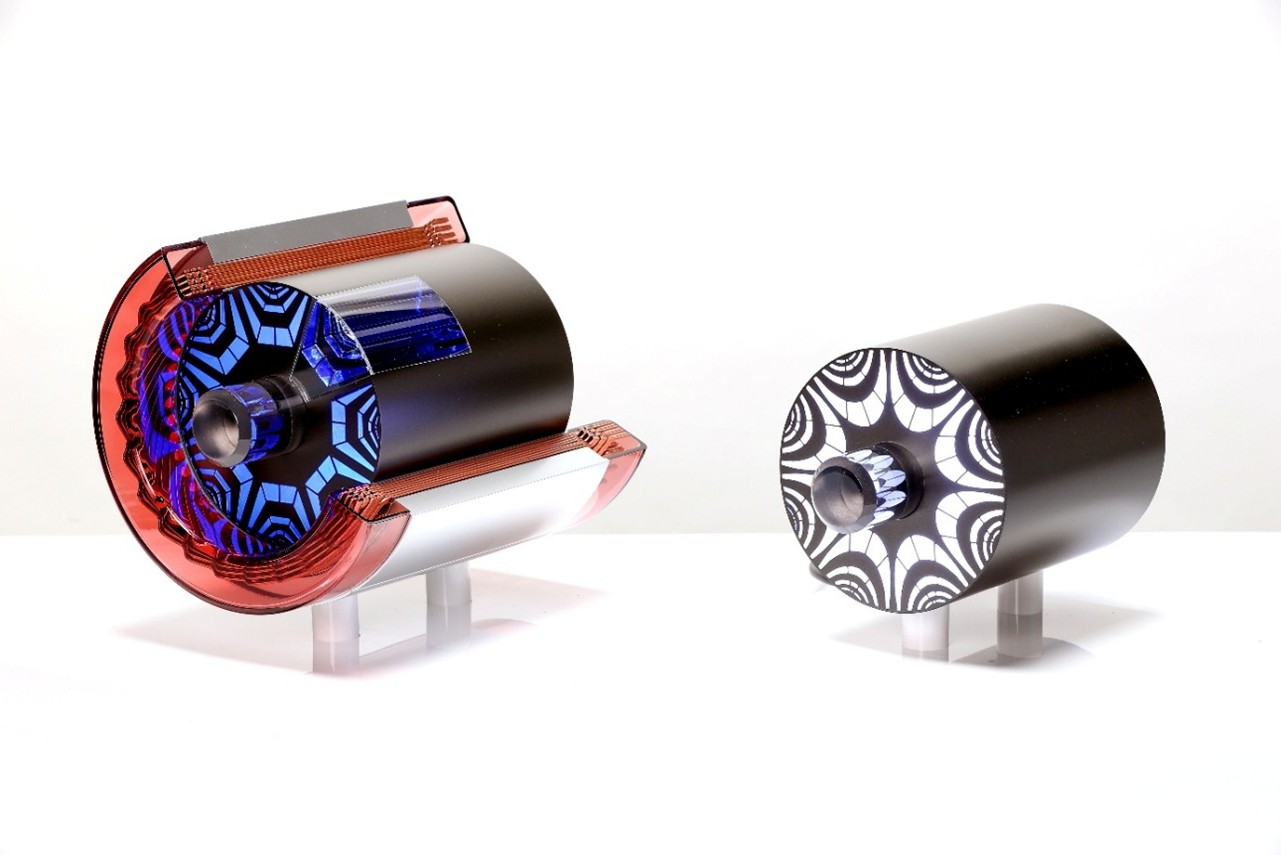
Astemo Ltd. has developed a new rare-earth -free motor for battery electric vehicles (BEVs). The announcement, made in Tokyo, signals a major shift in how high-performance EV motors could be designed in the near future—reducing dependence on critical materials without compromising efficiency or output.
The system is based on a magnet-assisted synchronous reluctance motor architecture that generates torque through differences in magnetic reluctance within an iron rotor core, rather than by relying on strong neodymium permanent magnets typical of conventional BEV motors.
In its main drive configuration, designed for continuous propulsion, the new motor delivers 180 kW of output by embedding rare-earth-free ferrite magnets, limiting the overall size increase to just 30% compared with a conventional permanent-magnet motor.
Astemo complements this with a 135 kW auxiliary drive motor, a pure synchronous reluctance unit that operates without any magnets. The auxiliary motor activates only when additional power is required, minimizing energy loss during coasting phases. Together, the two motors achieve a combined system output of 315 kW, balancing performance and efficiency across varying driving conditions.
Advanced structure and thermal control
At the core of the innovation lies Astemo’s multi-layer flux structure, which divides the magnetic flux path into multiple layers and precisely controls current to form magnetic poles inside the rotor core. This design compensates for the lower magnetic strength of ferrite compared to neodymium, enabling strong torque generation without rare-earth materials.
A key engineering challenge for this system is managing the heat generated by higher current densities in the stator coils. Astemo addressed this by developing a coil oil-immersion cooling system, submerging coil slots and end windings in cooling oil to efficiently dissipate heat and ensure stable performance under sustained load.
Industrial and sustainability implications
The development responds to global concerns about geopolitical and supply risks linked to rare-earth materials, notably neodymium and dysprosium—critical resources largely controlled by China. By eliminating reliance on these elements, Astemo’s new motor mitigates procurement risks, stabilizes cost structures, and supports a more secure supply chain for electric vehicle manufacturers.
From an environmental perspective, reducing rare-earth use also means fewer mining and refining operations, both of which have significant ecological footprints. This innovation thus represents a dual step toward material sustainability and carbon neutrality in the e-mobility sector.
Astemo aims to bring its rare-earth-free synchronous reluctance motor technology to mass production by 2030, potentially becoming the first company worldwide to integrate this motor architecture into full-scale BEV manufacturing.





. The announcement, made in Tokyo, signals a major shift in how high-performance EV motors.)