
Corrada has always regarded innovation as a key driver of competitiveness. Its long-standing patent portfolio now finds a concrete expression in PRINT-CORPACK, a technology developed to optimize the bonding of electrical steel laminations, overcoming the limitations of mechanical joining methods and spray-based processes.
Corrada is a company that has always innovated – not out of obligation, but as an integral part of its industrial culture. From its first patent in 1954 to the 107th filed in 2024, innovation has been a tangible reality, embedded across all departments rather than delegated to a specific office. It is a shared responsibility and a daily driver of continuous improvement. PRINT-CORPACK technology stems precisely from this approach: it is the result of a real market need translated into a completely new technical solution. Developed by an in-house team, the technology addresses a long-standing limitation in lamination bonding by introducing a method that is fundamentally different from both mechanical joining and spray processes. A competitive landscape characterized by high-volume production, standardization and increasing attention to electric motor performance called for a solution that was more precise, cleaner, and more controllable. PRINT-CORPACK responds directly to these requirements, defining a new benchmark for industrial bonding. This combination of applied innovation and tangible results led to its protection through a patent filed in 2019 by Eng. Alberto Curatoli, Davide Verri, and other technical specialists from Corrada.
From need to solution
PRINT-CORPACK was developed as a direct response to a production challenge: achieving bonded laminations through a proprietary process that is reliable, repeatable, and free from the structural limitations of existing techniques. The key insight was to combine two well-established processes. Flexographic printing – traditionally used to transfer ink via engraved rollers – has been reinterpreted by Corrada to apply single- or two-component adhesives with the same level of precision and quantitative control typical of industrial printing processes. Thanks to calibrated rollers made of special ceramic materials, the deposition of micro-patterns is extremely accurate and fully controllable.
The patent covers the printing of component A (activator) on the upper side of the lamination and component B on the lower side, so that during blanking – at the moment the part is separated – the two adhesive layers come into contact, immediately sealing the lamination (the same process can also be carried out with single-component B adhesives that activate upon contact with the steel). The curing process reaches 80% in just 20 seconds, ensuring a compact part with high mechanical strength. The core idea is straightforward yet highly effective: bringing the precision of industrial printing into lamination bonding, resulting in a clean, controlled, repeatable process that is fully integrated into the die.
From prototype to production
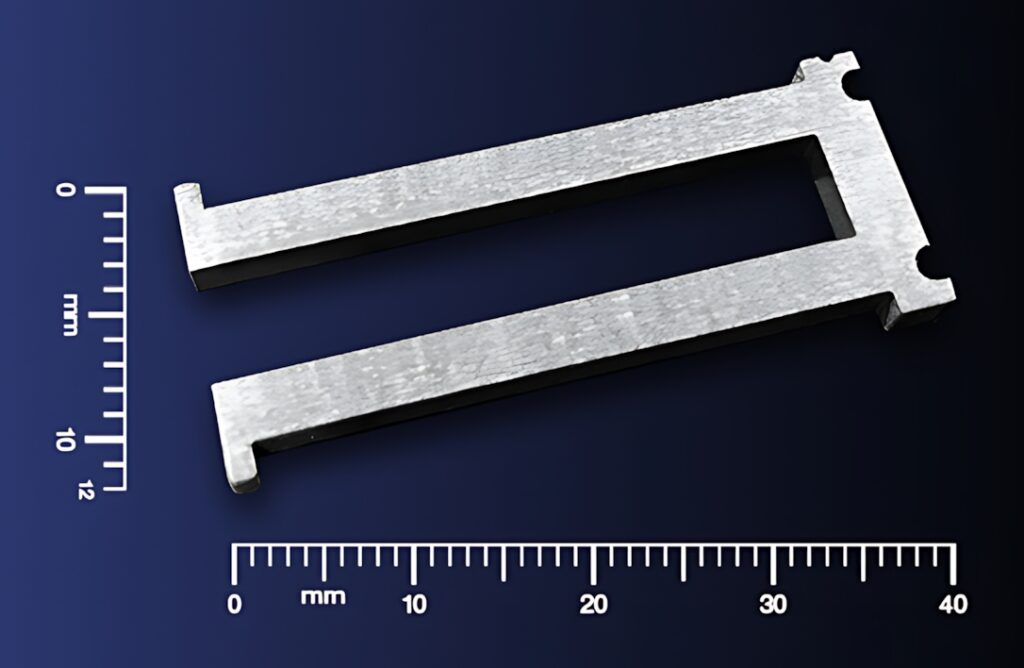
The first application of PRINT-CORPACK involved the lamination of an innovative electric toothbrush, characterized by the presence of mechanical embossments – known critical points that generate electromagnetic losses. Replacing embossments with adhesive bonding increases the effective cross-section of the magnetic circuit and improves motor performance, a decisive advantage in devices where compactness and efficiency are essential. From the prototype stage, the technology demonstrated its ability to produce laminations that were already aligned and bonded in a single step, without deformation and with virtually zero scrap.
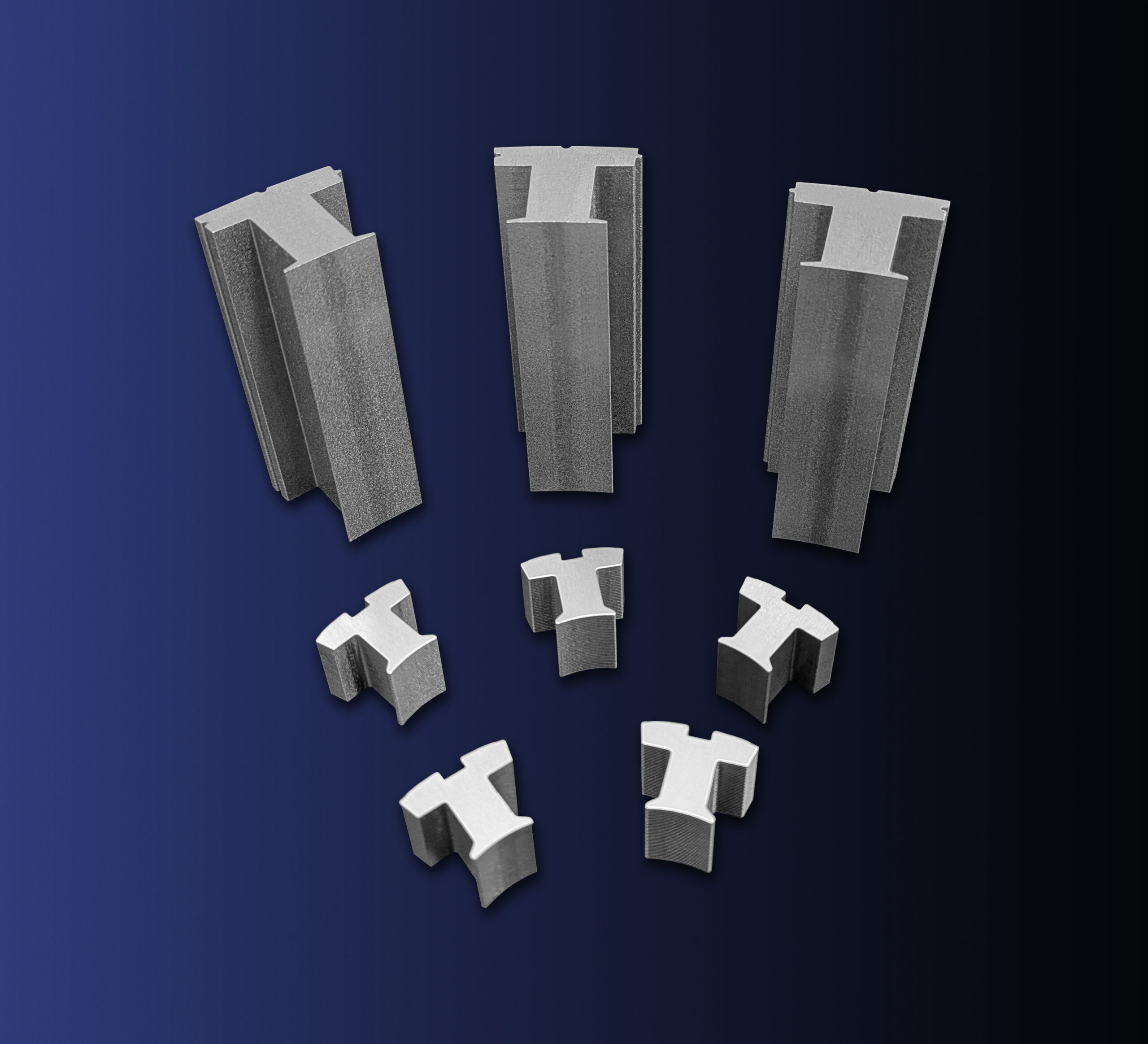
The second project, focused on a T-pole, marked a turning point. The application highlighted a clear superiority over the traditional backlack process originally used to manufacture these components. The resulting parts exhibited improved geometric quality because masks, ovens, and additional handling steps – factors that negatively affect quality – were no longer required. With PRINT-CORPACK, the part exits the die already finished and compliant. Dimensional reports confirmed the complete absence of adhesive leakage or overflow.
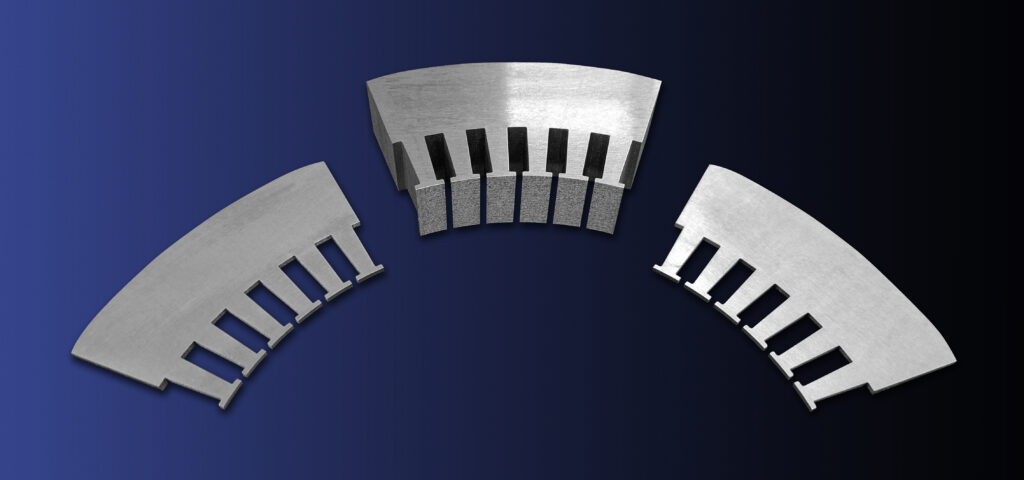
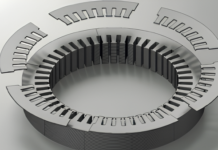
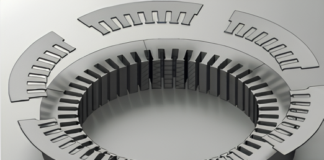
The third project, involving a segmented stator, further expanded the application range. Adhesive can be applied over the entire surface of the segment, particularly on the stator teeth, ensuring greater stability during assembly and reducing vibrations and scrap during winding of the lamination stack.
Distinctive advantages: precision, cleanliness, control
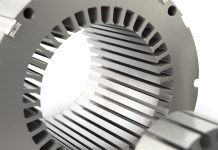
PRINT-CORPACK delivers technical advantages that cannot be achieved by spray or dot systems. The first one is geometric precision: the technology enables the printing of micro-patterns of adhesive with very high definition, even on extremely small surfaces such as stator teeth, ensuring the exact amount of material required. Roller porosity determines the transferred volume, allowing for repeatable, stable dosing that can be easily adapted to different designs.
The second advantage is process cleanliness. The absence of spraying eliminates adhesive mist clouds that, in conventional processes, are deposited on the die, reducing cleaning operations and improving line availability.
The third aspect is process control. Deposition is carried out entirely in-line, without external phases that are sensitive to environmental or operational variables. This ensures consistent quality and a high level of repeatability, which is essential for high-volume production. Moreover, the complete absence of mechanical deformation – since no embossments are created – preserves the integrity of the steel and improves the final quality of the lamination stack.
Precision, cleanliness and control are not secondary features; they represent the core of PRINT-CORPACK’s industrial value and what makes it one of the most advanced solutions for lamination bonding.
Scalability, implementation and technical support
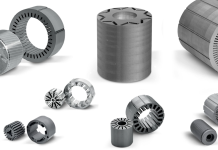
PRINT-CORPACK has been designed as a scalable technology, applicable to both small laminations and stators with an outer diameter of up to 240 mm. The flexographic machine architecture allows it to be used as an auxiliary unit to the press, independently of the die, offering a decisive economic advantage: a single machine can serve dozens of different products. Dies are also simplified, as the entire stacking section is eliminated.
Initial investment is limited and operating costs are significantly lower than those associated with processes based on ovens and external handling. Moreover, the value of technical and scientific support is added: Corrada operates an in-house laboratory that tests compatibility between steels, coatings and adhesives, offering customers an assisted industrialization pathway. Adhesive formulations with rapid curing (80% in 20 seconds) have been developed, stable at room temperature and compliant with the highest European safety standards.
This integration of technology, research and application support enables customers to adopt PRINT-CORPACK with confidence, reducing risk and accelerating time to production. After six years of development and field validation, the technology is now ready for large-scale industrial deployment, particularly in small components, where precision, cleanliness and control are not optional advantages but competitive requirements.
Patented in-die bonding technology based on flexographic printing.
– Precise, controlled, and repeatable adhesive application, even on micro-areas.
– Clean process, without spraying or adhesive mist; minimal maintenance.
– No mechanical deformation: complete elimination of embossments.
– Rapid curing: 80% in 20 seconds, 100% in < 5 minutes.
– Scalable: small parts, segmented components and diameters up to 240 mm.
– Adhesives also available in green formulations and stable at room temperature.
For more information: eng. Alberto Curatoli alberto.curatoli@corrada.it



 bonding of electrical steel laminations. Corrada has always regarded innovation as a key driver)