Modern electric motors are becoming increasingly compact, lightweight and high-performance. This trend brings with it a growing challenge: overheating. When a motor has to deliver high power within a small enclosure, internal temperatures rise unevenly, leading to the formation of hotspots that accelerate material ageing, reduce performance and can cause premature failure. In this context, thermal management is certainly not a secondary aspect of design but becomes a factor that directly influences the system’s performance, reliability and service life. Monitoring what is actually happening inside the motor during operation is not straightforward but would be extremely useful.
Integrating thermal sensors within an electric motor presents obvious practical limitations. Available space is often minimal, particularly in compact machines. Furthermore, the points of greatest diagnostic interest do not necessarily coincide with the most accessible areas. Monitoring moving components, such as the rotor, during high-speed operation further complicates the picture. Traditional methods of internal measurement are often complex and costly, to the extent that they are not normally adopted in practical applications.
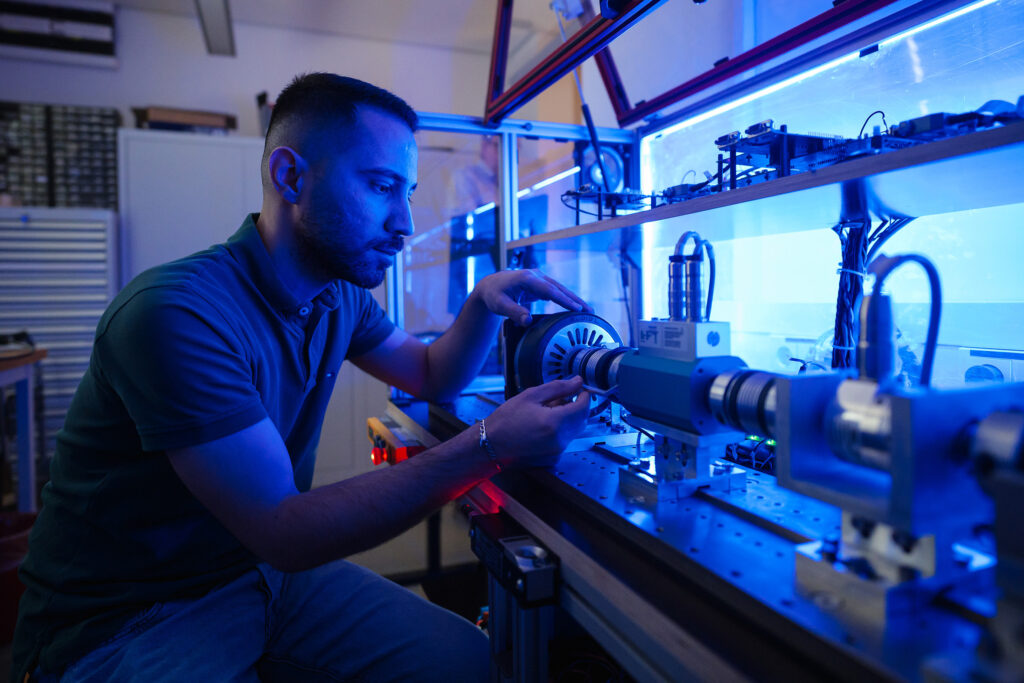
This limitation gave rise to the project developed at Saarland University by Professor Matthias Nienhaus’s research group: estimating the internal thermal distribution without adding dedicated sensors, but instead utilising information already available to the drive. The idea forms part of a line of research the group has been pursuing for some time: using the motor as a sensor of itself, extracting diagnostic information from its own electromagnetic signals.
The approach
Saeed Farzami, M.Sc., a researcher in the working group, explains the technical approach. «The system,» explains Farzami, «uses only signals already available in a standard drive: currents and voltages on the d-q axes, phase currents, rotor speed and boundary conditions such as ambient temperature. To this information are added further parameters derived through feature engineering, but without introducing new physical instrumentation.» Variations in all these parameters also indirectly reflect the machine’s thermal state. The interesting aspect is that the principle is not limited to a single motor architecture. According to Farzami, the method is applicable to different topologies, including PMSMs, induction motors and other configurations.
This does not mean, however, that there is a ready-to-use universal model. Farzami points out: «Each motor type requires its own specific training process, because the loss mechanisms and thermal paths vary depending on the architecture.» This is where artificial intelligence comes into play.
How is each model trained?
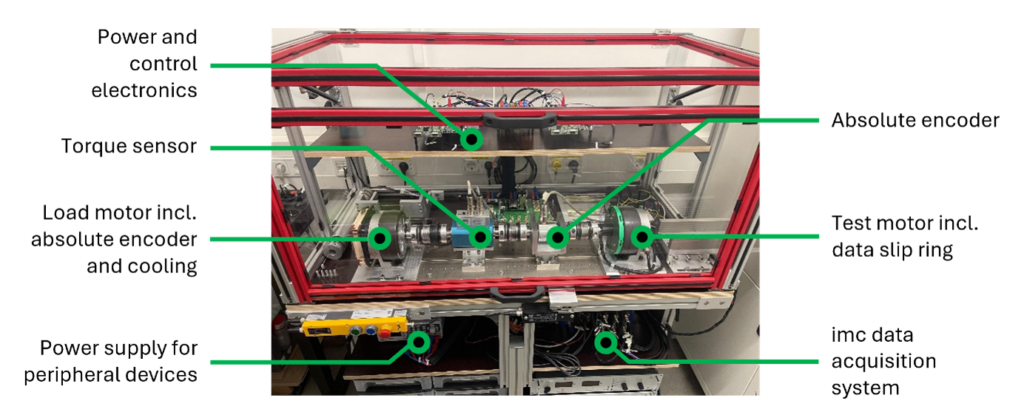
To build the system, the researchers set up a test bench (shown in figure 2) equipped with sensors positioned at the motor’s thermally critical points: in the windings, on the rotor and on the housing. A large amount of data was then acquired: electrical, mechanical and thermal data under various operating conditions, from low to high speeds, including different load profiles. The raw measurement data is subsequently subjected to extensive processing and systematic feature engineering. In this step, the data is refined, physically meaningful features are extracted, and the data is transformed into a representation that is optimally suited for the subsequent learning process. The final dataset was used to train a neural network capable of correlating the signals available in the drive with the internal thermal distribution. Farzami explains that to train a new model, test bench data containing electrical and mechanical signals is required, along with reference temperatures obtained via sensors or validated thermal models, such as FEM simulations. The training method employed utilized various regularization techniques from the fields of machine learning and deep learning, with the aim of improving the performance of the learning method and the generalization of the models, as well as preventing overfitting.
In terms of time, the process requires between a few hours and a few days of data acquisition, depending on the desired level of coverage. Furthermore, the dataset covers a wide range of operating scenarios, from low to high rotational speeds, with load cycles that are representative in terms of torque, speed and thermal transients. According to Farzami, the method has been designed to be replicable in an industrial context, with standardised excitation profiles, defined feature sets and automated tuning procedures. The use of transfer learning should also reduce the effort required to adapt the system to variants within the same product family.
Accuracy: errors in the order of a few kelvins
The experimental results documented by the research group confirm the effectiveness of the approach. Farzami reports average errors in the order of 3-7 K for stator winding temperatures and 2-4 K for rotors and magnets. In the worst transients, the error generally remains below 10–15 K, but this depends on the coverage of the training dataset and the initial operating phase, when the model does not yet have sufficient temporal information to produce stable estimates.
Farzami notes: «Accuracy is highest in steady-state conditions and decreases slightly for rare operating points or extreme dynamics, as well as at start-up, when the model has not yet accumulated sufficient temporal context to stabilise its estimates. These levels of accuracy are, however, entirely compatible with industrial and automotive applications.»
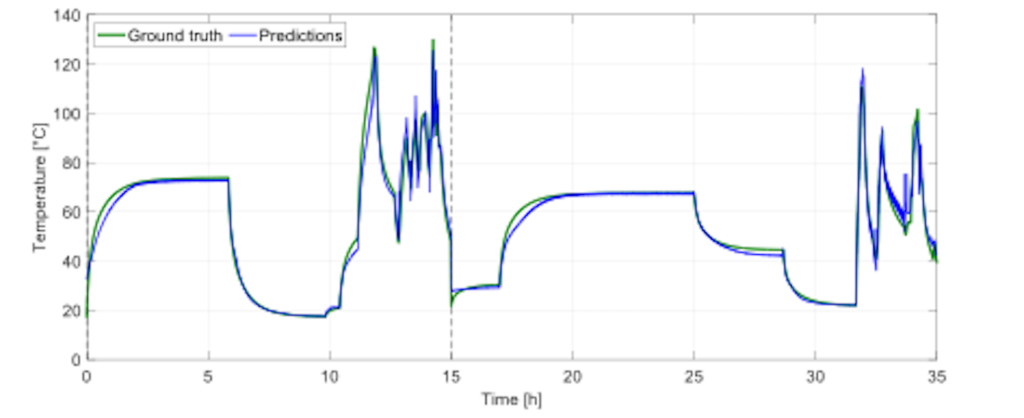
For instance, figure 3 shows the estimation results for the phase‑2 stator winding temperature (T_WP2) based on 35 hours of measurement data. The root mean square error (RMSE) of this estimation is 3.18 °C across the entire validation process.
The challenge of industrial integration
From a hardware perspective, integration does not appear to be the main obstacle: according to the team, compact models can be run on the current embedded controllers of a standard inverter, without dedicated hardware. The most significant challenges relate instead to functional certification and industrial robustness, particularly when using black-box AI models that are difficult to interpret. For this reason, hybrid approaches combining machine learning and physical system models now appear more realistic for commercial deployment.
Topology-agnostic versus motor-specific
As Farzami explains, the method developed can be applied to an OEM’s entire range of motors, using transfer learning to reduce the effort required for each variant. It is “topology-agnostic” (compatible with PMSMs, induction motors and other architectures), but the trained model is “motor-specific”: the method is independent of the motor’s topology, in the sense that the principle can be applied to PMSMs, asynchronous motors and other architectures. However, the AI model is not universal: each motor requires dedicated training, as losses, thermal paths and electromagnetic behaviour vary from machine to machine.
The benefits can be immediate
In terms of applications, Farzami identifies the most promising contexts in automotive traction, high-performance industrial drives and robotics. More generally, the approach appears promising in all applications where cost, complexity or the physical impossibility of sensor integration represent a limitation.
For manufacturers, the potential benefit is not limited to simply saving on components. Farzami explicitly mentions greater efficiency in resource use and increased power density thanks to the possibility of reducing conservative thermal margins. Added to this are reduced thermal limitations on performance under high-temperature conditions, a longer motor lifespan due to the prevention of overheating, and reduced costs associated with sensors, cabling and implementation, particularly where rotor monitoring would otherwise be required.
Beyond the virtual sensor
Perhaps the most interesting aspect of the project is not the replacement of a physical sensor with an algorithm, but the potential paradigm shift in motor management. Today, many systems operate with conservative thermal margins because what happens internally is not fully observable. If this opacity were reduced, control could become more dynamic and less conservative. The question, therefore, is not merely whether AI can estimate a motor’s temperature, but whether this capability can redefine the way drives are designed and utilised. For the world of drives, this is probably where the most interesting game is being played.