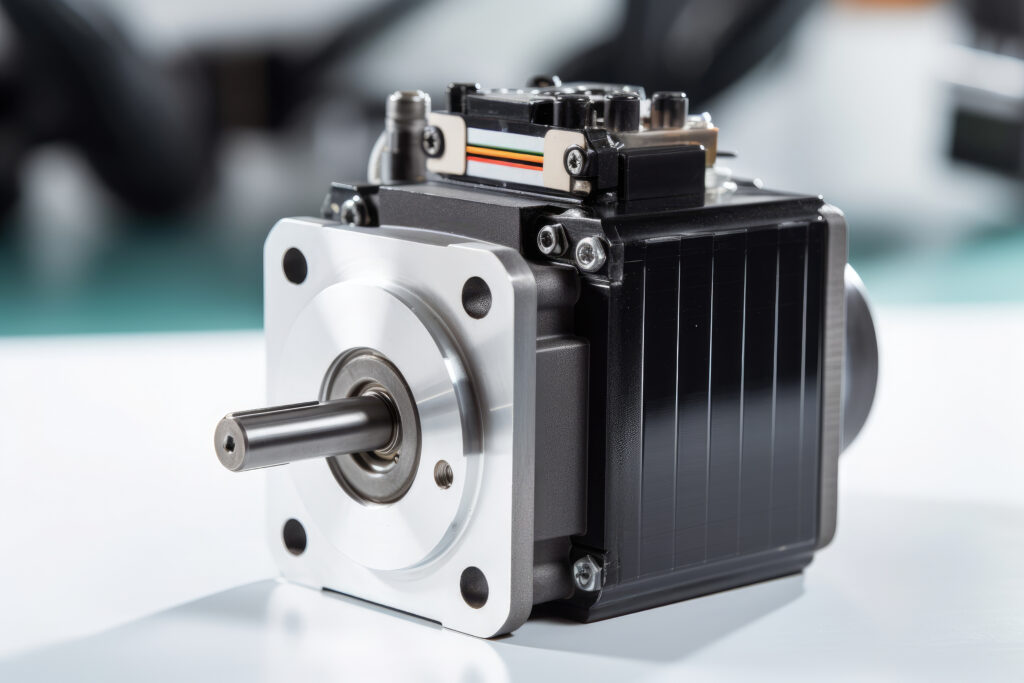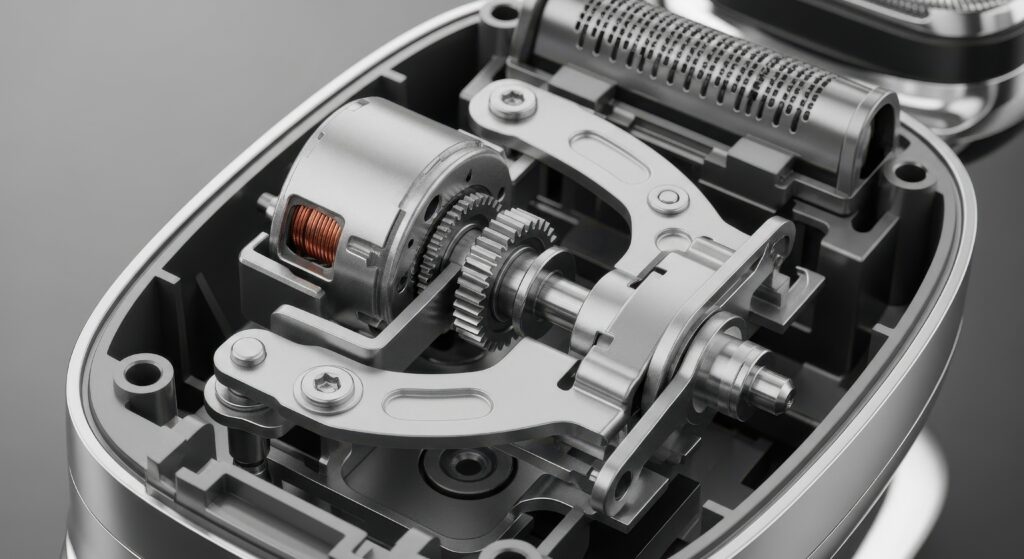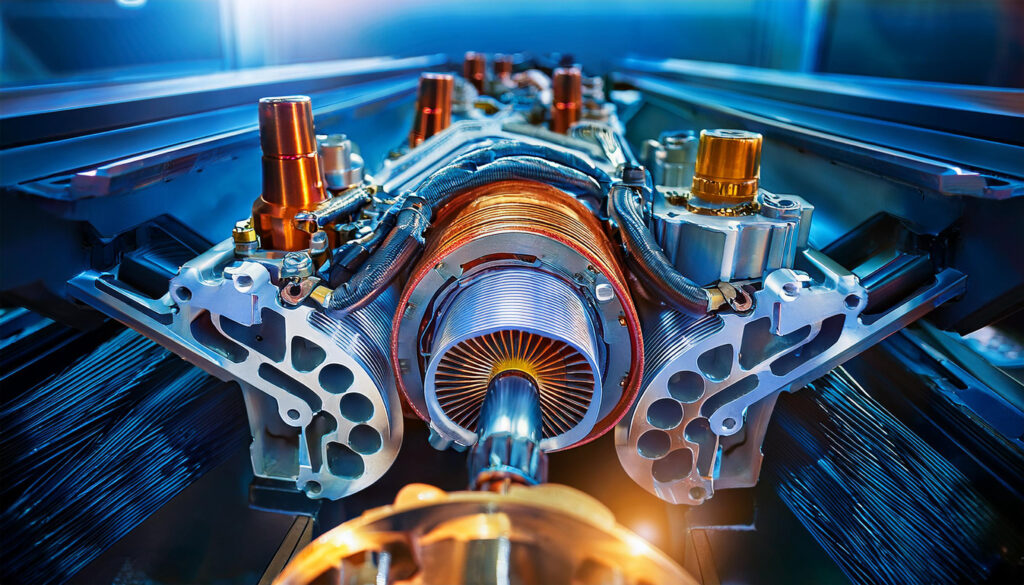
Motor control is an essential component in a wide variety of applications, from industrial manufacturing equipment to automotive systems. Its importance lies in the ability to precisely and efficiently manage the performance of electric motors, whether DC or AC
Electric motor control is the process of managing them to perform specific tasks or operations. This involves adjusting parameters such as speed, direction, starting, stopping, and protection, ensuring efficient and safe operation in various applications.
Control also plays a crucial role in maximizing energy efficiency, simultaneously improving product life and user safety. In industrial settings, precise motor control is essential for achieving high production rates with minimal waste; in consumer electronics, it helps improve device utilization and efficiency.
In manufacturing environments in particular, intelligent motion control combines precision feedback, advanced sensors for protection, and seamless connectivity to provide deterministic motion solutions that enable highly flexible and efficient production. Motion control solutions in robotics (particularly used in mass production, such as household appliances) have evolved from simple fixed-speed on/off motors to complex multi-axis servo drive solutions. This transformation has been driven by the increasing complexity of the automation required to deliver higher levels of performance and autonomy in smart manufacturing.
Electromechanical control and electronic control
Control systems can be classified into two categories, each with its own applications, technologies, and advantages: electronic systems and electromechanical systems.
Before the advent of electronic control, electromechanical systems formed the basis for motor control and used pushbuttons, relays, and timers for both starting and stopping and reversing. They are obviously less precise than their electronic counterparts, but also less expensive. Being virtually insensitive to environmental factors such as heat and dust, they are suitable for use in harsh industrial environments.
Electronic motor control systems use solid-state components to manage motor operation. These technologies not only improve motor performance and efficiency, but also reduce energy consumption, wear, and maintenance.
Electronic control includes a wide variety of technologies, ranging from PLCs (programmable logic controllers) to DSPs (digital signal processors). Using precise feedback and complex algorithms, they provide precise control of motor speed, position, and torque. Electronic systems also have the ability to interface with enterprise networks and automation systems; this is one of their major advantages. Electronic controllers can be used to manage servomotors, stepper motors, AC motors, and DC motors.
For example, variable-frequency drives are used to control AC motors, and pulse-width modulation (PWM) control is used for DC motors.
The evolution of motor drives
Modern signal chain solutions integrate current and voltage sensing, high-density power management, and seamless connectivity.
By controlling motor speed, a variable-speed drive can significantly improve efficiency, resulting in energy savings, increased productivity, and extended equipment life. Many manufacturers provide signal chain solutions that integrate high-precision feedback, current sensing, isolation, power management, and connectivity to provide deterministic motion solutions.
The deterministic motion of an electric motor means its motion is predictable and precisely controlled, free of random or unpredictable elements. This is achieved through precise calculations and control inputs that cause the motor to follow a specific path or reach a precise position, often by precisely managing the interaction between magnetic fields and electric currents. Unlike stochastic motion (motor motion that includes random variations due to noise, uncertainty, or probabilistic control), deterministic motion ensures that the motor’s behavior can be predicted with certainty.
Key aspects of deterministic motion include:
- Precise control – Control systems use specific algorithms, such as field-oriented control (FOC), to calculate and apply the exact voltages and currents needed to achieve the desired motion.
- Predictable output – The motor’s position, speed, and torque are directly determined by the control signals, making its motion predictable and repeatable.
- Absence of randomness – Unlike Brownian motion, which involves random fluctuations, deterministic control eliminates or minimizes these unpredictable variables.
- Basic physics – It is based on the principles of electromagnetism, where the force on a current-carrying wire in a magnetic field is predictable. The direction of the current, the magnetic field, and the resulting force are precisely defined, often using rules such as Fleming’s left-hand rule (used to determine the direction of the force acting on a current-carrying wire in a magnetic field. Place the thumb, index finger, and middle finger of the left hand perpendicular to each other: the thumb indicates the direction of the force F, the index finger indicates the magnetic field B, and the middle finger indicates the direction of the current I).
The evolution from fixed-speed to variable-speed motor drive systems has enabled higher performance, reduced production times, increased productivity, and optimized energy consumption throughout the production plant.
Electronic control functions
Microprocessors and sensors are the basic components of any motor control system.
Speed, torque, and position are common variables in motor control:
- Speed control – This is the process of adjusting the rotational speed of the output shaft to a desired setpoint.
- Torque control – Torque control refers to the regulation of the torque delivered by the motor in various applications that require specific levels of force to control the load. Torque, or the rotational force generated by the motor, is directly related to the current flowing in its windings. Controlling this current allows for precise management of the motor’s torque.
- Position control – In all precision applications, such as robots and CNC systems, position control ensures that the motor reaches and remains in the specified position.
- Direction control – To achieve direction control, the direction of the current in the motor circuit is changed. In DC motors, the polarity of the applied voltage is reversed; in AC motors, the phase sequence is adjusted.
Motor control techniques
The feedback mechanism distinguishes the two categories of electronic control.
In an open-loop system, the performance of the control action is not influenced by the outcome. This means that the system operates based on preset data, without adapting to load fluctuations. Open-loop systems are easy to use and are suitable for
simple applications, where precise control of speed, torque, or position is not critical.
In a feedback system, motor operation is adjusted based on real-time data. Sensors monitor motor performance and provide real-time data to the controller. The controller then makes adjustments to the motor’s operation to achieve the desired result. This type of control allows for precise management of motor speed, position, and torque, accounting for disturbances and load variations.
The interaction between controller, sensors, and actuators is the basis for the correct operation of the motor control circuit. The controller analyzes data from the sensors to determine whether the motor is operating within specified parameters. If it detects deviations, it calculates the necessary adjustments and signals the actuators to adjust the motor power.
Another control system uses PWM (Pulse Width Modulation) technology. Pulse Width Modulation is a control technique commonly used to generate analog signals from digital devices such as microcontrollers. The signal consists of a train of square-wave pulses. PWM has two key parameters —the frequency and the duty cycle— which precisely regulate the motor speed.
Control components
Controllers are the most important components of the motor control circuit and vary in complexity. They are responsible for processing input signals from sensors, implementing control algorithms, and generating output commands for the various actuators.
Basic microcontrollers, programmable logic controllers (PLCs), and digital signal processors (DSPs) are all examples of controllers. Application requirements determine the specific tasks to be performed, such as speed regulation, position control, or torque management.
Sensors provide real-time data on the surrounding environment and the motor’s operating parameters, allowing the motor to make decisions and make adjustments based on accurate data. The most common include speed sensors, position encoders, current sensors, and temperature sensors.
Actuators are the components that execute commands from the controller and directly affect the operation of the motor. In motor control technologies, the term actuator commonly refers to power electronic components such as transistors, thyristors, and relays. To achieve precise control of motor speed, torque, and position, these devices can turn the power on and off, change power levels, or reverse the direction of the current: in essence, actuators regulate the motor’s power supply.
In an automation line, for example, sensors monitor the feed rate and the condition of any loads; the controller regulates the motor speed to maintain a constant flow rate, regardless of the load. To achieve this performance and smooth operation, actuators modulate the motor’s power, ensuring the smooth and efficient operation of the entire system.
Author: Piero Oltolina