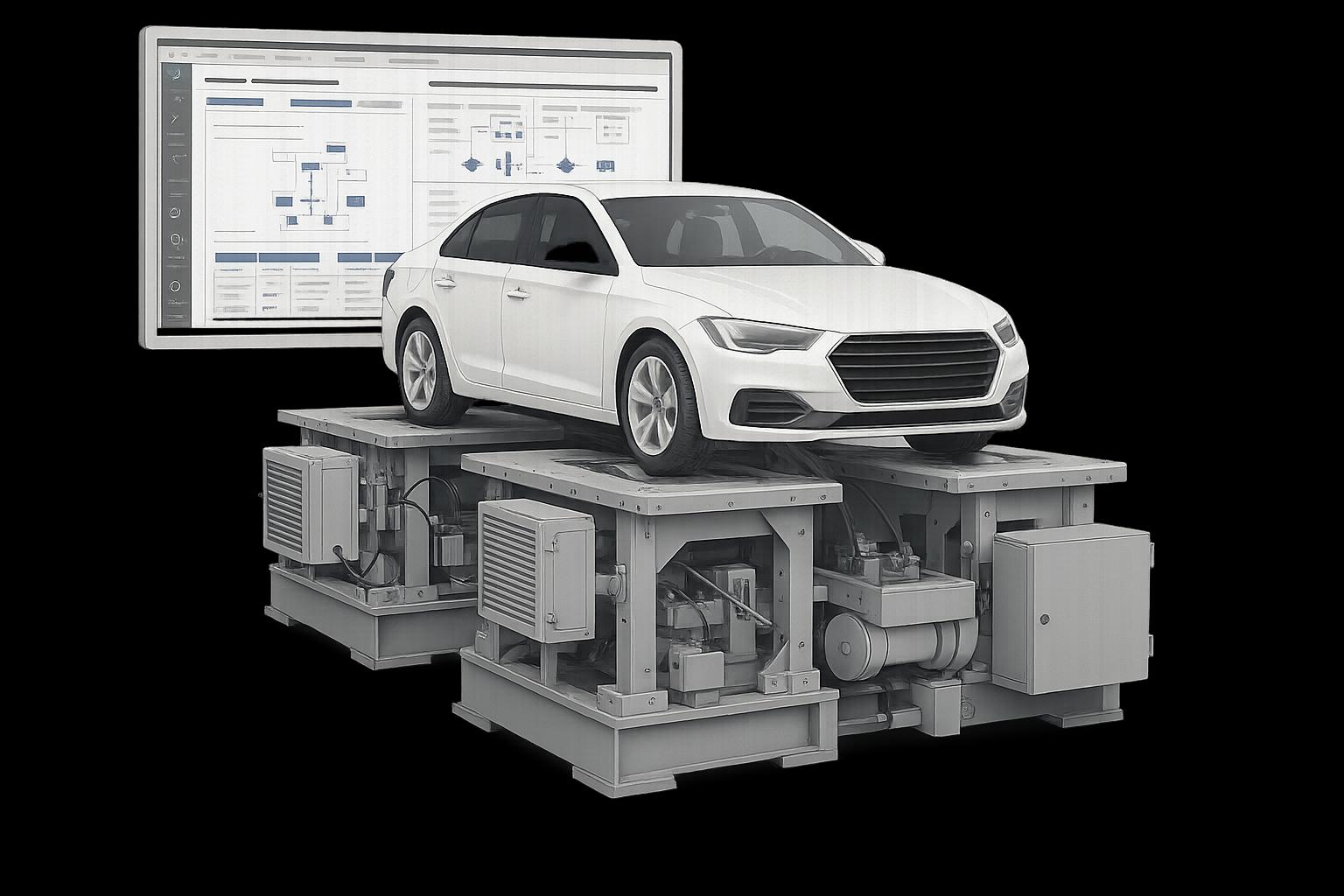
The evolution of vehicle powertrains from conventional internal combustion engines to hybrid and electric systems has significantly increased the complexity of emissions testing and regulatory compliance. In this work, present scenario of emissions homologation procedures for hybrid and electric vehicles within the European regulatory framework is presented.
Introduction
Starting from the fundamentals of combustion and pollutant formation, the study highlights the transition towards more representative testing methodologies, such as WLTP and Real Driving Emissions (RDE), designed to better reflect real-world driving conditions. Attention is particularly focused on the challenges introduced by electrified vehicles, where emissions depend not only on instantaneous engine operation but also on energy management strategies and battery state-of-charge.
Combustion and Emission
The origin of vehicle emissions lies in the combustion process, which remains the dominant energy conversion mechanism in conventional propulsion systems. In internal combustion engines, the chemical energy stored in hydrocarbons is released through oxidation, generating heat and mechanical work. However, this process is intrinsically linked to the formation of pollutants, making combustion both a technological asset and an environmental challenge.
The combustion process requires three main elements: fuel, oxidant, and ignition. The fuel typically consists of carbon and hydrogen atoms, while atmospheric air provides the oxidant, containing approximately 21% oxygen. Ignition can occur through a spark (spark ignition engines) or through compression (compression ignition engines).
Under ideal conditions, complete combustion produces carbon dioxide (CO₂), water vapor (H₂O), and nitrogen (N₂). However, real engines operate under transient conditions, with imperfect mixing, temperature gradients, and dynamic loads. These deviations result in incomplete combustion and the formation of harmful emissions such as carbon monoxide (CO), hydrocarbons (HC), and nitrogen oxides (NOx).
A key concept in understanding emissions is the conservation of mass. The atoms entering the engine do not disappear; they are rearranged into different molecules. This means that emissions are not eliminated but transformed. The quality of combustion, and therefore emissions, is influenced by multiple parameters, including:
- Air-fuel ratio;
- Engine load and speed;
- Ignition timing;
- Combustion temperature.
These parameters directly affect pollutant formation mechanisms. For example, high temperatures promote NOx formation, while rich mixtures increase CO and HC emissions.
The need of emission control for both regulators and manufacturers, has led to the development of increasingly strict emission standards and the rise of hybrid and electric powertrains.
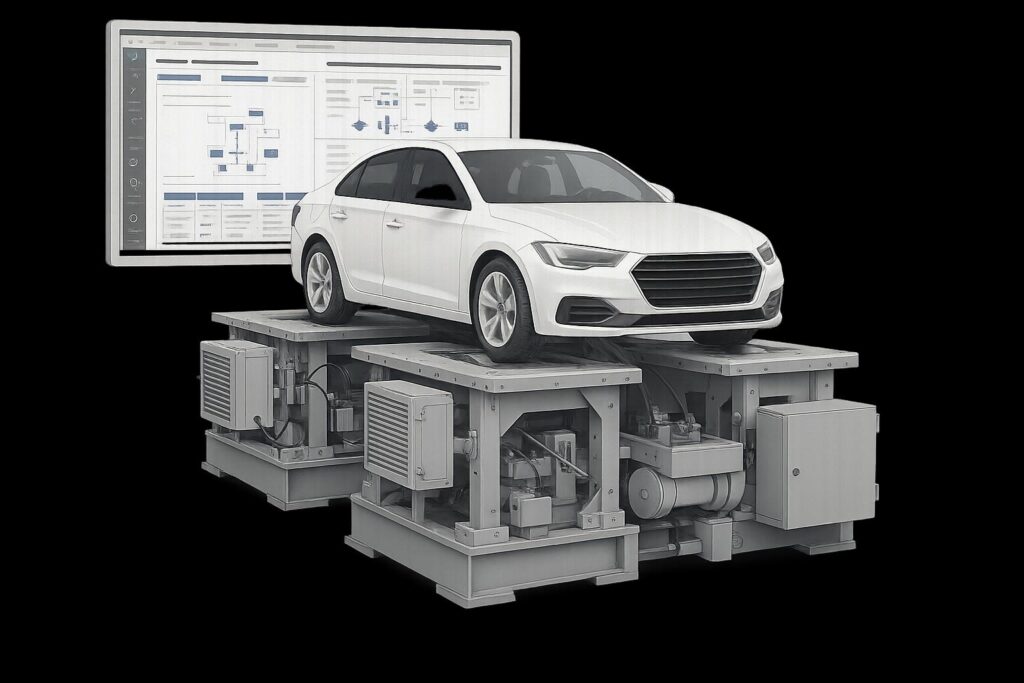
European Exhaust Emission Standard
The European emission regulation framework is one of the most structured and progressive systems worldwide. It is designed not only to limit pollutant emissions but also to standardize how these emissions are measured, ensuring comparability across vehicles and manufacturers.
The evolution from Euro 1 to Euro 6 reflects a continuous tightening of emission limits and an increasing focus on real-world relevance. Early standards primarily addressed CO and HC emissions, while later regulations introduced limits on NOx and particulate matter, significantly impacting diesel engine development.
A fundamental shift occurred with the introduction of Euro 6, which not only reduced emission limits but also redefined the testing methodology. The goal was no longer just laboratory compliance, but alignment with real-world driving conditions.
The transition from the New European Driving Cycle (NEDC) to the Worldwide Harmonised Light Vehicle Test Procedure (WLTP) marked one of the most significant changes in European regulation, as WLTP was developed using real-world driving data collected globally, making it far more representative of actual vehicle usage.
The WLTP cycle is structured into four phases:
- low speed (urban driving);
- medium speed (suburban conditions);
- high speed (rural driving);
- extra-high speed (highway driving).
each incorporating accelerations, decelerations, and stops to better reflect real driving patterns, thereby introducing greater variability in engine load and operating conditions and resulting in more realistic emissions measurements. In addition to laboratory-based testing, Euro 6 also introduced Real Driving Emissions (RDE), which involves measuring emissions on public roads using portable equipment to ensure that vehicles comply with emission limits not only under controlled conditions but also in real-world scenarios. Furthermore, the emergence of hybrid and electric vehicles required a fundamental shift in regulatory philosophy, as these vehicles operate under multiple modes and their emissions depend on factors such as battery usage, driving behavior, and control strategies; consequently, regulations now emphasize aspects such as energy balance (battery state-of-charge), mode transitions between electric and combustion operation, repeatability of test conditions, and clearly defined break-off criteria, all of which ensure consistent and reliable emissions measurements regardless of how the vehicle manages its energy.
Regulations
The regulatory framework governing emissions testing has progressively evolved from a relatively straightforward set of laboratory procedures into a highly articulated system designed to capture the real behavior of increasingly complex powertrains. This evolution has been driven not only by stricter environmental targets but also by the introduction of hybrid and electric vehicles, whose operating logic cannot be described through a single steady-state condition.
In conventional internal combustion engine (ICE) vehicles, emissions are directly linked to fuel combustion. For this reason, regulatory procedures were historically centered around repeatable driving cycles performed under controlled laboratory conditions. However, even in this seemingly simple scenario, ensuring reproducibility requires strict control of boundary conditions such as temperature, vehicle conditioning, and driving trace accuracy.
With electrified vehicles, the situation becomes significantly more complex. Emissions are no longer solely dependent on instantaneous engine operation, but also on the history of energy usage within the vehicle. In particular, the state of charge (SOC) of the battery plays a central role, as it determines whether the vehicle operates in electric mode, hybrid mode, or combustion-dominated mode. This introduces a temporal dimension into emissions testing: the result depends not only on what the vehicle is doing, but also on what it has done before.
ICE Vehicles
For ICE vehicles, the regulatory logic is built around the concept of repeatability. The goal is to ensure that two identical vehicles, tested in different laboratories, produce comparable results. To achieve this, the testing procedure begins with a preconditioning phase, during which the vehicle is stabilized under controlled ambient conditions. This step is essential because engine temperature, lubricant viscosity, and after-treatment efficiency are all temperature-dependent.
Once stabilized, the vehicle is subjected to the WLTP driving cycle on a chassis dynamometer. The dynamometer simulates road load, allowing the vehicle to “drive” while remaining stationary. The driver must follow a predefined speed trace, and even small deviations can invalidate the test. This is why driver assistance systems such as AVL DriverAid are used: they provide real-time feedback to ensure that the vehicle speed closely matches the prescribed profile.
The WLTP cycle itself is not a simple constant-speed test, but a highly dynamic sequence of accelerations, decelerations, and steady-state phases. This variability is crucial, as it forces the engine to operate across a wide range of conditions, revealing emission behavior that would not be visible under steady-state operation.
In parallel with laboratory testing, Real Driving Emissions (RDE) procedures extend the evaluation to real-world conditions. Here, the vehicle is driven on public roads while portable measurement systems record emissions. This dual approach – laboratory plus real-world -ensures that vehicles are not optimized solely for test conditions but perform consistently in everyday use.
OVC-HEVs Vehicles
Off-Vehicle Charging Hybrid Electric Vehicles (OVC-HEVs) introduce a fundamentally different paradigm. These vehicles can operate using electrical energy stored in the battery, energy generated by the internal combustion engine, or a combination of both. As a result, their emissions cannot be characterized by a single test cycle.
The regulatory solution to this complexity is the definition of distinct operating conditions, primarily charge-depleting (CD) and charge-sustaining (CS) modes. These modes are not arbitrary labels, but reflect the underlying energy balance of the vehicle.
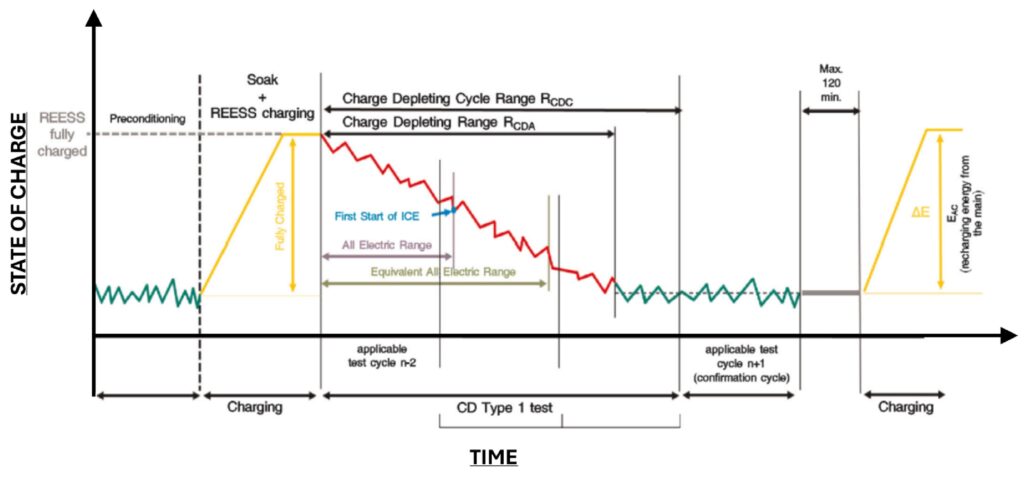
In charge-depleting operations, the vehicle relies heavily on the battery, and the stored electrical energy decreases over time. This mode is representative of real-world scenarios in which a plug-in hybrid starts with a fully charged battery and gradually transitions toward hybrid operation. From a testing perspective, this introduces the need for repeated driving cycles. The vehicle is driven over consecutive WLTP cycles, and after each cycle, the system evaluates whether the transition to charge-sustaining behavior has occurred (figure 1).
This transition is not defined by a single parameter, but by a break-off criterion that captures the stabilization of the energy balance. In practical terms, the test continues until the battery is no longer being depleted on average, indicating that the vehicle has reached a quasi-steady hybrid operation. At that point, the cycle in which the transition occurs is identified, and an additional confirmation cycle is performed to ensure consistency.
The charge-sustaining condition, by contrast, represents a steady-state hybrid operation in which the battery acts as a buffer rather than a primary energy source. Here, the energy drawn from the battery during driving is approximately balanced by energy recovered through regenerative breaking or generated by the engine. Because of this equilibrium, a single WLTP cycle is sufficient to characterize emissions.
What makes OVC-HEV testing particularly interesting is the possibility of combining these modes in different sequences. For example, a test may begin in charge-depleting mode and then transition to charge-sustaining mode, or vice versa. These combinations are not merely procedural variations; they are designed to capture different real-world usage patterns and ensure that the vehicle performs consistently across all operating conditions.
NOVC-HEVs
Non-Off-Vehicle Charging Hybrid Electric Vehicles (NOVC-HEVs) simplify the problem by eliminating external charging. In these vehicles, the battery is always charged internally, either through regenerative braking or through the engine itself. As a result, the vehicle operates exclusively in a charge-sustaining regime.
From a regulatory perspective, this means that the complexity associated with charge-depleting operation disappears. There is no need to track battery depletion over multiple cycles, and no break-off criterion is required. Instead, the test focuses on ensuring that the vehicle operates in a stable energy balance condition, which can be achieved after a single preconditioning cycle followed by one WLTP test cycle.
Despite this simplification, it is important to note that the hybrid system still influences emissions. The interaction between the engine and the electric motor affects load distribution, transient behavior, and overall efficiency. Therefore, even in NOVC-HEVs, the testing procedure must ensure that the hybrid control strategy is properly represented.
PEVs Vehicles
Plug-in Electric Vehicles (PEVs), particularly battery electric vehicles, represent the most radical departure from traditional emission testing. Since these vehicles do not rely on combustion during operation, the focus shifts from pollutant emissions to energy consumption and driving range.
However, the absence of tailpipe emissions does not simplify testing as much as one might expect. The challenge lies in accurately determining how much energy the vehicle consumes under realistic driving conditions, and how far it can travel before the battery is depleted.
To address this, regulations define two main testing approaches: consecutive cycles and shortened cycles.
In the consecutive cycle approach, the vehicle is driven repeatedly over the WLTP cycle until the battery is depleted. This method closely mimics real-world driving, where a vehicle is used continuously until its energy reserve is exhausted. The end of the test is determined by a break-off condition, typically when the vehicle can no longer follow the prescribed speed trace within tolerance limits.
The shortened cycle approach introduces an interesting optimization. Instead of relying solely on repeated WLTP cycles, it combines dynamic driving segments with constant-speed phases. The dynamic segments represent typical driving conditions, while the constant-speed segments—often at relatively high speeds—accelerate battery depletion. This reduces the overall test duration while preserving the representativeness of the results.
Test Procedure
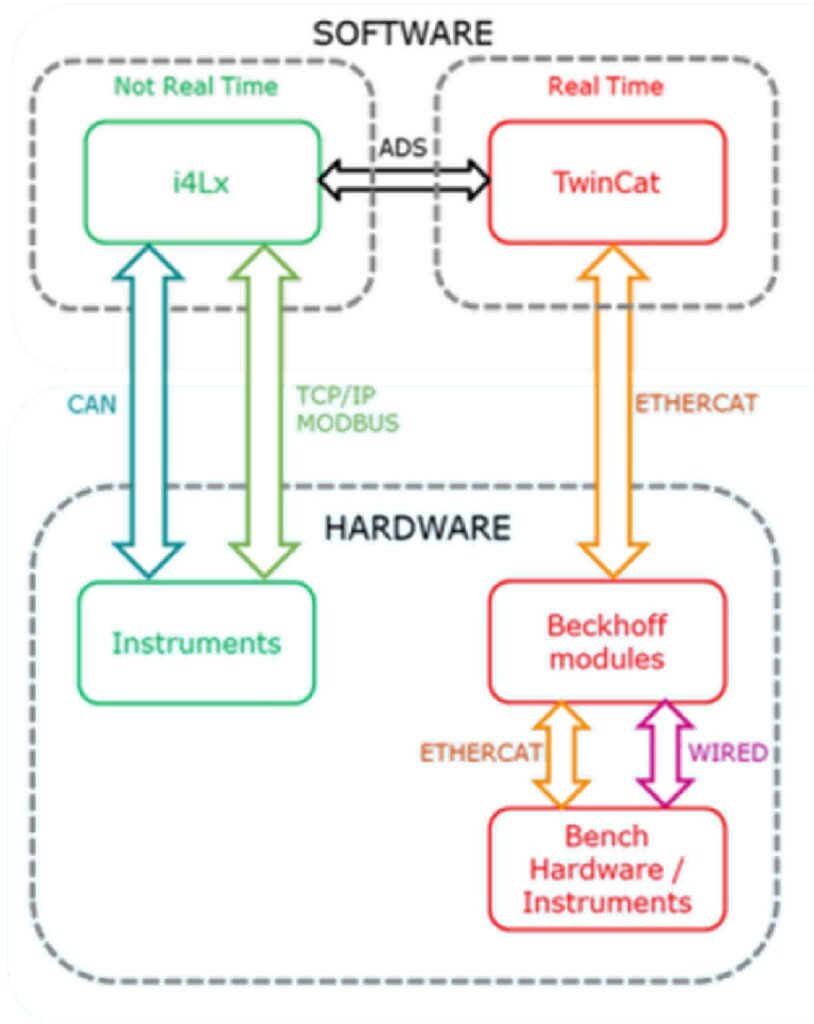
While regulatory definitions provide the framework, the actual implementation of emissions testing takes place within a highly structured software environment. In this work, the procedures have been implemented in the AVL i4Lx automation platform, which coordinates all phases of the test, from initialization to data acquisition and result processing (figure3).
Testing hybrid and electric vehicles requires a multidisciplinary approach that integrates mechanical, electrical, and software systems. The complexity arises from the need to monitor both fuel-based and electrical energy flows.
A typical test cell includes:
- chassis dynamometer for load simulation;
- cooling systems for thermal management;
- gas analyzers for emissions measurement;
- automation software for test control.
For electrified vehicles, additional components are required:
- battery monitoring systems (soc tracking);
- power analyzers (voltage, current, energy flow);
- high-voltage safety systems;
- control logic for hybrid operation.
ICE Vehicles
The testing process for ICE vehicles begins with the configuration of the test environment. The operator selects the appropriate test parameters, including vehicle characteristics, environmental conditions, and the driving cycle to be used. This configuration phase is not merely administrative; it defines the boundary conditions that ensure the validity of the test.
Once the system is configured, the WLTP speed trace is loaded into AVL DriverAid system. This step is critical, as the entire test depends on the driver’s ability to follow the prescribed speed profile. AVL DriverAid interface provides real-time feedback, showing both the target speed and the actual vehicle speed, along with the allowable deviation.
When the test begins, the vehicle is driven on the chassis dynamometer, and all relevant data—emissions, fuel consumption, engine parameters—are recorded continuously. The automation software ensures synchronization between the various measurement systems, guaranteeing that all data are aligned in time.
OVC-HEVs Vehicles
For OVC-HEVs, the test procedure becomes significantly more dynamic. The software must not only control the execution of the driving cycle, but also monitor the internal state of the vehicle, particularly the battery SOC.
In charge-depleting testing, the procedure starts with a preconditioning phase, followed by the execution of the WLTP cycle. At the end of each cycle, the software evaluates whether the break-off condition has been reached. If not, the cycle is automatically repeated. This loop continues until the system detects that the vehicle has transitioned to charge-sustaining operation.
One of the most delicate aspects of this procedure is the handling of the break-off event. When the break-off condition is reached, the test must be terminated in a controlled manner. The vehicle cannot simply stop abruptly; instead, it must decelerate smoothly to a standstill within a defined time window. This requirement ensures both safety and consistency across tests.
In charge-sustaining testing, the procedure is more straightforward. After preconditioning, the vehicle performs a single WLTP cycle. Since the energy balance is stable, there is no need for repetition or break-off detection.
When combined testing modes are used, the software must manage transitions between phases. This includes tracking the completion of preconditioning, identifying the current test level, and ensuring that each phase is executed in the correct sequence. The complexity of this logic highlights the importance of automation in modern emissions testing.
NOVC-HEVs Vehicles
The testing procedure for NOVC-HEVs reflects their simpler operating principle. After preconditioning, the vehicle performs a single WLTP cycle under charge-sustaining conditions. The absence of external charging and charge-depleting operation eliminates the need for cycle repetition and break-off logic.
However, the software must still ensure that the vehicle is correctly initialized and that all measurement systems are synchronized. Even in a simplified scenario, precision remains essential.
PEVs Vehicles
For PEVs, the testing procedure focuses on energy rather than emissions. In consecutive testing, the WLTP cycle is repeated until the battery is depleted. The software continuously monitors vehicle performance, and the test is terminated when the break-off condition is reached (figure 4).
In shortened cycle testing, the procedure becomes more structured. The software alternates between dynamic segments and constant-speed segments, managing transitions and ensuring that the vehicle follows the prescribed profile. The break-off condition typically occurs during the second dynamic segment, marking the end of the test.
What distinguishes PEV testing is the need to integrate electrical measurements into the evaluation. Energy consumption is calculated based on both the energy drawn from the battery and the energy recharged from the grid, providing a comprehensive picture of vehicle efficiency.
Conclusion
The increasing complexity of vehicle powertrains has transformed emission testing from a purely mechanical procedure into a multidisciplinary process involving advanced software, control logic, and regulatory compliance.
Hybrid and electric vehicles require sophisticated testing methodologies that account for multiple operating modes, energy flows, and system interactions. The integration of automation platforms such as AVL i4Lx enables the implementation of these complex procedures in a reliable and repeatable manner.
Ultimately, accurate emissions testing is essential not only for regulatory compliance but also for guiding the development of cleaner and more efficient vehicles. By combining advanced technology with rigorous standards, the automotive industry can continue its transition toward sustainable mobility.
(by Sajad Ali Hosseini, Chiara Ramella, Andrea Mura, Politecnico di Torino – Andrea Cricchio, Salvatore Villani, Giulio Marmorato, AVL Italia Spa)