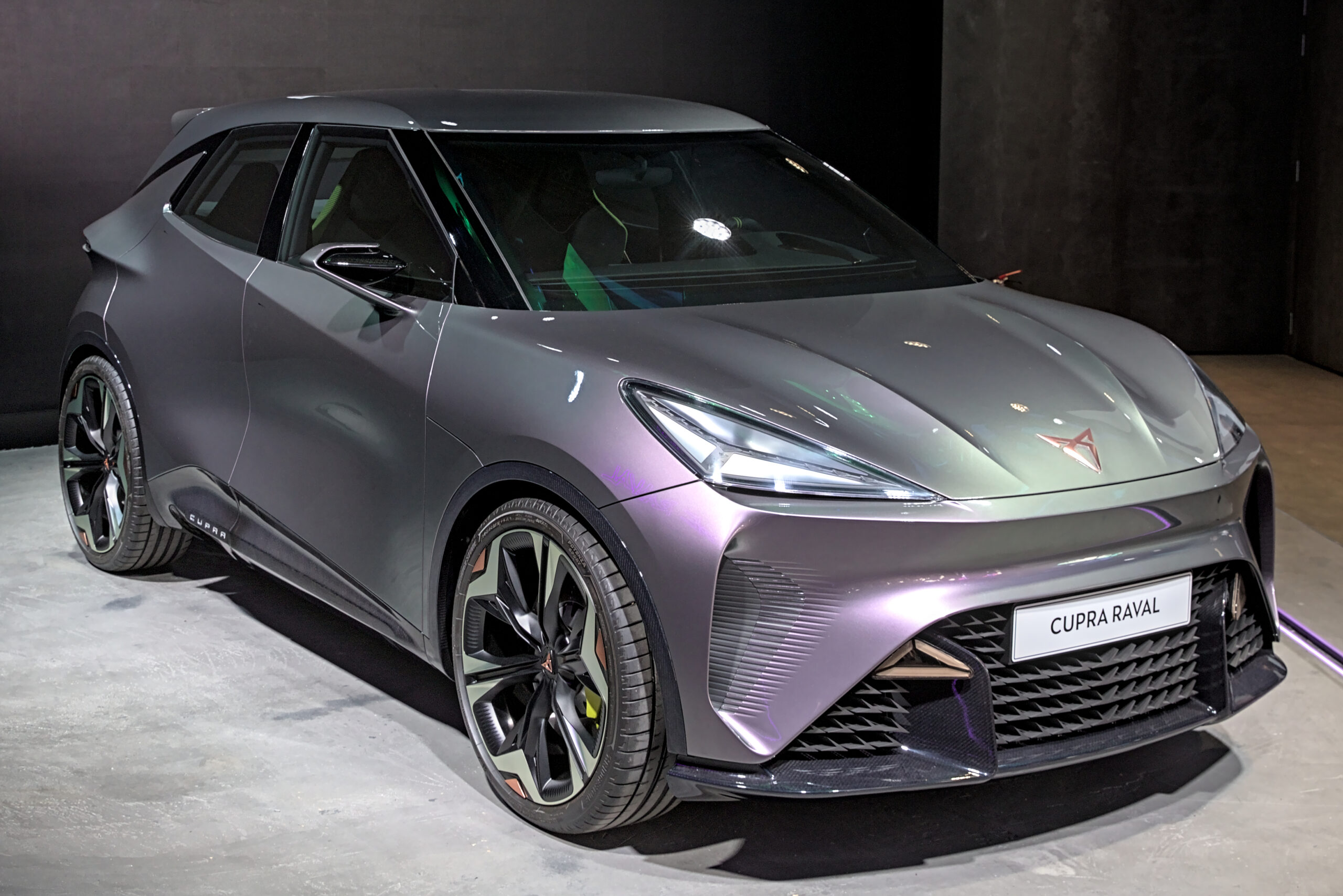
Due in 2027, CUPRA’s compact Raval debuts the MEB+ front‑drive platform in the city‑car segment, pairing a high‑density electric motor and battery with a distinctly sporty chassis setup.
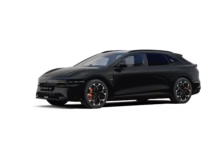
CUPRA Raval is the model tasked with opening CUPRA’s new family of urban electric vehicles, and it is also the brand’s first production car on the new MEB+ platform in compact form. It measures around 4.05 metres in length with a 2.60-metre wheelbase and front-wheel drive, combining tight urban dimensions with a price positioning expected to start at about 26,000 euros in Europe, and a focus on making electric mobility more accessible. Within this framework, CUPRA has developed a high‑density electric powertrain paired with a deliberately sporty chassis, while targeting a driving range of up to 450 km on the homologation cycle.
Built on the Volkswagen Group’s modular MEB+ architecture, the Raval represents an evolution of the original MEB platform, with an emphasis on higher‑density battery packs and more efficient energy management. In this compact application, the architecture is configured with a single electric motor on the front axle, a choice that frees space in the central tunnel and rear area and makes it easier to integrate the battery pack into the floor. CUPRA has confirmed two battery options, aimed at covering a range that starts at roughly 400 km for the more performance‑oriented versions and rises to about 450 km for the most efficient variants. The use of MEB+ in this urban format allows engineers to work with a low centre of gravity and a favourable weight distribution, even with traction concentrated at the front.
At launch, CUPRA anticipates three power levels for the Raval, all based on a single front‑mounted synchronous electric motor. The Dynamic and Dynamic Plus versions deliver 155 kW, with a claimed range of up to about 450 km, while the VZ Extreme variant increases output to 166 kW and 290 Nm, with an operating range of around 400 km. From a powertrain engineering perspective, focusing on a single front motor reduces mechanical complexity and cost, freeing resources for more advanced power electronics and refined torque‑control strategies. The combination of this layout with a VAQ differential, ESC in Sport mode and the possibility to fully deactivate stability control on the VZ Extreme highlights CUPRA’s intent to exploit the instantaneous torque delivery of the electric motor as a defining dynamic feature. The adoption of 19‑inch wheels with 235‑section tyres also reflects the need to manage load transfer and traction in a context where peak torque is available immediately at the driven axle.
To support the Raval’s explicitly sporty character, the chassis sits 15 mm lower than a standard set‑up, with specific suspension tuning and a progressive steering system designed to emphasise front‑end response. The MEB+ platform also enables close integration of driver‑assistance and control systems; CUPRA references Travel Assist with automated lane‑change capability, traffic‑light recognition, Intelligent Park Assist and a 360‑degree Area View. On mid‑trim versions such as Dynamic Plus, systems engineering is further complicated by the presence of Matrix LED headlights, bucket seats and a premium audio system, all of which demand careful attention to the vehicle’s overall energy budget, especially in urban use with frequent on‑off cycles. The outcome is an electric city car that attempts to reconcile efficiency with driving dynamics, using software – from traction control to ADAS – as a genuine multiplier of perceived performance.
From an industrial standpoint, the CUPRA Raval is the first visible step in the Volkswagen Group’s “Electric Urban Car” strategy, with series production planned at the Martorell plant. The adoption of MEB+ in a compact, front‑wheel‑drive package allows CUPRA to experiment with high‑density powertrain solutions in a price bracket starting at roughly 26,000 euros, paving the way for a new generation of urban electric cars where the motor is no longer just a component but a key element of brand differentiation.