

Cleantech: a strategic driver for economic growth, employment and competitiveness.
The definition of Cleantech applies to a set of processes and technological solutions aimed at reducing environmental impact by improving energy efficiency and, of course, promoting decarbonization. The School of Management of the Politecnico di Milano and its team of consultants and researchers, Energy & Strategy, recently addressed the topic at a dedicated event, in firs place describing and defining their fields of investigation.
Essentially, there are three areas:
- energy generation from renewable sources;
- infrastructure and storage;
- finally, consumption efficiency (also) through the adoption of specific tools.
Photovoltaic and wind power, and – as energy vector producers – biomethane and electrolysis plants are part of the first grouping. The second encompasses traditional and alternative energy storage systems and HV/EHV transmission networks; as well as electric vehicle charging networks. Residential and industrial energy efficiency, heat pumps, and waste recycling technologies fall within the third. What’s important to point out, as Davide Chiaroni – co-founder and deputy director of Energy & Strategy and professor of Strategy & Marketing at Politecnico di Milano – did, is that in Italy, interest in clean technologies is growing, together with investments.

More benefits than costs
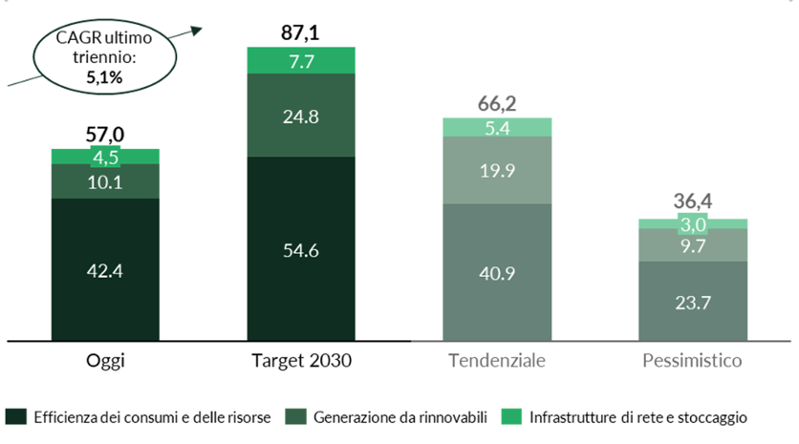
«Our investigation», Chiaroni said, «was conducted along two distinct paths. On the one hand, we initially sought to outline an economic perspective of the current or potential budgets involved and the effects on the country’s economy; on the other, we focused on the employment implications and therefore on the favourable impacts for workers who are engaged in the aforementioned sectors». As anticipated, significant sums are at stake. Direct investments in Cleantech in Italy amount to 57 billion euros, but on top of these there are 5 more billion euros, in terms of added value. The figures expressed, once again in terms of added value, from other collateral sectors of the industry are no less impressive, and the same can be said for earnings derived from the supply chain, to which logistics activities and related services contribute: they total approximately 25 billion euros overall. «To get an idea of the importance that clean technologies have already achieved», Chiaroni continued, «just consider the fact that the wood and furniture sector generates a turnover equivalent to approximately 51 billion euros and is considered a flagship of Made in Italy. The automotive industry is no less renown but its business is only slightly higher because it amounts to 60 billion» The most interesting aspect is that we are only at the very beginning and the untapped potential is still enormous. For this to materialize, it is necessary to overcome «that degree of scepticism that still surrounds» the world of green energy and its supply chain. We are now at a classic crossroads. «The figures cited», Davide Chiaroni explained, «are likely to double between this same year and the end of this decade, if we only choose to decisively embrace the sustainable transition. Otherwise, the risk is that of a marked decline towards the 30 billion euros threshold overall». Therefore, everything depends on the will to continue investing in these areas. It has been proven that positive evolution is entirely accessible and within reach and no transformation is impossible.
Time for consolidation
The Energy & Strategy team and the Politecnico have already identified areas that, for various reasons, can achieve the most ambitious goals. These include energy efficiency in general and renewable energy sources, which already show a reasonably broad reach and a solid pool of expertise waiting to be properly consolidated. «Nevertheless», reflected the Deputy Director and co-founder of Energy & Strategy, «storage systems have significant chances of development and a strong dose of innovation written into their DNA. Nor can we forget the development horizons of hydrogen: in 2030, however, it could still play a negligible role, and the reason is that although the components are advanced, integrators are lacking and it is difficult to build a strong supply chain». A further obstacle is the fact that to be truly efficient, hydrogen must also be produced from renewable sources: a surge in costs is therefore to be expected. «Certainly», Chiaroni admitted, «matching efficiency, sustainability, and cost-effectiveness is not easy at all. At the same time it is true, however, that other European partners are also involved in these plans, and the creation of a robust component supply chain can undoubtedly provide several attractive export opportunities» The electrification of industry is an additional topic, that probably deserves to be further explored in the future. «It is closely connected», he noted, «both to automation and digitalization. From this perspective, the ideal virtuous circle requires that the installation of digital and electrical solutions goes hand in hand with a more rigorous control of consumption and, consequently, its optimization in order to achieve the goal of environmental sustainability. There is also, of course, a downside: given this scenario, powerful data centres are indispensable, but their requirements, in terms of energy demand and consumption, are remarkable. Hence, these aspects need to be harmonized».
A goldmine for employment
As anticipated, cleantech is – theoretically at least – a rich goldmine for employment as, according to the Energy & Strategy study, its growth could open up at least 50,000 new positions in the next four to five years. It’s not just about engineers and specialists; it’s not just about graduates. «For instance», Chiaroni explained, «there’s a deep need for technicians and maintenance workers at a time when these skills are perhaps harder to find than others. While the Italian average of graduates in STEM disciplines is low, compared to other EU countries, secondary technical education is also struggling. The gap between graduates who can adapt to the industry and the total is around 90%». This raises an additional and almost decisive challenge for the future of clean technologies, on two distinct fronts. «The goal is that to develop skills suited to the new scenario and the related market, while also ensuring that certain roles become more attractive. Sometimes, we look at such professionals as electronic engineers as if, more or less, they were mere circuit designers. On the contrary, they are, or must become, experts in digitalization and digital twins, virtual and augmented reality, drones, and remote control of production systems; not least, in preparing sustainability reports. These roles are today much more focused and devoted to innovation than they used to be». Chiaroni went further, by emphasizing that Cleantech requires «transversal skills» or even more precisely, «it stands out for its transversality» In the field of Cleantech, demand includes traditional and renewable energy system engineers, knowledge of reuse and recycling, and the circular economy; plus, finally, measurement systems and metrology. The employment landscape seems ready to welcome both hands and brains, or at least that’s the impression Davide Chiaroni gained from discussions with companies and industry associations. «At the public meetings I’ve attended recently», he concluded, «I’ve noticed that interest among managers and association representatives is consistently growing, reflecting a shared vision. I believe the industry itself recognizes and appreciates the value of Cleantech, and it’s no coincidence that efforts are increasing, with the aim to raise awareness among young people, provide training, and, finally, to foster empowerment».
| Sector | 2024 | Target 2030 | Growth |
| Renewable energy generation | 20.500 – 24.750 | ≈ 48.400 | up to 27.900 |
| Network and storage infrastructures | 7.000 – 13.300 | ≈ 12.400 | up to 5.400 |
| Consumption and resource efficiency | 90.000 – 97.500 | ≈ 111.800 | up to 21.800 |
| Total amount | 117.500 – 135.550 | ≈ 172.600 | up to 55.100 |
Table 1 – Jobs in Cleantech: employee growth (Source: Energy & Strategy Group)
Investments in renewable energy in Italy could grow significantly over the next five years, reaching a 2-2.5 times greater volume. This growth depends largely on the development of biomethane and on that of the electrolyzer market. Currently, investments are primarily focused on photovoltaic and wind power, but the potential associated with new technologies is quite significant. Investments in networks are expected to remain stable, combined with the strengthening and expansion of the existing infrastructure. In storage, a reduction in investment costs and a significant growth are both expected thanks to the launch of the MACSE (the Electricity Storage Capacity Procurement Mechanism) but the procurement of components and raw materials is significantly impacted by the geopolitical context. As for EV charging, a slight slowdown in the installation of charging points is to be considered, due to the misalignment between electric vehicles and charging points, with a consequent market downsizing. In 2030, the growth of the energy efficiency market depends on the evolution of incentives and the ability to revitalize after the current slowdown. The most favourable scenarios predict a recovery driven by the residential sector and heat pumps, with a positive contribution from the industrial segment as well.(Source: Energy & Strategy Group)
(by Roberto Carminati)