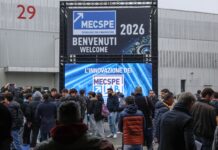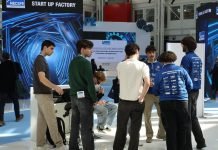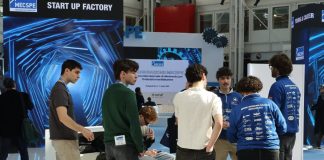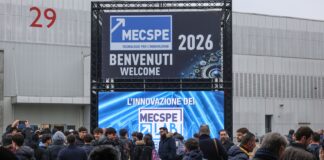
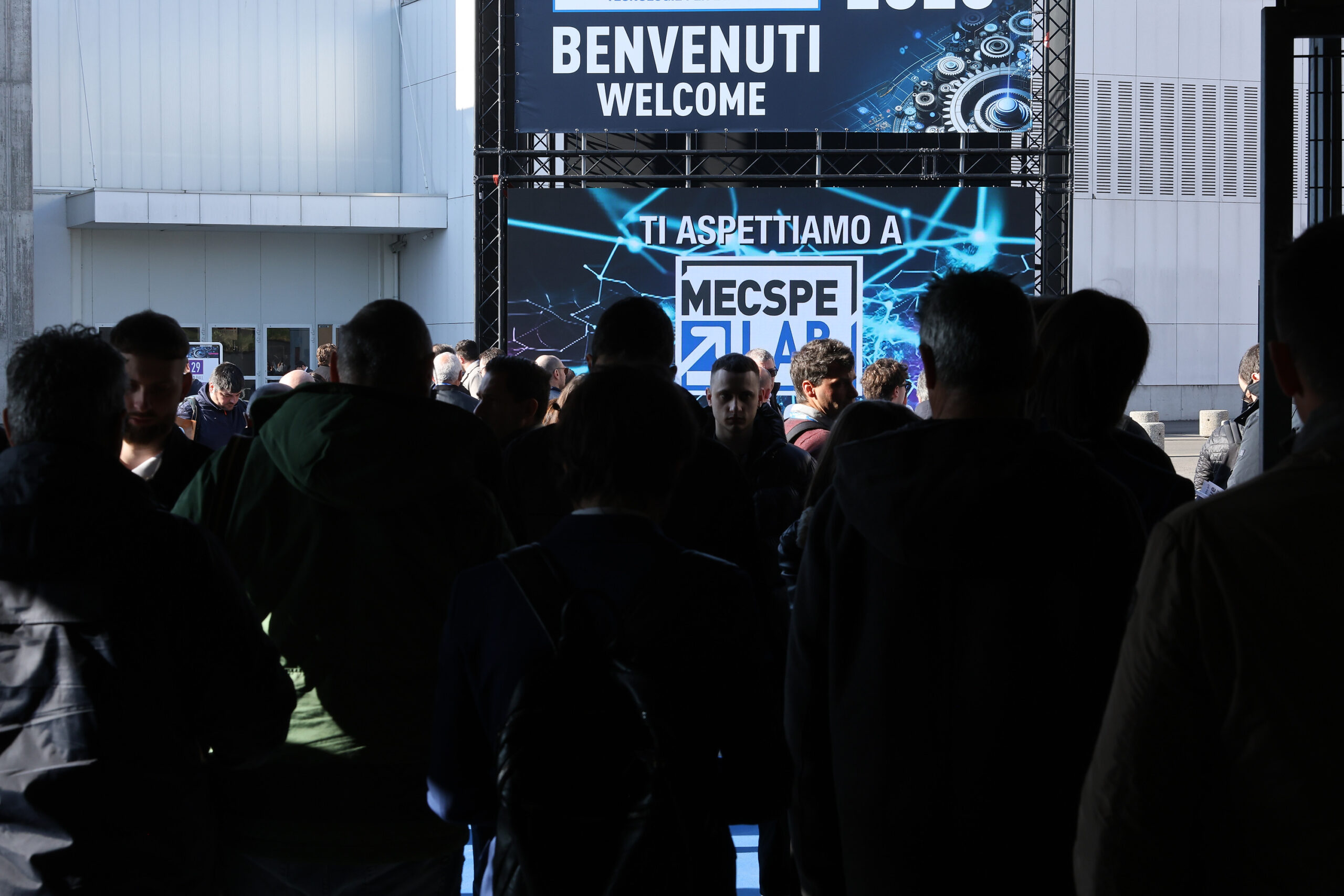
Advanced technologies, human capital and supply chain relationships: among the models showcased at MECSPE 2026 in Bologna, the Relational Factory. Over 2,000 exhibiting companies, technologies and skills at the heart of the new manufacturing model.
A leading trade fair for the Italian manufacturing industry
From March 4 to 6, 2026, MECSPE returns to BolognaFiere, confirming its role as the leading trade fair for the Italian manufacturing industry and a key meeting point for production technologies, industrial supply chains and expertise. Now in its 24th edition, the event will bring together over 2,000 Italian and international exhibiting companies, organized into 13 thematic halls and 15 special initiatives, hosting 12 trade associations and offering a structured program of events and conferences designed to support companies in their technological innovation, training and production model transformation journeys.
The 2026 edition of MECSPE will focus on the three pillars that have always defined the exhibition – innovation, training and sustainability – introducing, in this new edition, the concept of the Relational Factory, a new manufacturing model that interprets innovation as the result of interaction between advanced technologies, human capital and supply chain relationships, moving beyond an exclusively technology-driven vision of the factory. This evolution marks the transition from rigid and hierarchical production models to more flexible, collaborative and learning-oriented organizations, where people, machines and digital systems cooperate in real time. In an increasingly complex industrial landscape, characterized by widespread digitalization, automation and intensive data use, companies’ competitiveness increasingly depends on their ability to integrate technological solutions with skills development and structured dialogue between industry, academia and research.
A highly relevant topic, as also highlighted by the results of the MECSPE Observatory, which show that AI is generating growing interest, with 73% of entrepreneurs expressing confidence in its positive impact on industry. AI is increasingly perceived as an accelerator of innovation and a tool capable of simplifying and speeding up production processes. Forty percent of companies have already launched applications in areas such as process supervision, customer service, planning or quality control, although only one in four has so far managed to integrate it on an ongoing basis.
In line with MECSPE data, findings from ASCOMUT (the Italian Association of Machine Tool, Tooling and Equipment Manufacturers and Distributors), which developed the Artificial Intelligence Observatory, show that artificial intelligence is entering companies not as a mere technological trend, but as an operational lever to improve efficiency, process quality and market responsiveness. At the same time, some structural challenges are emerging: 52% of companies report a lack of clear use cases, while 39% cite a shortage of internal skills as one of the main obstacles to AI adoption. Particularly significant is the training-related figure: only 13% of companies state that they have launched structured training programs on artificial intelligence.
In this context, MECSPE positions itself as a promoter of the Relational Factory, enhancing the role of exhibitors not only as technology solution providers, but as active players in building ecosystems of expertise capable of connecting companies, universities and research centers. The technologies presented at the fair—from artificial intelligence to automation, from process digitalization to interconnected factory models—are thus placed within a broader vision, in which innovation is closely linked to people, organization and the ability to manage change. This approach is consistent with emerging trends in the manufacturing sector, where the effective adoption of innovation increasingly depends on governance, skills development and structured processes, in addition to the introduction of new technological tools.
The crucial link between business and academia
Particular attention is devoted to the link between business and academia, a central element of the Relational Factory and a strategic lever for addressing the growing demand for new skills currently characterizing manufacturing. In this context fits the participation of NEOS, an exhibiting company at MECSPE 2026 specializing in the reorganization and efficiency improvement of industrial processes, with solutions dedicated to integrated management and optimization of Supply Chain Planning & Execution. NEOS is involved in a project developed in collaboration with Prof. Flavio Tonelli and Prof. Marco Mosca of the University of Genoa, aimed at fostering knowledge transfer between research and industry, experimenting with innovative technological solutions, and developing skills capable of supporting the evolution of production processes. This path also includes the development of NICIM AI, a platform that interprets the factory as a living and cognitive ecosystem, in which people, processes and artificial intelligence cooperate through distributed intelligence models capable of learning, adapting and reacting in real time.
“The Relational Factory represents the shift from an intelligence that controls to an intelligence that cooperates. With NICIM AI, we wanted to go beyond traditional factory management models by building a platform that does not rigidly govern processes, but orchestrates them by connecting people, data and technologies,” says Paolo Campo, founder of NICIM. “It is an approach that enhances distributed intelligence and collaboration between human beings and digital systems, transforming the factory into an organism capable of learning, adapting and reacting in real time. A new way of thinking about manufacturing—more human, more fluid and closer to the real needs of those working within production processes.”
Through its thematic halls, special initiatives and numerous networking opportunities, MECSPE 2026 presents itself as a true ecosystem of connections, where technology, training and relationships become enabling factors for industrial competitiveness and for the growth of an increasingly advanced and aware manufacturing sector.
“The Relational Factory is an innovation that marks the evolution of manufacturing,” states Maruska Sabato, Project Manager of MECSPE. “Technological innovation must go hand in hand with skills development and with companies’ ability to build strong relationships with academia and the entire supply chain. MECSPE aims to be the place where these connections take shape, offering companies concrete tools to address the challenges of industrial transformation.”
With the 2026 edition, MECSPE confirms its role as a catalyst for manufacturing innovation, promoting a new factory model that is increasingly connected, collaborative and people-oriented, where technology and human capital grow together.
For more information: www.mecspe.com/en