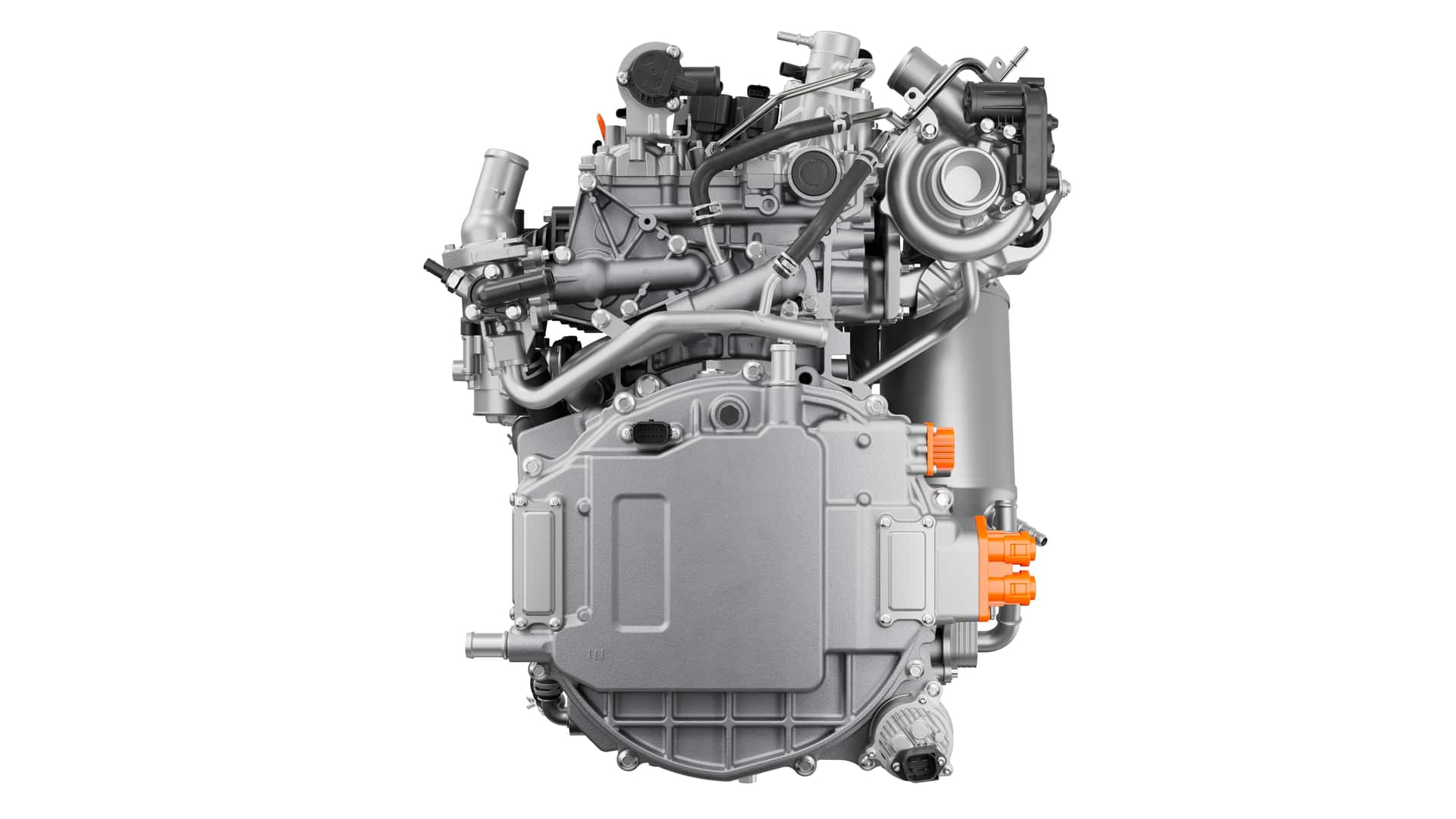
The HORSE D20 Methanol combines a compact dual-rotor axial-flux generator, SiC power electronics and a 2.0-litre engine in a 170 kg integrated unit for range-extended electric vehicles.
Horse Powertrain, the powertrain joint venture backed by Renault Group, Geely and Aramco, has unveiled the D20, a project that reflects the company’s focus on electrified architectures in which internal combustion engines support electric propulsion as onboard energy generators.
The system combines a turbocharged four-cylinder methanol engine, an axial-flux generator and power electronics in a 170 kg assembly. Rated at up to 105 kW at system level, it generates electricity for the vehicle battery without any mechanical connection to the driven wheels.
A dual-rotor axial-flux generator
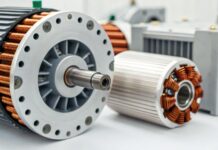
At the heart of the system is a yokeless axial-flux electrical machine mounted directly on the engine crankshaft. Its architecture consists of a single stator positioned between two disc-shaped rotors.
Unlike a conventional radial-flux machine, in which the magnetic field travels radially between a cylindrical rotor and the stator, the D20 generator directs the magnetic flux along the rotational axis. This disc-shaped configuration reduces axial length and increases the proportion of active electromagnetic material within the available volume.
According to Horse Powertrain, the generator is 46% shorter than an equivalent radial-flux unit and achieves 63% higher volumetric power density.
In this application, the axial-flux architecture is used to reduce the dimensions of the complete engine-generator assembly, an important consideration in range-extended vehicles, where the combustion engine, electrical machine, inverter and cooling system must coexist with the battery and traction components.
The generator offers a continuous output of between 100 and 120 kW, depending on the configuration, and can be integrated into both 400 V and 800 V vehicle platforms.
Direct mechanical and electrical integration
Mounting the generator directly on the crankshaft eliminates the need for a separate transmission between the combustion engine and the electrical machine. This reduces the number of rotating components and can limit mechanical losses while simplifying the overall assembly.
Since the engine is not mechanically connected to the wheels, it can operate independently of vehicle speed. Its operating points can therefore be selected according to electrical demand and optimized within the most favourable regions for efficiency, emissions and noise.
The battery continues to supply the traction motor, while the D20 generates electricity when the state of charge falls below a defined threshold or when the propulsion system requires additional energy.
SiC power electronics and immersion cooling
Horse Powertrain reports a peak electrical-machine efficiency of 96.4%. The generator integrates an immersion-cooling system and a silicon-carbide power module designed to reduce conduction and switching losses.
The use of SiC devices supports higher switching frequencies and can reduce the size of passive components, although it also increases the importance of coordinated thermal management.
In the D20, immersion cooling removes heat directly from the active components, helping to control the temperatures of the windings, semiconductors and magnetic materials within a compact assembly. This may allow the machine to sustain higher continuous loads without relying exclusively on an external cooling jacket.
Horse Powertrain states that the D20 can start on pure methanol at temperatures down to –35 °C. Other technical specifications released by the company refer to a target of –40 °C, suggesting that the final value may depend on the test conditions or system configuration.
47% methanol-to-electricity conversion efficiency
In laboratory testing, Horse Powertrain measured an overall methanol-to-electricity conversion efficiency of 47%. This corresponds to approximately 1 kWh of electrical energy generated for every 2.1 kWh of fuel energy consumed.
The company estimates that 19.6 litres of methanol can produce 40 kWh of electricity.
This value refers to the output of the range extender rather than to the energy actually transferred to the wheels. Overall vehicle efficiency will also depend on inverter losses, battery charging and discharging, traction-motor performance, auxiliary consumption and the energy-management strategy.
A possible route towards mass production of axial-flux machines
Axial-flux machines offer high torque and power density, but their industrialization remains more complex than that of established radial-flux solutions. Manufacturing challenges include stator construction, rotor tolerances, magnet assembly, thermal management and the control of axial electromagnetic forces.
Using the technology as a generator may offer a more manageable route towards automotive-scale production. Compared with a traction motor, the machine can operate within a narrower and more predictable working range, potentially simplifying its electromagnetic design, cooling requirements and control strategy.