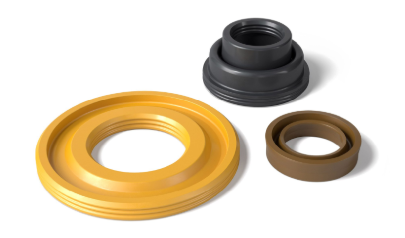
In electric motors and compact mechatronic systems, tolerances management is becoming a decisive design factor. Connectors, cable feedthroughs, service ports and functional interfaces are increasingly integrated into cast, moulded or formed housings, where dimensional variability can challenge conventional static sealing solutions. Parker Hannifin’s Prädifa Technology Division addresses this issue with its new Warp Seals, adaptive sealing elements designed to compensate for axial, radial and angular tolerances in ports, feedthroughs and plug connections.
The development responds to a very practical manufacturing challenge. Many housings and connection points used in automotive, industrial, HVAC, off-road, aerospace and electrified applications are produced by high-pressure die casting, plastic injection moulding, sheet metal forming or similar processes. These technologies are efficient and cost-effective, but the tolerances they can achieve economically are often relatively wide. When the resulting tolerance chains exceed the reliable operating range of standard seals, manufacturers may face rework, stricter production specifications, more complex assembly procedures and higher warranty risks.
The concept behind Parker Prädifa’s Warp Seals is therefore based on a shift in design logic: instead of requiring the component to fit the seal profile perfectly, the seal is engineered to adapt to the real assembly space. This approach is particularly relevant for electric motor manufacturers, drive systems, cooling units, power electronics and electrified subsystems, where high functional density and compact layouts leave little room for dimensional deviations.
The seals are designed to provide reliable sealing of housing openings, ports, feedthroughs and plug connections even where conventional static seals reach their limits. Available in several variants, the product family can meet different assembly-space geometries and tolerance-compensation requirements. Parker also highlights the use of suitably adapted materials, intended to provide resistance to a wide range of media and environmental influences.
From an engineering perspective, the benefit is twofold: reliable sealing can be maintained despite significant dimensional variation, while assembly can be simplified without imposing excessive design restrictions or additional manufacturing steps. Depending on the design, Warp Seals can also function as pressure relief valves, further extending their application potential.
For the electric motor sector, possible uses include cable and busbar feedthroughs, sensor passages, interfaces between housings and connectors, sealing elements in cooling systems and auxiliary components mounted on compact enclosures. In electrified systems, where environmental protection, compactness, process reliability and ease of assembly must coexist, adaptive sealing can contribute to a more robust overall design.
Parker indicates a broad application range for the new seals, including automotive, aerospace and defence, HVAC, industrial manufacturing equipment, mechanical engineering, off-road machinery, hydrogen and fuel-cell engineering, electrification and electric mobility. The technology may also be used for rods and pistons in hydraulic and pneumatic systems.
With Warp Seals, Parker Prädifa positions sealing technology as an active contributor to tolerance management rather than a purely passive interface. For manufacturers working with complex housings and compact electrified architectures, this represents a practical route to reducing assembly effort, controlling costs and improving sealing reliability.