For years, the conventional assumption in marine electrification has been relatively straightforward: significant propulsion power requires high voltage. As electric and hybrid systems have evolved, architectures operating at 400 or even 800 volts have become increasingly common, particularly in larger yachts, commercial vessels and high-performance applications where energy throughput and efficiency are critical.
German company Molabo has taken a different approach. Rather than moving toward higher voltages, the company has focused on extending the capabilities of low-voltage propulsion systems, developing a 48 V architecture capable of delivering up to 50 kW of power.
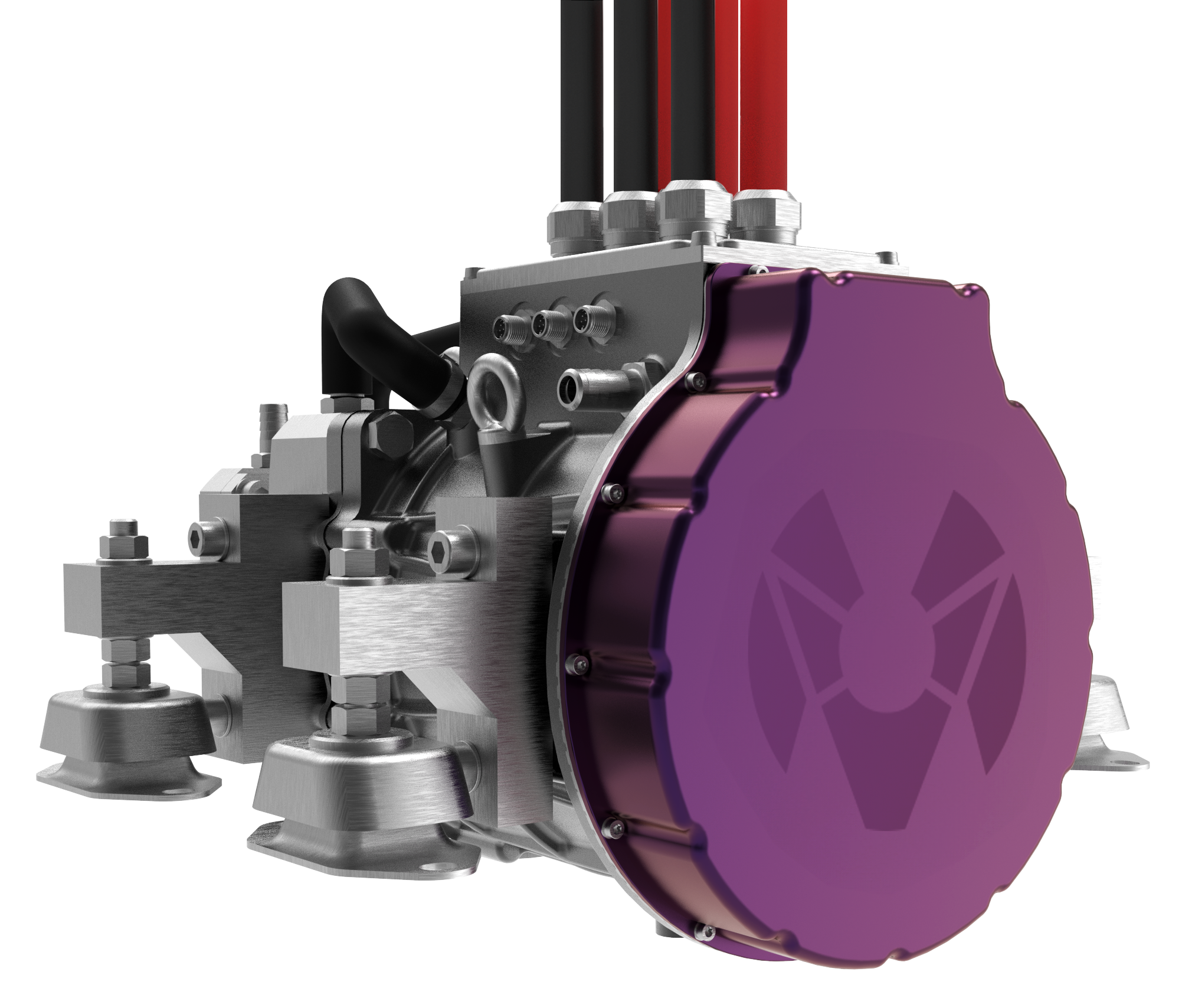
The result is the ARIES platform, a fully integrated electric propulsion system that combines motor, inverter, control electronics and energy management within a unified low-voltage framework. Developed for both inboard and outboard applications, the platform is now being used across a wide range of marine sectors, from sailing yachts and leisure craft to racing boats and hybrid commercial applications.
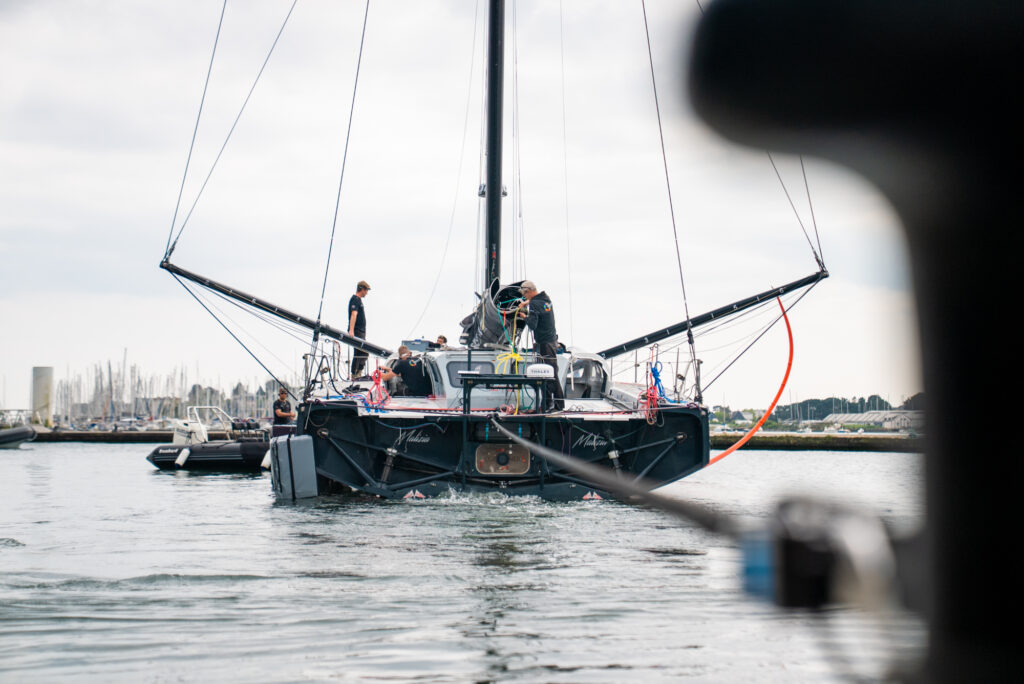
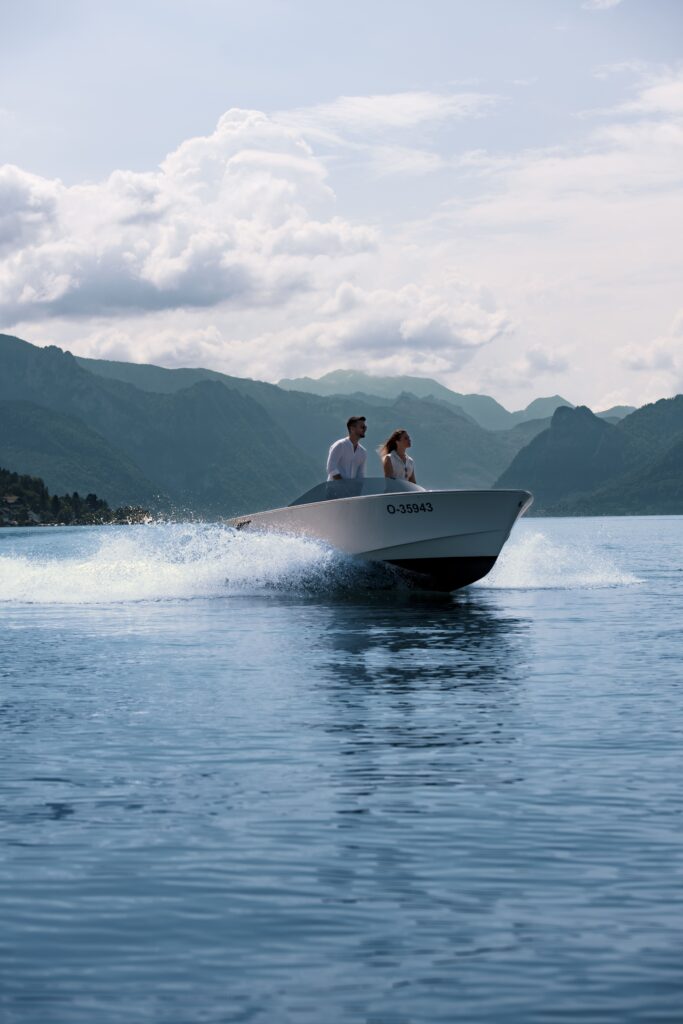
Recent developments, including a serial hybrid configuration created in collaboration with Fischer Panda and applications such as the solar-electric boat AMY, suggest that low-voltage propulsion is increasingly moving beyond auxiliary functions and small-scale experimentation.
What makes this approach technically relevant is not simply the use of 48 V itself, but the attempt to extend low-voltage architectures into a power range traditionally dominated by high-voltage systems.
From automotive research to marine propulsion
Interestingly, Molabo’s original research was not initially focused on the marine sector.
Speaking with us, Adrian Patzak, COO of Molabo, recalls that the company’s original research was not initially focused on the marine sector. «When we first started investigating low-voltage propulsion back in 2014, we actually were not thinking about boats at all. The original idea came from automotive applications and from a very fundamental engineering question: could you achieve very high power levels without relying on high-voltage systems?»
At the time, electric vehicles such as the Tesla Model S were already demonstrating the advantages of high-voltage architectures. Molabo’s early work instead explored whether similar power levels could theoretically be achieved at very low voltage.
«In fact, our earliest concepts were based on 24 V systems, not even 48 V,» Patzak recalls. «Of course, at those power levels you are talking about enormous currents well above 10,000 amps in theory. But through scientific work and early prototypes, we were able to show that it was technically possible if you designed the system architecture correctly.»
The reasoning behind this research was linked to system simplicity and scalability.
«We believed then, and still believe today, that building a global high-voltage infrastructure is difficult. High-voltage systems require specialized safety procedures, trained technicians, and more complex installation and maintenance processes. We wanted to explore whether there could be another path.»
When 48 V standards began emerging in the automotive sector, Molabo identified the voltage level as a practical compromise between safety, standardization and scalability.
«That eventually became the basis for MOLABO’s patented ISCAD motor technology and for the ARIES platform.»
A serial hybrid system at 48 V
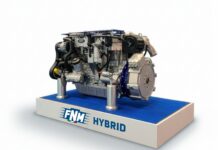
One of the most recent developments built around the ARIES platform is the serial hybrid propulsion system developed together with Fischer Panda.
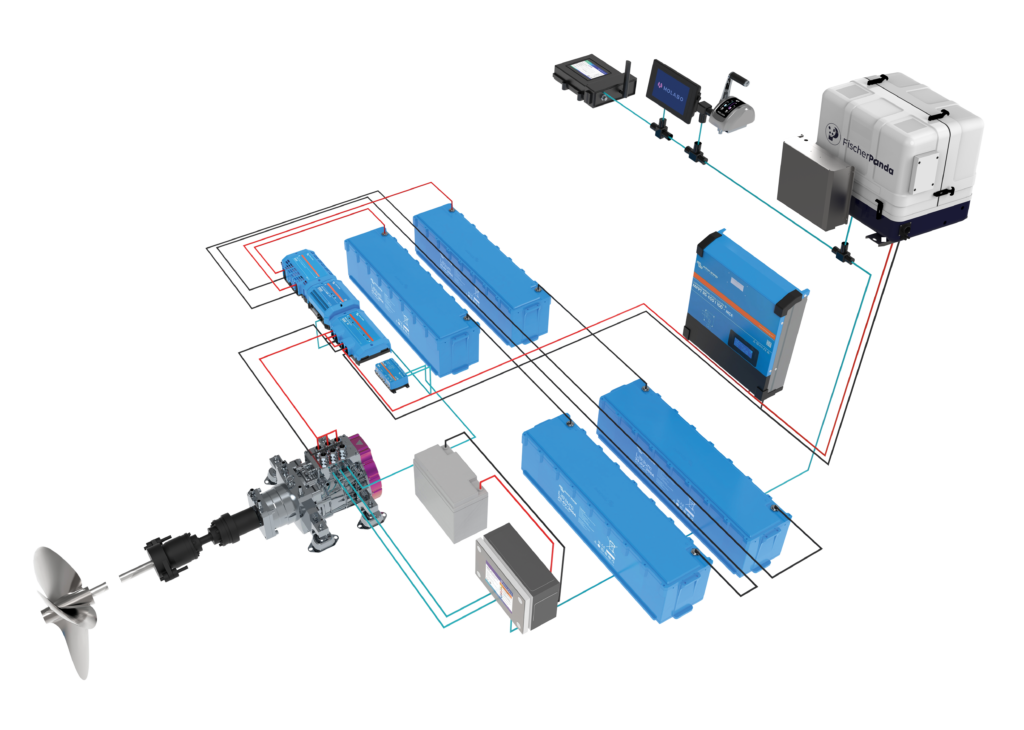
The system combines a DC generator, battery storage and electric propulsion within a unified 48 V electrical architecture designed for electric and hybrid boats. In this configuration, the generator acts as a range extender, supplying power when required while allowing the vessel to operate in fully electric mode under suitable conditions.
The technical relevance of the system lies in the fact that all components – generator, batteries and propulsion – operate within the same voltage domain.
In conventional hybrid systems, energy often passes through multiple AC/DC conversion stages, each introducing losses and additional complexity.
«The biggest advantage is efficiency, because we eliminate unnecessary energy conversion steps throughout the energy path,» Patzak says. «In many conventional hybrid systems, you are constantly converting between AC and DC power. The generator produces AC power, then you convert it back to DC for the batteries and propulsion system, and every conversion introduces losses and additional complexity.»
Within the Fischer Panda collaboration, the entire architecture operates natively on 48 V DC.
«That means the generator, propulsion system, batteries, and energy management are all working within the same voltage domain.»
This configuration also enables hybrid operating modes that would otherwise require more complex system management.
«With the Fischer Panda integration, the vessel can propel electrically while simultaneously recharging the batteries. The generator can directly support propulsion loads while also managing battery charging dynamically.»
The system can additionally automate energy management functions, including generator start-stop strategies linked to battery state of charge.
«So beyond efficiency, the unified voltage architecture simplifies the entire system integration and creates a much more seamless operational concept.»
Engineering high power at low voltage
The central engineering challenge of low-voltage propulsion is straightforward: lower voltage requires higher current in order to achieve the same power output.
Delivering up to 50 kW at 48 V therefore implies extremely high current levels, with direct implications for every part of the drivetrain architecture, including power electronics, thermal behaviour, cabling and mechanical integration.
«The central challenge with low-voltage high-power systems is always current,» Patzak explains. «If you want significant power at 48 V, you inevitably have very high currents, so the entire design has to focus on managing those currents efficiently.»
According to the company, minimizing electrical resistance becomes a primary design objective.
«That means very short cable distances, large conductor cross-sections, excellent electrical contacts, and an architecture optimized specifically for high-current operation.»
One important design decision was to integrate the inverter directly onto the motor in order to reduce resistive losses.
«We did not want long high-current cable runs between the power electronics and the motor because every connection and every additional cable length creates resistance and losses.»
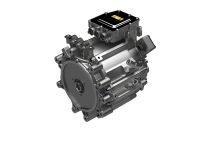
At the core of the platform lies Molabo’s proprietary ISCAD (Intelligent Stator Cage Drive) technology, which rethinks the internal architecture of the electric machine itself.
«We developed a highly parallel multiphase motor design. Instead of concentrating all the current through only a few phases, we spread it across many phases and semiconductor switches. That reduces the current load on each individual component and makes the system much more manageable thermally and electrically.»
The motor also uses a single, solid conductor bar in every stator slot instead of conventional wire windings, with the overall geometry optimized specifically around efficient current handling.
At the same time, Molabo does not position low-voltage systems as universal replacements for high-voltage architectures.
«We never positioned this technology as a replacement for high-voltage energy transmission over long distances,» Patzak points out. «Our philosophy was always focused on compact mobile applications where the battery and motor are physically close together, typically within a meter or less.»
Within these operating conditions, the company sees advantages in terms of safety, installation simplicity and serviceability.
From propulsion unit to integrated platform
Over time, the ARIES system has evolved from a propulsion motor into a broader low-voltage drivetrain ecosystem.
Beyond the motor itself, the platform integrates inverter technology, system control electronics and energy management tools within a unified 48 V architecture. Through its MOLAConnect distribution framework, the system can coordinate batteries, generators and auxiliary systems while maintaining operation within the same voltage domain.
This modular approach allows the platform to support different configurations, from fully electric propulsion systems to serial hybrid arrangements such as the Fischer Panda solution.
Maintaining a single voltage domain simplifies system integration by reducing the need for complex interfaces between subsystems operating at different voltages. At the same time, it requires careful management of power flows, load balancing and thermal stability.
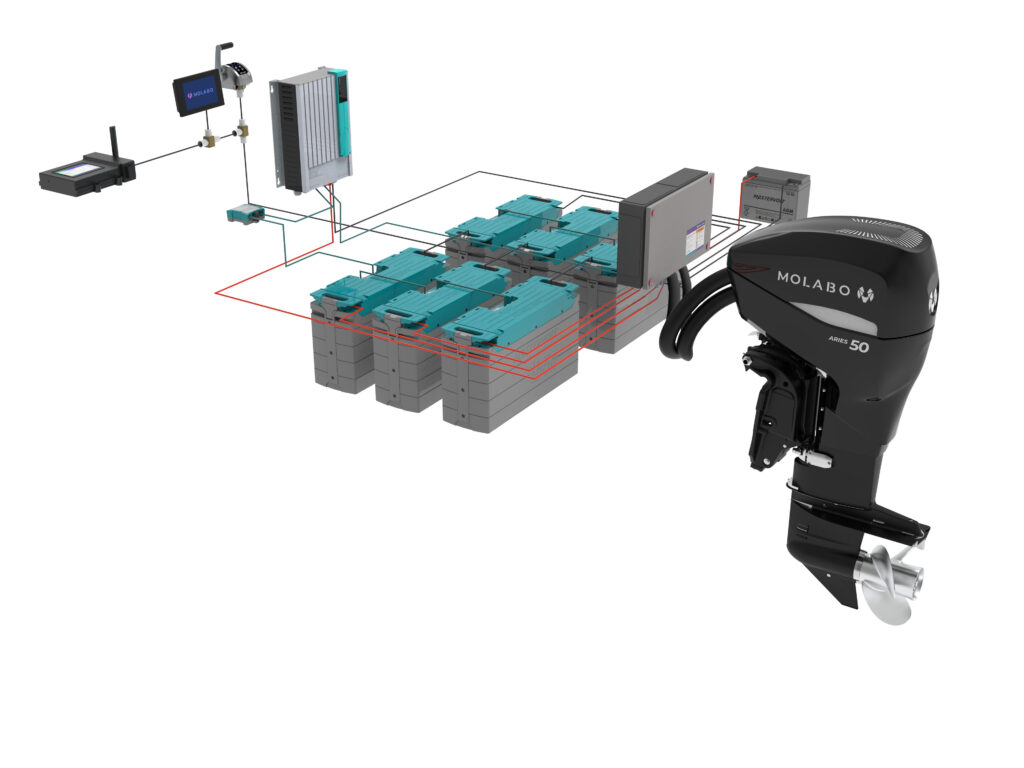
The current ARIES range includes both inboard and outboard propulsion systems. Models such as the ARIES i30 and i50 are intended for inboard applications, while the ARIES R50 extends the same low-voltage architecture into outboard propulsion.
According to Molabo, integration flexibility continues to expand through ongoing mechanical developments.
«One recent development we are seeing strong interest in is a new version of the ARIES 50 with an internally splined shaft interface,» Patzak adds.
While seemingly a relatively small modification, the redesigned coupling geometry allows more compact mechanical integration in applications such as jet drives, motorsport and off-highway systems.
«From an engineering perspective, it is actually a relatively small modification, but it opens up many additional integration possibilities and makes the platform much more flexible.»
Applications across different operating profiles
According to Molabo, the potential application range for low-voltage propulsion is continuing to expand.
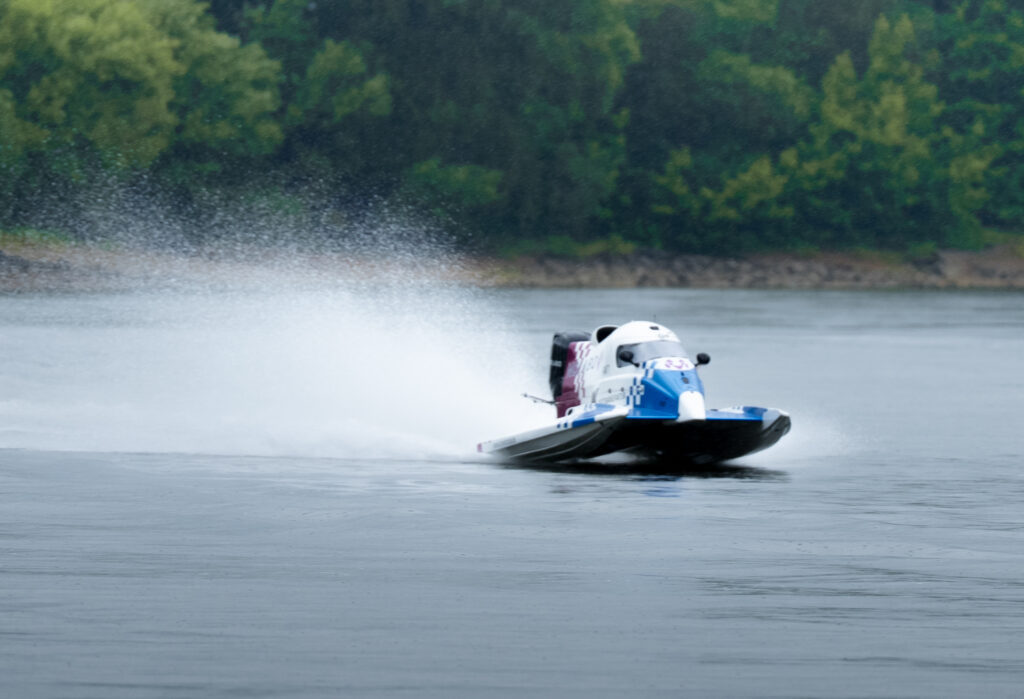
«At the smaller end, we already see applications in personal watercraft, sportboats, and cruising yachts,» Patzak notes. «But at the same time, we are also working on much larger applications such as passenger ferries, houseboats, and commercial workboats using multi-drive configurations.»
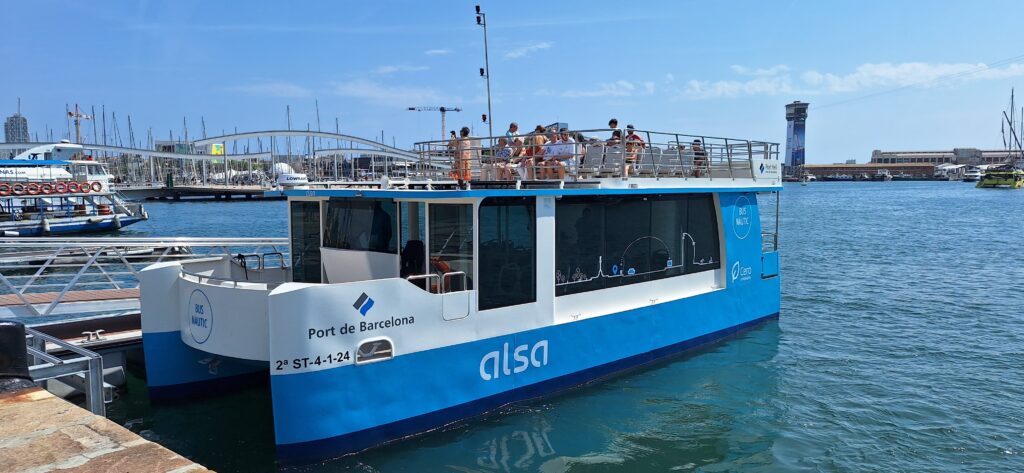
One example is the Barcelona electric ferry project, which explores the scalability of low-voltage architectures beyond recreational boating. «With multi-drive architectures, you can scale the concept quite significantly.»
The company also identifies cruising multihulls and houseboats as particularly suitable applications because of their compatibility with solar integration, hydrogeneration and energy-autonomous operation.
«I would not describe 48 V as a niche solution anymore,» Patzak says. «We increasingly see it as a practical architecture for a wide range of mobile applications.»