
As rare earth elements are becoming more and more critical for the European manufacturing industry, a group of 24 partners from six different nations aims to strengthen the domestic value chain by increasing extraction, improving recycling rates, and fostering research to reduce imports.
Rare Earth Elements: a critical topic
The 17 metallic elements grouped under the definition of Rare Earth Elements or REEs are considered critical for manufacturing electronics, renewable energy technology and advanced defence systems and therefore their importance for the European industry is growing steadily. For instance, such elements as neodymium and dysprosium are commonly used in those powerful permanent magnets which are finally destined to wind turbines as well as to electric motors. As the United States Geological Survey reported, China hosts the largest part of global reserves (33.8%) followed by Vietnam (16.9%) and finally Russia and Brazil (16.1% each). Europe imports 90% of its REEs but at the same time, according to the EU Critical Raw Materials Act, is aiming to increase its domestic capability for annual consumption. The target is to achieve a 10% annual growth for extraction, 40% for processing; 25% for recycling; no more than 25% imports from a third country.
Innovation is the key
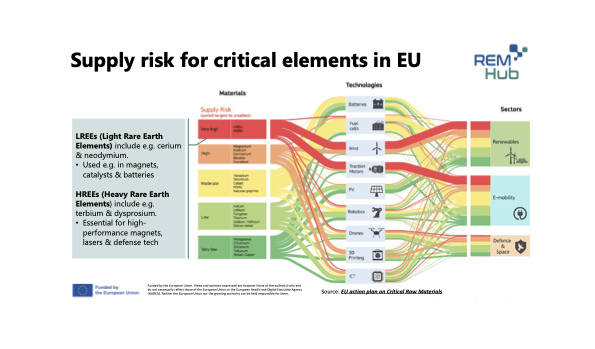
To reduce import reliance is thus a priority, especially considering that Rare Earth Elements can be found in a large number of widespread technologies and applications, including car batteries, robotics and drones. And, furthermore, permanent magnets, which dominate the stocks in use, are at the heart of consumer electronic goods, EVs, wind turbines, just to name a few. Their recycling rate, as for neodymium iron boron magnets, is today below 1% of overall magnets and the European recycling rate, in particular, is dubbed “very low” despite the surging interest and pressure. At the same time the goal is to achieve a global recycling capacity of 15,500 tonnes of material by 2030, covering 17% of global magnet waste. All of the aforementioned figures were provided by the Italian branch of the European REMHub project: the Padua-based Opigeo and the Giulio Natta department at the Politecnico, Milan. The initiative involves 24 partners from six different countries: Slovenia, Spain, Finland, Estonia, Italy, Ireland and was officially launched in 2024. The aim is that to «create a cutting-edge digital innovation hub propelling EU excellence for Rare Earth Elements and magnets». In order to do so, as sources stated, «REMHub will develop test and pilot novel technologies for exploration and primary production of rare earths and recovering rare earths from side streams to enhance supply security of REEs in EU». Also focused on the industrialisation and commercialisation of its revolutionary technologies via a dedicated digital platform, it plans to «cover the entire REE value chain starting from mineral exploration, through mineral processing and refining to metal production and magnet making as well as recycling». Last but not least, it offers «a safe and sustainable by design framework (SSbD) including design for a Re-X approach (i.e. recycling, reuse, refurbishment, repurposing) integrating easy dismantling and circularity».
Unexpected resources
REMHub is funded by the Horizon Europe Resilient Value Chains program and, as for Italy, researchers are studying the possibility to obtain Rare Earth Elements from the red mud of Portovesme, in Sardinia, home to a vast steel mill and former bauxite-alumina transformation site. According to estimates the area contains some 3,000 tonnes of scandium and cerium, whereas other additional resources could be provided by the titanium dioxide production plant in Scarlino, Tuscany. In this case waste streams could produce 25 tonnes of scandium and 200 tonnes of vanadium per year, approximately. The latter does not belong of course to the REE group, but not less precious for the manufacturing industry, given the «moderate supply risk» it has, according to the European community. Although two sites only were so far taken into account, their potential is not negligible at all. As researcher Maurizio Bellotto, from Opigeo, and professors Cinzia Cristiani and Giovanni Dotelli (Politecnico of Milan) explained, the point is that the recovery of Rare Earth Elements must prove to be both financially and environmentally sustainable. And this is where the REMHub project moves one step further. In fact, it addresses the mining aspects of recovery from magnets and waste streams, theoretically yielding reusable REEs. However, should studies focus exclusively on the sourcing of these elements, then of course the economic balance would be lost.
Waiting for EVs
Everything changes when precious metals or copper also end up in the network, because their value and mass could justify the activity and make it reasonably profitable. On top of that, sustainability is achieved by scaling up, that is, by considering larger-scale projects. The methodologies generally employed are varied. Magnets disassembled from motors are recycled and reused as-is; or, otherwise, mechanically destroyed – pulverized, more precisely- through heat treatments in a hydrogen atmosphere and finally rebuilt using additive manufacturing techniques. REMHub also explores hydrometallurgical processes, which involve dissolving the components and separating the elements of interest into oxide or salt form; then their reduction and the final reconstitution as usable metals. The e-mobility industry is far too young to emerge as a source for end-of-life raw materials, from REMHub’s point of view: the amount of waste that, in this case, could be addressed to recycle and reuse is too low, if compared to the overall float. To treat e-waste in general is also rather complicated, since collectors find it often much more profitable to trade them to Asia or even on the grey or black market. Finally, the reason why REMHub and especially its Italian branch are concentrating on industrial subproducts is that they ensure a consistent flow of materials; whereas the hydrometallurgical processes adopted are less impacting and have so far proven cost-effective.